
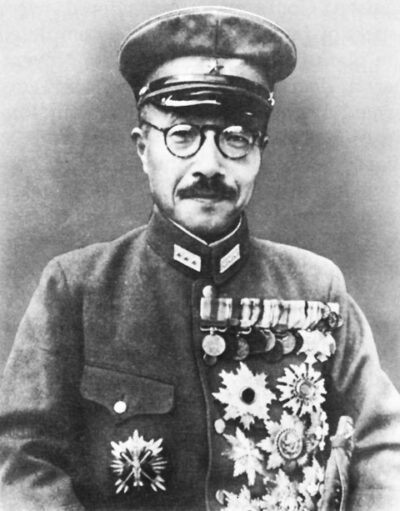
Hideki Tojo
Hideki Tojo was a Japanese general and politician. Born December 30, 1884, in Kōjimachi-ku. Died December 23, 1948, in Sugamo Prison. Positions held include Prime Minister of Japan (1941–1944), Ministry of the Army (1940–1944) and Minister of Agriculture and Commerce of Japan (1943). Known for Following the issuance of the Imperial edict of declaration of war and wills of Hideki Tojo. Educated at Imperial Japanese Army Academy and Army War College. Awards include Order of the Rising Sun, 1st class, Order of the German Eagle and Order of Chula Chom Klao.
Facts
51 facts · 2 confirmed by two sources · 9 cited · 39 from one source · 1 where the sources disagree
What’s different
- Buried in: we show Zōshigaya Cemetery (Sources disagree). Wikidata also lists Yasukuni Shrine and Pacific Ocean
Where this comes from
Papalocal keeps its own record. It started from these sources; what each one said is kept here as it was copied, so a change on their side never changes this page by itself. Tap one to read its version.
What Wikidata says · copied November 16, 2026 · revision 2569997710
- Described as
- Japanese general and politician (1884–1948)
- Born
- December 30, 1884 · 3 references
- Died
- December 23, 1948 · 7 references
- Born in
- Kōjimachi-ku
- Died in
- Sugamo Prison
- Buried in
- Zōshigaya Cemetery; Yasukuni Shrine; Pacific Ocean
- Cause of death
- hanging to death
- Citizen of
- Japan
- Occupation
- politician; diplomat; military officer
- Positions held
- Prime Minister of Japan (1941–1944) · 2 references; Ministry of the Army (1940–1944); Minister of Agriculture and Commerce of Japan (1943); Ministry of Munitions (1943–1944); Minister of Home Affairs (1941–1942); Minister for Foreign Affairs (1942); Ministry of Education, Science Sports and Culture (1943); Imperial Japanese Army General Staff Office (1944)
- Political party
- Taisei Yokusankai
- Education
- Imperial Japanese Army Academy; Army War College; Central Military Preparatory School; Tokyo Military Preparatory School
- Known for
- Following the issuance of the Imperial edict of declaration of war; wills of Hideki Tojo
- Awards
- Order of the Rising Sun, 1st class (1940); Order of the German Eagle; Order of Chula Chom Klao; Order of the White Elephant; Order of the Golden Kite (1940); Inter-Allied Victory Medals · 1 reference; Grand Cross of the Order of the White Rose of Finland (1942) · 1 reference; Military Medal of Honor · 2 references; Showa Enthronement Commemorative Medal · 2 references; Japanese Red Cross Society Silver Merit Medal · 2 references; Order of the Orchid Blossom · 2 references; Order of the Illustrious Dragon · 2 references; Order of the Auspicious Clouds · 2 references; Order of the Pillars of the State · 2 references; Knight grand cross of the order of the crown of Italy · 2 references
- Spouse
- Katsuko Tōjō
- Children
- Teruo Tōjō; Toshio Tōjō; Makie Tōjō
- Father
- Hidenori Tōjō
- Mother
- Chitose Tōjō
- Religion
- Jōdo Shinshū; Shinto · 1 reference
- Military branch
- Imperial Japanese Army; Kwantung Army (1932–1934)
- Military rank
- general
- Wikipedias with a page
- 88
Wikidata item Q160847 (wikidata.org/wiki/Q160847), public domain (CC0). Copied November 16, 2026.
What Wikipedia says · copied November 16, 2026 · revision 1384907637
Hideki Tojo (30 December 1884 – 23 December 1948) was a Japanese military officer and politician who served as Prime Minister of Japan from 1941 to 1944 during World War II. His leadership was marked by widespread state violence and mass killings perpetrated in the name of Japanese nationalism.
Born into a military family of samurai descent in Kōjimachi, Tokyo, Tojo followed in his father's footsteps by pursuing a military career, graduating from the Imperial Japanese Army Academy in 1905. After serving as a military attaché in Germany, he rose to prominence in the 1930s as a member of the Tōseiha (lit. 'Control Faction') within the Imperial Japanese Army (IJA). In 1937, as chief of staff of the Kwantung Army, he led operations during the Japanese invasion of China. By 1940, he was appointed Minister of the Army, where he advocated a tripartite alliance with Nazi Germany and Fascist Italy. In October 1941, he was appointed Prime Minister of Japan by Emperor Hirohito.
Upon taking office as Prime Minister, Tojo prioritized the total mobilization of the Empire of Japan for "total war". He enforced strict censorship and utilized the Kempeitai (military police) to suppress dissent while promoting an ideology of absolute loyalty to the Emperor. His foreign policy was defined by the pursuit of the Greater East Asia Co-Prosperity Sphere, a concept used to justify aggressive expansion into Southeast Asia and the Pacific in order to secure natural resources. On 7 December 1941, Tojo's cabinet oversaw the Japanese attack on Pearl Harbor which resulted in his country's entry into World War II on the side of the Axis powers. Despite achieving significant territorial gains in Asia and the Pacific during the opening months of the conflict, the tide decisively turned against Japan following its defeat at the Battle of Midway in June 1942. In the capacity of his nation's head of government throughout most of the war, Tojo presided over numerous war crimes, including the massacre and starvation of thousands of POWs and millions of civilians.
As Allied forces closed in on the Japanese home islands, Tojo's hold on power steadily declined before he was ultimately forced to resign on 18 July 1944 upon the fall of Saipan. After his nation's surrender to the Allied powers in September 1945, he was arrested, convicted by the International Military Tribunal for the Far East in the Tokyo Trials, sentenced to death, and hanged on 23 December 1948. To this day, Tojo's complicity in the July 1937 invasion of China, the surprise attack on Pearl Harbor in December 1941 and numerous acts of mass murder have firmly intertwined his legacy with the Empire of Japan's warmongering brutality during the early Shōwa era.
- Born, in its opening lines
- December 30, 1884
- Died, in its opening lines
- December 23, 1948
From the Wikipedia article “Hideki Tojo” (en.wikipedia.org/wiki/Hideki_Tojo), by its contributors, under CC BY-SA 4.0 (creativecommons.org/licenses/by-sa/4.0/). Copied November 16, 2026; not changed.
Confirmed Two sources agree. Cited One source, and it names where it got it. One source One source, without a reference of its own. Sources disagree The sources disagree. We show the best-supported value and keep theirs below.
