
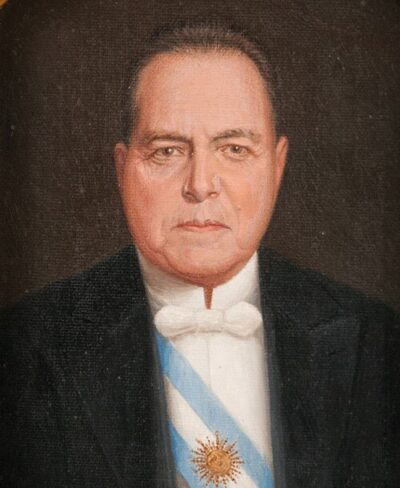
Hipólito Yrigoyen
Hipólito Yrigoyen was a president of Argentina. Born July 13, 1850, in Buenos Aires. Died July 3, 1933, in Buenos Aires. Positions held include President of Argentina (2 times) (1916–1930). Educated at University of Buenos Aires. Awards include Collar of the Order of Isabella the Catholic.
Facts
16 facts · 1 confirmed by two sources · 5 cited · 9 from one source · 1 where the sources disagree
What’s different
- Born: we show July 13, 1850 (Sources disagree). Wikipedia says July 12, 1852
Where this comes from
Papalocal keeps its own record. It started from these sources; what each one said is kept here as it was copied, so a change on their side never changes this page by itself. Tap one to read its version.
What Wikidata says · copied November 16, 2026 · revision 2565555286
- Described as
- president of Argentina (1852-1937)
- Other names
- Hipólito Yrigoyen de las Marías, Hipólito del Sagrado Corazón de Jesús Yrigoyen, Hipolito Yrigoyen
- Born
- July 13, 1850 · 2 references
- Died
- July 3, 1933 · 3 references
- Born in
- Buenos Aires · 2 references
- Died in
- Buenos Aires · 2 references
- Buried in
- Mausoleum of the Fallen in the Revolution of 1890 · 1 reference
- Citizen of
- Argentina
- Occupation
- lawyer; politician · 1 reference; author
- Positions held
- President of Argentina (2 times) (1916–1930)
- Political party
- Radical Civic Union
- Education
- University of Buenos Aires
- Awards
- Collar of the Order of Isabella the Catholic (1928) · 1 reference
- Children
- Luis H. Irigoyen · 1 reference
- Siblings
- Martín Yrigoyen
- Lived in
- Buenos Aires
- Wikipedias with a page
- 51
Wikidata item Q297134 (wikidata.org/wiki/Q297134), public domain (CC0). Copied November 16, 2026.
What Wikipedia says · copied November 16, 2026 · revision 1361885527
Juan Hipólito del Sagrado Corazón de Jesús Yrigoyen (12 July 1852 – 3 July 1933) was an Argentine politician of the Radical Civic Union who served as President of Argentina from 1916 to 1922 and again from 1928 until his overthrow in 1930. He was the first president elected democratically by means of the secret ballot and mandatory male suffrage established by the Sáenz Peña Law of 1912. His activism was the prime impetus behind the passage of that law in Argentina.
Known as "the father of the poor", Yrigoyen presided over a rise in the standard of living of Argentina's working class together with the passage of a number of progressive social reforms, including improvements in factory conditions, regulation of working hours, compulsory pensions, and the introduction of a universally accessible public education system. Yrigoyen was the first nationalist president, convinced that the country had to manage its own currency and, above all, should have control of its transportation, energy and oil exploitation networks.
Between the 1916 general election and the 1930 coup d'état, political polarization was on the rise. Personalist radicalism was presented as the "authentic expression of the nation and the people" against the "oligarchic and conservative regime". For the ruling party, the will of the majorities prevailed over the division of powers. The opposition, on the other hand, accused the Executive Branch of being arrogant and demanded greater participation from Congress, especially in matters such as the contentious federal interventions.
- Born, in its opening lines
- July 12, 1852
- Died, in its opening lines
- July 3, 1933
From the Wikipedia article “Hipólito Yrigoyen” (en.wikipedia.org/wiki/Hipólito_Yrigoyen), by its contributors, under CC BY-SA 4.0 (creativecommons.org/licenses/by-sa/4.0/). Copied November 16, 2026; not changed.
Confirmed Two sources agree. Cited One source, and it names where it got it. One source One source, without a reference of its own. Sources disagree The sources disagree. We show the best-supported value and keep theirs below.
