
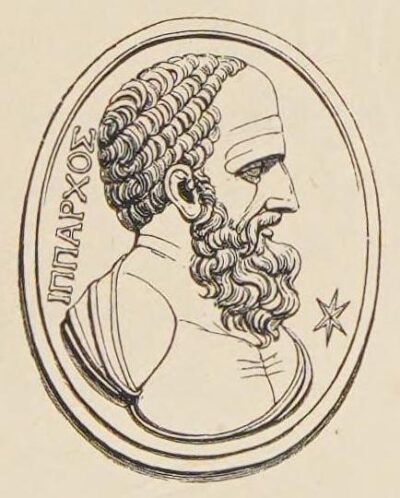
Hipparchus
Hipparchus was the 2nd century Greek astronomer, geographer and mathematician. Born 190 BC, in Nicaea. Died 120 BC, in Rhodes. Known for Ton Aratou kai Eudoxou Phainomenon exegeseos biblia tria, Against the Geography of Eratosthenes and On Bodies Carried Down by Their Weight. Awards include International Space Hall of Fame.
Facts
17 facts · 0 confirmed by two sources · 5 cited · 12 from one source
Where this comes from
Papalocal keeps its own record. It started from these sources; what each one said is kept here as it was copied, so a change on their side never changes this page by itself. Tap one to read its version.
What Wikidata says · copied November 16, 2026 · revision 2568793717
- Described as
- 2nd century Greek astronomer, geographer and mathematician
- Other names
- Hipparchus of Rhodes, Hipparchus of Nicaea
- Born
- 190 BC · 1 reference
- Died
- 120 BC
- Born in
- Nicaea · 2 references
- Died in
- Rhodes
- Name at birth
- Ἵππαρχος
- Citizen of
- Kingdom of Pergamon
- Occupation
- astronomer · 1 reference; mathematician; geographer · 1 reference
- Known for
- Ton Aratou kai Eudoxou Phainomenon exegeseos biblia tria; Against the Geography of Eratosthenes; On Bodies Carried Down by Their Weight; Hipparchus star catalog; On Sizes and Distances; Schröder–Hipparchus number
- Awards
- International Space Hall of Fame (2004) · 2 references
- Field
- astronomy · 1 reference
- Wikipedias with a page
- 86
Wikidata item Q159905 (wikidata.org/wiki/Q159905), public domain (CC0). Copied November 16, 2026.
What Wikipedia says · copied November 16, 2026 · revision 1373939794
Hipparchus (; Greek: Ἵππαρχος, Hípparkhos; c. 190 – c. 120 BC) was a Greek astronomer, geographer, and mathematician. He is considered the founder of trigonometry, but is most famous for his incidental discovery of the precession of the equinoxes. Hipparchus was born in Nicaea, Bithynia, and probably died on the island of Rhodes, Greece. He is known to have been a working astronomer between 162 and 127 BC.
Hipparchus is considered the greatest ancient astronomical observer and, by some, the greatest overall astronomer of antiquity. He was the first whose quantitative and accurate models for the motion of the Sun and Moon survive. For this he certainly made use of the observations and perhaps the mathematical techniques accumulated over centuries by the Babylonians and by Meton of Athens (fifth century BC), Timocharis, Aristyllus, Aristarchus of Samos, and Eratosthenes, among others.
He developed trigonometry and constructed trigonometric tables, and he solved several problems of spherical trigonometry. His other reputed achievements include the discovery and measurement of Earth's precession, the compilation of the first known comprehensive star catalog from the western world, and possibly the invention of the astrolabe, as well as of the armillary sphere that he may have used in creating the star catalogue. He contributed to optics, developing an atomist theory of light. He is often called the "father of astronomy", a title conferred on him by Jean Baptiste Joseph Delambre in 1817.
From the Wikipedia article “Hipparchus” (en.wikipedia.org/wiki/Hipparchus), by its contributors, under CC BY-SA 4.0 (creativecommons.org/licenses/by-sa/4.0/). Copied November 16, 2026; not changed.
Confirmed Two sources agree. Cited One source, and it names where it got it. One source One source, without a reference of its own. Sources disagree The sources disagree. We show the best-supported value and keep theirs below.
