
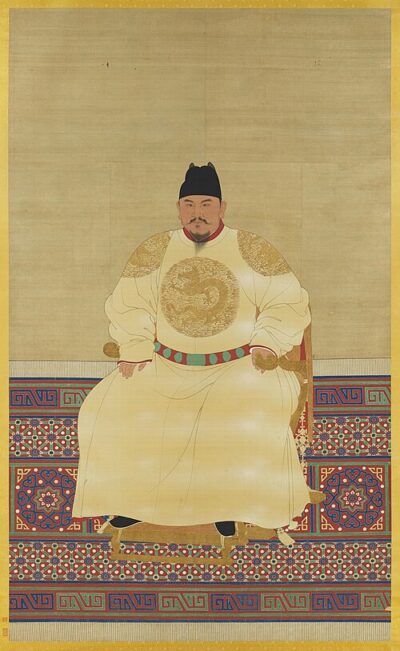
Hongwu Emperor
Hongwu Emperor was a founding emperor of China's Ming dynasty; ruled 1368–1398. Born October 29, 1328, in Fengyang County. Died June 24, 1398, in Nanjing. Positions held include Emperor of China (1368–1398). Known for Collected Works of Taizu of Ming and Imperial Commentary on the Daodejing by Emperor Taizu of the Great Ming.
Facts
40 facts · 1 confirmed by two sources · 9 cited · 29 from one source · 1 where the sources disagree
What’s different
- Born: we show October 29, 1328 (Sources disagree). Wikipedia says October 21, 1328
Where this comes from
Papalocal keeps its own record. It started from these sources; what each one said is kept here as it was copied, so a change on their side never changes this page by itself. Tap one to read its version.
What Wikidata says · copied November 16, 2026 · revision 2568952236
- Described as
- founding emperor of China's Ming dynasty; ruled 1368–1398
- Other names
- Emperor Taizu of Ming, Taizu of Ming, Emperor Hongwu, Gaohuangdi, Hóngwǔdì, Ming Taizu, Hongwu, Shengshenwenwuqinmingqiyunjundechenggongtongtiandaxiaogaohuangdi, Kang Di, Guorui, Kaitianxingdaozhaojilijidashengzhishenrenwenyiwujundechenggonggaohuangdi, Wu
- Born
- October 29, 1328 · 2 references
- Died
- June 24, 1398 · 2 references
- Born in
- Fengyang County
- Died in
- Nanjing
- Buried in
- Ming Xiaoling
- Name at birth
- Chongba
- Citizen of
- Ming dynasty · 1 reference; Yuan dynasty
- Occupation
- ruler; sovereign · 1 reference
- Positions held
- Emperor of China (1368–1398)
- Known for
- Collected Works of Taizu of Ming; Imperial Commentary on the Daodejing by Emperor Taizu of the Great Ming
- Spouse
- Empress Ma · 1 reference; Cheng Mu; Li Shufei; Consort Guo Ningfei; Consort Guo Huifei · 1 reference
- Children
- Zhu Biao · 2 references; Zhu Shuang · 2 references; Zhu Gang · 1 reference; Zhu Su · 2 references; Zhu Fu; Yongle Emperor · 2 references; Zhu Zhen; Zhu Zi; Zhu Ji; Zhu Tan; Zhu Chun; Zhu Bo
- Father
- Zhu Shizhen
- Mother
- Empress Chun
- Siblings
- Princess Caoguo; Princess Taiyuan; Zhu Xingsheng; Zhu Xinglong; Zhu Xingzu
- Religion
- Buddhism
- Military rank
- admiral; general · 1 reference
- Wikipedias with a page
- 69
Wikidata item Q9957 (wikidata.org/wiki/Q9957), public domain (CC0). Copied November 16, 2026.
What Wikipedia says · copied November 16, 2026 · revision 1384521668
The Hongwu Emperor (21 October 1328 – 24 June 1398), personal name Zhu Yuanzhang, was the founding emperor of the Ming dynasty of China, reigning from 1368 to 1398.
Born in 1328 into a peasant family in Anhui, Zhu Yuanzhang grew up during a period of epidemics, famines, and widespread uprisings in China under the Mongol-led Yuan dynasty. When he was 16, his parents and brother died in an epidemic. The orphaned Zhu briefly lived as a novice monk, begging for alms and gaining insight into the hardships of the common people. He also developed a dislike for book-dependent scholars. In 1352, he joined the Red Turban rebels, a movement that sought to overthrow Yuan rule, and quickly rose to command his own army. He captured Nanjing in 1356 and built a powerful regional regime in southern China. He adopted Yuan administrative practices and applied them to his expanding territory. Although he nominally acknowledged the authority of the Red Turban figurehead Han Lin'er, Zhu increasingly acted independently and, after defeating rival rebels, declared himself King of Wu in 1364.
After successfully dominating southern and central China in early 1368, Zhu decided to rename the Kingdom of Wu to Da Ming, which translates to 'Great Radiance'. He adopted Hongwu, meaning 'Vastly Martial', as his era name. In the following four-year war, he drove out the Mongol forces loyal to the Yuan dynasty and unified the country, but failed to conquer Mongolia. During the Hongwu Emperor's 30-year reign, Ming China experienced significant growth and recovered from the effects of prolonged wars. The Emperor had a strong understanding of the structure of society and believed in implementing reforms to improve institutions. This approach differed from the Confucian belief that the ruler's moral example was the most important factor. The Hongwu Emperor also prioritized the safety of his people and the loyalty of his subordinates, demonstrating pragmatism and caution in military affairs. He maintained a disciplined army and made efforts to minimize the impact of war on civilians. He died in 1398 and was succeeded by his grandson, the Jianwen Emperor. In 1402, the Hongwu Emperor's fourth son, Zhu Di, overthrew the Jianwen Emperor following a civil war and took the throne as the Yongle Emperor.
- Born, in its opening lines
- October 21, 1328
- Died, in its opening lines
- June 24, 1398
From the Wikipedia article “Hongwu Emperor” (en.wikipedia.org/wiki/Hongwu_Emperor), by its contributors, under CC BY-SA 4.0 (creativecommons.org/licenses/by-sa/4.0/). Copied November 16, 2026; not changed.
Confirmed Two sources agree. Cited One source, and it names where it got it. One source One source, without a reference of its own. Sources disagree The sources disagree. We show the best-supported value and keep theirs below.
