
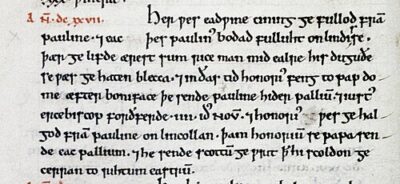
Honorius
Honorius was a member of the Gregorian mission to the Anglo-Saxons and Archbishop of Canterbury. Born 6th century, in Rome. Died September 30, 653, in Canterbury. Positions held include Roman Catholic Archbishop of Canterbury (627–653).
Facts
9 facts · 1 confirmed by two sources · 1 cited · 7 from one source
Where this comes from
Papalocal keeps its own record. It started from these sources; what each one said is kept here as it was copied, so a change on their side never changes this page by itself. Tap one to read its version.
What Wikidata says · copied November 18, 2026 · revision 2551246945
- Described as
- member of the Gregorian mission to the Anglo-Saxons and Archbishop of Canterbury
- Other names
- Honorius of Canterbury, St. Honorius
- Born
- 6th century
- Died
- September 30, 653 · 1 reference
- Born in
- Rome
- Died in
- Canterbury
- Buried in
- St Augustine's Abbey · 1 reference
- Occupation
- missionary · 1 reference; Catholic priest
- Positions held
- Roman Catholic Archbishop of Canterbury (627–653) · 2 references
- Religion
- Catholic Church · 1 reference
- Wikipedias with a page
- 20
Wikidata item Q503207 (wikidata.org/wiki/Q503207), public domain (CC0). Copied November 18, 2026.
What Wikipedia says · copied November 18, 2026 · revision 1357616839
Honorius (died 30 September 653) was a member of the Gregorian mission to Christianize the Anglo-Saxons from their native Anglo-Saxon paganism in 597 AD who later became Archbishop of Canterbury. During his archiepiscopate, he consecrated the first native English bishop of Rochester as well as helping the missionary efforts of Felix among the East Anglians. Honorius was the last to die among the Gregorian missionaries.
- Died, in its opening lines
- September 30, 653
From the Wikipedia article “Honorius of Canterbury” (en.wikipedia.org/wiki/Honorius_of_Canterbury), by its contributors, under CC BY-SA 4.0 (creativecommons.org/licenses/by-sa/4.0/). Copied November 18, 2026; not changed.
Confirmed Two sources agree. Cited One source, and it names where it got it. One source One source, without a reference of its own. Sources disagree The sources disagree. We show the best-supported value and keep theirs below.
