
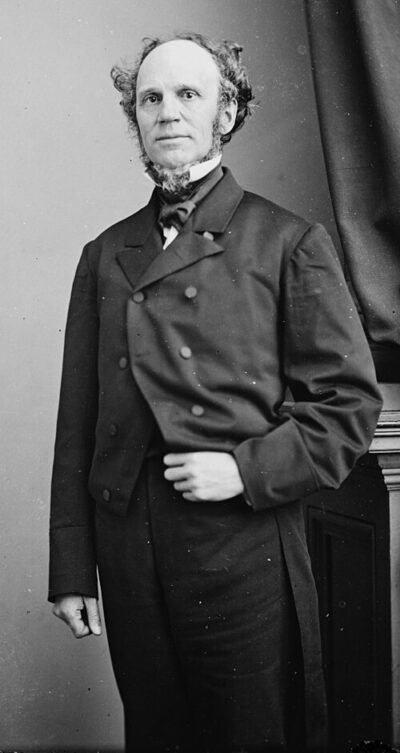
Horatio Seymour
Horatio Seymour was an American politician. Born May 31, 1810, in Pompey. Died February 12, 1886, in Utica. Positions held include Governor of New York (2 times) (1853–1864) and member of the New York State Assembly. Educated at Norwich University.
Facts
16 facts · 2 confirmed by two sources · 5 cited · 9 from one source
Where this comes from
Papalocal keeps its own record. It started from these sources; what each one said is kept here as it was copied, so a change on their side never changes this page by itself. Tap one to read its version.
What Wikidata says · copied November 16, 2026 · revision 2513978888
- Described as
- American politician (1810–1886)
- Born
- May 31, 1810 · 5 references
- Died
- February 12, 1886 · 5 references
- Born in
- Pompey
- Died in
- Utica · 1 reference
- Buried in
- Forest Hill Cemetery · 1 reference
- Citizen of
- United States
- Occupation
- lawyer; politician; governor · 1 reference; jurist · 1 reference; mayor · 1 reference
- Positions held
- Governor of New York (2 times) (1853–1864); member of the New York State Assembly
- Political party
- Democratic Party
- Education
- Norwich University
- Father
- Henry Seymour
- Wikipedias with a page
- 21
Wikidata item Q887320 (wikidata.org/wiki/Q887320), public domain (CC0). Copied November 16, 2026.
What Wikipedia says · copied November 16, 2026 · revision 1369634524
Horatio Seymour (May 31, 1810 – February 12, 1886) was an American politician. He served as the eighteenth Governor of New York from 1853 to 1854 and again from 1863 to 1864. He was the Democratic Party nominee for president in the 1868 United States presidential election, losing to Republican Ulysses S. Grant.
Born in Pompey, New York, Seymour was admitted to the New York bar in 1832. He primarily focused on managing his family's business interests. After serving as a military secretary to Governor William L. Marcy, Seymour won election to the New York State Assembly. He was elected that body's speaker in 1845 and aligned with Marcy's "Softshell Hunker" faction. Seymour was nominated for governor in 1850 but narrowly lost to the Whig candidate, Washington Hunt. He defeated Hunt in the 1852 gubernatorial election, and spent much of his tenure trying to reunify the fractured Democratic Party, losing his 1854 re-election campaign in part due to this disunity.
Despite this defeat, Seymour emerged as a prominent national figure within the party. As several Southern states threatened secession, Seymour supported the Crittenden Compromise as a way to avoid civil war. He supported the Union war effort during the Civil War but criticized President Abraham Lincoln's leadership. He won election to another term as governor in 1862 and continued to oppose many of Lincoln's policies. Several delegates at the 1864 Democratic National Convention hoped to nominate Seymour for president, but Seymour declined to seek the nomination. Beset by various issues, he narrowly lost re-election in 1864. After the war, Seymour supported President Andrew Johnson's Reconstruction policies.
As the 1868 Democratic National Convention opened, there was no clear front-runner for the Democratic presidential nomination, but Seymour remained widely popular. Serving as the chairman of the convention, as he had in 1864, Seymour refused to seek the nomination for himself. After twenty-two indecisive ballots, the convention nominated Seymour, who finally relented on his opposition to running for president. Seymour faced General Ulysses S. Grant, the widely popular Republican Party nominee, in the 1868 election. Grant won a strong majority of the electoral vote, though his margin in the popular vote was not as overwhelming. Seymour never again sought public office but remained active in politics and supported Grover Cleveland's 1884 campaign for president.
- Born, in its opening lines
- May 31, 1810
- Died, in its opening lines
- February 12, 1886
From the Wikipedia article “Horatio Seymour” (en.wikipedia.org/wiki/Horatio_Seymour), by its contributors, under CC BY-SA 4.0 (creativecommons.org/licenses/by-sa/4.0/). Copied November 16, 2026; not changed.
Confirmed Two sources agree. Cited One source, and it names where it got it. One source One source, without a reference of its own. Sources disagree The sources disagree. We show the best-supported value and keep theirs below.
