
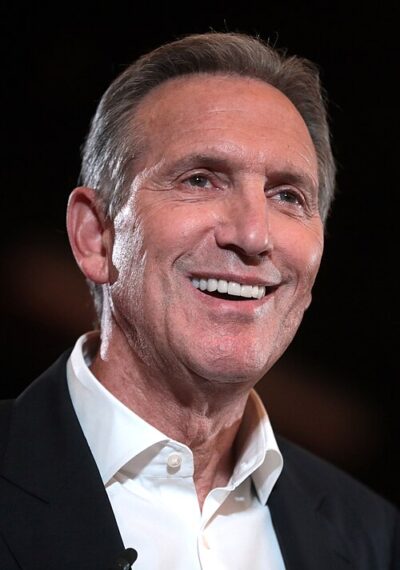
Howard Schultz
Howard Schultz is an American businessman. Born July 19, 1953, in Brooklyn. Educated at Northern Michigan University and Canarsie High School.
Facts
16 facts · 1 confirmed by two sources · 4 cited · 11 from one source
Where this comes from
Papalocal keeps its own record. It started from these sources; what each one said is kept here as it was copied, so a change on their side never changes this page by itself. Tap one to read its version.
What Wikidata says · copied November 15, 2026 · revision 2547143043
- Described as
- American businessman
- Other names
- Howard D. Schultz
- Born
- July 19, 1953 · 3 references
- Born in
- Brooklyn · 1 reference
- Citizen of
- United States · 1 reference
- Occupation
- entrepreneur · 4 references; writer; financier; businessperson · 1 reference
- Political party
- Democratic Party (–2019)
- Worked for
- Xerox (1975–1979); Hammarplast (1979–1981); Starbucks (1982–2018)
- Education
- Northern Michigan University; Canarsie High School
- Member of
- American Academy of Arts and Sciences (2021–)
- Lived in
- Seattle
- Website
- https://www.howardschultz.com/ · 1 reference
- Wikipedias with a page
- 31
Wikidata item Q472330 (wikidata.org/wiki/Q472330), public domain (CC0). Copied November 15, 2026.
What Wikipedia says · copied November 15, 2026 · revision 1383987450
Howard D. Schultz (born July 19, 1953) is an American businessman, entrepreneur, and author who was the chairman and CEO of Starbucks from 1986 to 2000, and from 2008 to 2017, and interim CEO from 2022 to 2023. Schultz owned the Seattle SuperSonics basketball team from 2001 to 2006.
Schultz began working at Starbucks in 1982. He later left and opened Il Giornale, a specialty coffeeshop that merged with Starbucks during the late 1980s. Under Schultz, the company established a large network of stores which has influenced coffee culture in Seattle, the U.S., and internationally. Following large-scale distribution deals, Starbucks became the largest coffee-house chain in the world. Schultz took the company public in 1992 and used a $271 million valuation to double their store count in a series of highly publicized coffee wars. He stepped down as CEO in 2000, succeeded by Orin Smith. Due to the rapid expansion of Starbucks under Schultz's leadership, he has been described as the “Ray Kroc of his generation”.
During the 2008 financial crisis, Schultz returned as chief executive. Succeeding Jim Donald, Schultz led a mass firing of executives and employees and shuttered hundreds of stores. He orchestrated multiple acquisitions of American and Chinese beverage companies, introduced a national loyalty program, and enforced fair trade standards. His aggressive expansion in Chinese markets has been credited with reconciling the country's tea-culture with coffee consumption in China. Schultz was succeeded by Kevin Johnson as CEO in April 2017 and Myron Ullman as chairman in June 2018.
Schultz has written four books on business. He is an outspoken neoliberal. Schultz publicly considered a candidacy in the 2012, 2016, and 2020 U.S. presidential elections as an independent candidate. He declined to join all three contests. His positions on domestic politics are socially liberal and fiscally conservative. In foreign policy, he is seen as a "liberal hawk", favoring American-led international affairs and neoliberalism. Schultz was named the 209th-richest person in the U.S. by Forbes with a net worth of $4.3 billion (October 2020). Schultz started the Schultz Family Foundation to help military veterans and fight youth unemployment.
On March 16, 2022, Starbucks announced that CEO Kevin Johnson was retiring and that Howard Schultz would take over as interim CEO until Laxman Narasimhan took over as CEO in April 2023. On March 20, 2023, Schultz announced that he would be stepping down early from the position.
- Born, in its opening lines
- July 19, 1953
From the Wikipedia article “Howard Schultz” (en.wikipedia.org/wiki/Howard_Schultz), by its contributors, under CC BY-SA 4.0 (creativecommons.org/licenses/by-sa/4.0/). Copied November 15, 2026; not changed.
Confirmed Two sources agree. Cited One source, and it names where it got it. One source One source, without a reference of its own. Sources disagree The sources disagree. We show the best-supported value and keep theirs below.
