
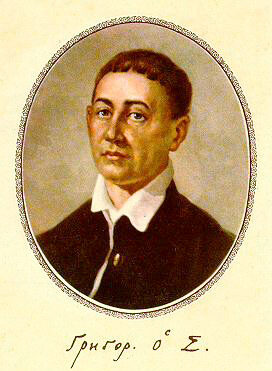
Hryhorii Skovoroda
Hryhorii Skovoroda was an Ukrainian philosopher. Born December 3, 1722, in Chornukhy. Died November 9, 1794, in Skovorodynivka. Educated at Kyiv-Mohyla Academy.
Facts
22 facts · 2 confirmed by two sources · 7 cited · 13 from one source
What’s different
- Born: we show December 3, 1722 (Confirmed). Wikidata also lists November 22, 1722
Where this comes from
Papalocal keeps its own record. It started from these sources; what each one said is kept here as it was copied, so a change on their side never changes this page by itself. Tap one to read its version.
What Wikidata says · copied November 16, 2026 · revision 2557925554
- Described as
- Ukrainian philosopher (1722–1794)
- Other names
- Grigorij Savvich Skovoroda, Hryhoriy Skovoroda, Hryhoriĭ Skovoroda, Gregory Skovoroda
- Born
- November 22, 1722 · 1 reference; December 3, 1722 · 1 reference
- Died
- November 9, 1794 · 3 references
- Born in
- Chornukhy
- Died in
- Skovorodynivka
- Buried in
- Skovorodynivka
- Name at birth
- Григорій Сковорода
- Citizen of
- Russian Empire · 1 reference
- Occupation
- philosopher · 1 reference; writer · 1 reference; composer; poet; translator · 1 reference
- Education
- Kyiv-Mohyla Academy
- Genre
- treatise; fable
- Instrument
- bandura
- Field
- poetry; literature · 1 reference; philosophy · 1 reference; lyricism · 1 reference; fable · 1 reference
- Religion
- Eastern Orthodoxy · 1 reference
- Wikipedias with a page
- 56
Wikidata item Q336803 (wikidata.org/wiki/Q336803), public domain (CC0). Copied November 16, 2026.
What Wikipedia says · copied November 16, 2026 · revision 1379467468
Hryhorii Skovoroda, also Gregory Skovoroda or Grigory Skovoroda (Latin: Gregorius Scovoroda; Ukrainian: Григорій Савич Сковорода, Hryhorii Savych Skovoroda; Russian: Григорий Саввич Сковорода, Grigory Savvich Skovoroda; 3 December 1722 – 9 November 1794), was a philosopher of Ukrainian Cossack origin who lived and worked in the Russian Empire. He was a poet, a teacher and a composer of liturgical music. His significant influence on his contemporaries and succeeding generations and his way of life were universally regarded as Socratic, and he was often called a "Socrates".
Skovoroda, whose native tongue was vernacular Ukrainian, wrote his texts in a mixture of three languages: Church Slavonic, Ukrainian, and Russian, with some elements from Latin and Greek and a large number of Western-Europeanisms. Different views exist about how to characterize the base language upon which he developed his highly individual idiom. One scholar has identified this base language as the variety of Russian spoken by the upper classes in Kharkiv and the surrounding Sloboda Ukraine region; this version of Russian contained many Ukrainianisms. According to another view, he wrote some of his works in the Ukrainian variety of Church Slavonic and others in the old Ukrainian literary language. The majority of his surviving letters are written in Latin and Greek.
He received his education at the Academia Mohileana in Kiev (now Kyiv, Ukraine). He led the life of an itinerant thinker-beggar. In his tracts and dialogs, biblical problems overlap with those examined earlier by Plato and the Stoics. Skovoroda's first book was issued after his death in 1798 in Saint Petersburg. Skovoroda's complete works were published for the first time in Saint Petersburg in 1861. Many of his works existed only in manuscript form before this edition.
- Born, in its opening lines
- December 3, 1722
- Died, in its opening lines
- November 9, 1794
From the Wikipedia article “Hryhorii Skovoroda” (en.wikipedia.org/wiki/Hryhorii_Skovoroda), by its contributors, under CC BY-SA 4.0 (creativecommons.org/licenses/by-sa/4.0/). Copied November 16, 2026; not changed.
Confirmed Two sources agree. Cited One source, and it names where it got it. One source One source, without a reference of its own. Sources disagree The sources disagree. We show the best-supported value and keep theirs below.
