
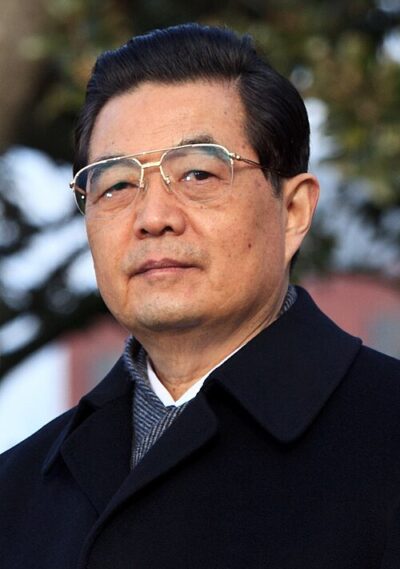
Hu Jintao
Hu Jintao is a former General Secretary of the Chinese Communist Party. Born December 21, 1942, in Jiangyan District. Positions held include General Secretary of the Chinese Communist Party (2002–2012), President of the People's Republic of China (2003–2013) and Chairman of the Central Military Commission of the Chinese Communist Party (2004–2012). Educated at Jiangsu Taizhou High School and Tsinghua University. Awards include Grand Cross of the Order of the Sun of Peru, Order of Prince Yaroslav the Wise, 1st class and Nishan-e-Pakistan.
Facts
38 facts · 1 confirmed by two sources · 5 cited · 32 from one source
Where this comes from
Papalocal keeps its own record. It started from these sources; what each one said is kept here as it was copied, so a change on their side never changes this page by itself. Tap one to read its version.
What Wikidata says · copied November 16, 2026 · revision 2563566971
- Described as
- former General Secretary of the Chinese Communist Party
- Other names
- Hu Jin Tao, Hujintao, Jintao Hu, General Secretary Hu Jintao, Hu Jin-tao
- Born
- December 21, 1942 · 3 references
- Born in
- Jiangyan District
- Citizen of
- People's Republic of China (1949–); Republic of China (–1949)
- Occupation
- politician · 1 reference; engineer · 1 reference
- Positions held
- General Secretary of the Chinese Communist Party (2002–2012); President of the People's Republic of China (2003–2013); Chairman of the Central Military Commission of the Chinese Communist Party (2004–2012); member of the Politburo of the Chinese Communist Party (1992–2012); Vice President of the People's Republic of China (1998–2003); First Secretary of the Chinese Communist Party (1992–2002); President of the Central Party School of the Chinese Communist Party (1993–2002); First Secretary of the Communist Youth League of China (1984–1985); Secretary of the Tibet Committee of the Chinese Communist Party (1988–1992); member of the National Committee of the Chinese People's Political Consultative Conference; National People's Congress deputy; standing member of the National Committee of the Chinese People's Political Consultative Conference (1983–1988); member of the Politburo Standing Committee of the Chinese Communist Party (1992–2012); Chairman of the Central Military Commission of the People's Republic of China (2005–2013)
- Political party
- Chinese Communist Party (1964–) · 1 reference
- Education
- Jiangsu Taizhou High School; Tsinghua University
- Awards
- Grand Cross of the Order of the Sun of Peru; Order of Prince Yaroslav the Wise, 1st class; Nishan-e-Pakistan; Order of José Martí; Order of Saparmurat Türkmenbaşy the Great; Golden Key of Madrid (2005) · 1 reference; Order of the Sun of Peru · 1 reference; National Order of Madagascar · 1 reference; Supreme Order of the Renaissance · 1 reference; honorary doctorate of École Centrale de Lyon (2001) · 1 reference
- Spouse
- Liu Yongqing (1970–)
- Children
- Hu Haifeng; Hu Haiqing
- Religion
- atheism
- Lived in
- Zhongnanhai
- Wikipedias with a page
- 122
Wikidata item Q15029 (wikidata.org/wiki/Q15029), public domain (CC0). Copied November 16, 2026.
What Wikipedia says · copied November 16, 2026 · revision 1385734352
Hu Jintao (born 21 December 1942) is a former Chinese politician who served as the general secretary of the Chinese Communist Party (CCP) from 2002 to 2012, president of China from 2003 to 2013, chairman of the Party Central Military Commission (CMC) from 2004 to 2012 and chairman of the State Central Military Commission from 2005 to 2013. He was a member of the CCP Politburo Standing Committee, China's top decision-making body, from 1992 to 2012, and served as the paramount leader of China from 2002 to 2012.
Born in Tai County, Jiangsu, Hu studied engineering at Tsinghua University, joining the CCP while in college. First working as a political counselor at Tsinghua, Hu later worked as an engineer in Gansu, later joining the province's Construction Department. He led the Communist Youth League of China (CYLC) branch in Gansu before joining the CYLC leadership in Beijing, eventually becoming the first secretary of the CYLC. Hu was appointed as Party Committee secretary for Guizhou and the Tibet Autonomous Region, where his harsh repression of dissent gained him attention from Beijing. He became a member of the CCP Central Secretariat and vice president under CCP general secretary Jiang Zemin, becoming Jiang's presumed successor as paramount leader.
Hu reintroduced state control in some sectors of the economy that were relaxed by the previous administration, and provided support for state-owned enterprises. He oversaw the response to the 2002–2004 SARS outbreak, as well as a significant increase in national healthcare coverage. He sought to improve socio-economic equality under his Scientific Outlook on Development, which aimed to build a Harmonious Society that was prosperous and free of social conflict. His leadership responded to the 2008 Tibetan unrest, the 2008 Sichuan earthquake and the 2009 Ürümqi riots. He oversaw the passing of the Anti-Secession Law, which laid conditions for authorizing military force for unification with Taiwan, and later saw closer relations with Taiwan, leading to the signing of the trade agreement Economic Cooperation Framework Agreement (ECFA) in 2010. Hu advocated for China's peaceful rise, pursuing a corporate and soft power approach to China's diplomacy. Throughout Hu's tenure, China's influence in Africa, Latin America, and other developing regions increased. Hu won praise for retiring voluntarily from all positions, succeeded by Xi Jinping.
Hu possessed a reserved and collective leadership style, making him an enigmatic figure in the public eye. His administration was known for technocratic competence and cautious political reforms. Alongside Chinese premier Wen Jiabao, Hu presided over a decade of consistent economic growth and development that cemented China as a major world power. Following Jiang's death, Hu is the only living former paramount leader of the People's Republic of China.
- Born, in its opening lines
- December 21, 1942
From the Wikipedia article “Hu Jintao” (en.wikipedia.org/wiki/Hu_Jintao), by its contributors, under CC BY-SA 4.0 (creativecommons.org/licenses/by-sa/4.0/). Copied November 16, 2026; not changed.
Confirmed Two sources agree. Cited One source, and it names where it got it. One source One source, without a reference of its own. Sources disagree The sources disagree. We show the best-supported value and keep theirs below.
