
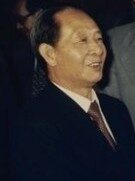
Hu Yaobang
Hu Yaobang was a Chinese politician (1915-1989), former General Secretary of the Chinese Communist Party. Born November 20, 1915, in Liuyang. Died April 15, 1989, in Beijing. Positions held include General Secretary of the Chinese Communist Party (1982–1987), Chairman of the Chinese Communist Party (1981–1982) and General Secretary of the Central Committee's Secretariat (1980–1982). Educated at Shanghai Jiao Tong University.
Facts
19 facts · 2 confirmed by two sources · 3 cited · 14 from one source
Where this comes from
Papalocal keeps its own record. It started from these sources; what each one said is kept here as it was copied, so a change on their side never changes this page by itself. Tap one to read its version.
What Wikidata says · copied November 16, 2026 · revision 2565549219
- Described as
- Chinese politician (1915-1989), former General Secretary of the Chinese Communist Party
- Other names
- Hu Guoguang, Guoguang, Hu Yao-pang
- Born
- November 20, 1915 · 1 reference
- Died
- April 15, 1989 · 6 references
- Born in
- Liuyang
- Died in
- Beijing · 1 reference
- Cause of death
- myocardial infarction
- Citizen of
- People's Republic of China (1949–); Republic of China (–1949)
- Occupation
- politician · 1 reference
- Positions held
- General Secretary of the Chinese Communist Party (1982–1987); Chairman of the Chinese Communist Party (1981–1982); General Secretary of the Central Committee's Secretariat (1980–1982); Head of the Publicity Department of the Chinese Communist Party (1978–1980); member of the Politburo Standing Committee of the Chinese Communist Party (1980–1987)
- Political party
- Chinese Communist Party (1933–1989)
- Education
- Shanghai Jiao Tong University
- Children
- Hu Deping · 1 reference; Liu Hu; Hu Dehua
- Religion
- atheism
- Wikipedias with a page
- 48
Wikidata item Q99850 (wikidata.org/wiki/Q99850), public domain (CC0). Copied November 16, 2026.
What Wikipedia says · copied November 16, 2026 · revision 1383982389
Hu Yaobang (20 November 1915 – 15 April 1989) was a Chinese politician who was a high-ranking official of the People's Republic of China. He held the top office of the Chinese Communist Party (CCP) from 1981 to 1987, first as Chairman from 1981 to 1982, then as General Secretary from 1982 to 1987. After the Cultural Revolution (1966–1976), Hu rose to prominence as a close ally of Deng Xiaoping, the paramount leader of China at the time.
Hu joined the CCP in the 1930s. During the Cultural Revolution, he was purged, recalled, and purged again by Mao Zedong. After Deng rose to power, following Mao's death, Hu played an important role in the Boluan Fanzheng program and oversaw the rehabilitation of wrongful convictions. Throughout the 1980s, he pursued a series of economic and political reforms under the supervision of Deng. Meanwhile, Hu's political and economic reforms also made him the enemy of several powerful Party elders, who opposed free-market and government reforms. When widespread student protests occurred across China in December 1986 and January 1987, Hu's political opponents blamed him for the disruptions and convinced Deng that Hu's tolerance of "bourgeois liberalization" had instigated the protests. Hu was forced to resign as General Secretary in early 1987, but allowed to retain his membership in the Politburo.
Hu's position as General Secretary was succeeded by his close ally Zhao Ziyang, who carried on many of Hu's economic and political reforms. A day after Hu's death in April 1989, a small-scale unofficial commemoration took place in Beijing, during which people demanded that the Chinese government reassess and recognize Hu's legacy; a week later, the day before Hu's funeral, some 100,000 students marched on Tiananmen Square, eventually leading to the 1989 Tiananmen Square protests and massacre in June. The Chinese government subsequently censored details of Hu's life, but in 2005 it commemorated him and lifted its censorships, on the occasion of his 90th birth anniversary. Hu was buried in Gongqingcheng in Jiangxi.
- Born, in its opening lines
- November 20, 1915
- Died, in its opening lines
- April 15, 1989
From the Wikipedia article “Hu Yaobang” (en.wikipedia.org/wiki/Hu_Yaobang), by its contributors, under CC BY-SA 4.0 (creativecommons.org/licenses/by-sa/4.0/). Copied November 16, 2026; not changed.
Confirmed Two sources agree. Cited One source, and it names where it got it. One source One source, without a reference of its own. Sources disagree The sources disagree. We show the best-supported value and keep theirs below.
