
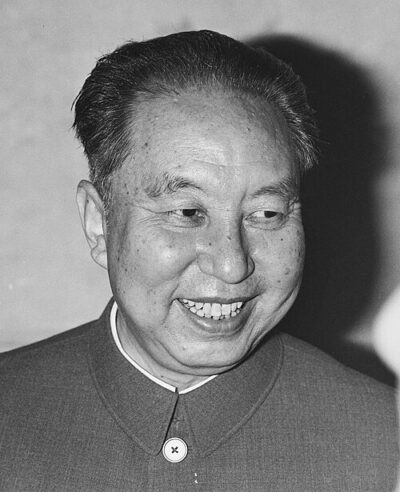
Hua Guofeng
Hua Guofeng was the 2nd Chairman of the Chinese Communist Party, 2nd Premier of the People's Republic of China. Born February 16, 1921, in Jiaocheng County. Died August 20, 2008, in Beijing. Positions held include Chairman of the Chinese Communist Party (1976–1981), Premier of the People's Republic of China (1976–1980) and Chairman of the Central Military Commission of the Chinese Communist Party (1976–1981).
Facts
15 facts · 2 confirmed by two sources · 2 cited · 10 from one source · 1 where the sources disagree
What’s different
- Name at birth: we show 苏铸 (Sources disagree). Wikidata also lists 蘇鑄
Where this comes from
Papalocal keeps its own record. It started from these sources; what each one said is kept here as it was copied, so a change on their side never changes this page by itself. Tap one to read its version.
What Wikidata says · copied November 16, 2026 · revision 2568264244
- Described as
- 2nd Chairman of the Chinese Communist Party, 2nd Premier of the People's Republic of China (1921–2008)
- Other names
- Su Zhu, Hua Guo Feng, Huaguofeng, Chairman Hua, Premier Hua, Chairman Hua Guofeng, Premier Hua Guofeng
- Born
- February 16, 1921 · 5 references
- Died
- August 20, 2008 · 7 references
- Born in
- Jiaocheng County
- Died in
- Beijing · 1 reference
- Name at birth
- 苏铸; 蘇鑄
- Citizen of
- People's Republic of China
- Occupation
- politician · 1 reference
- Positions held
- Chairman of the Chinese Communist Party (1976–1981); Premier of the People's Republic of China (1976–1980); Chairman of the Central Military Commission of the Chinese Communist Party (1976–1981); Minister of Public Security of the People's Republic of China (1973–1977); Vice Chairman of the Chinese Communist Party (1976); member of the Politburo Standing Committee of the Chinese Communist Party (1976–1982)
- Political party
- Chinese Communist Party
- Religion
- atheism
- Wikipedias with a page
- 69
Wikidata item Q41570 (wikidata.org/wiki/Q41570), public domain (CC0). Copied November 16, 2026.
What Wikipedia says · copied November 16, 2026 · revision 1383982657
Hua Guofeng (born Su Zhu (苏铸); 16 February 1921 – 20 August 2008; also spelled as Hua Kuo-feng) was a Chinese politician who served as chairman of the Chinese Communist Party and the premier of China. As the successor of Mao Zedong, Hua held the top offices of the government, party, and the military after the deaths of Mao and Premier Zhou Enlai, but was gradually forced out of power between December 1978 and June 1981, and subsequently retreated from the political limelight, though still remaining a member of the Central Committee until 2002.
Born and raised in Jiaocheng, Hua joined the Chinese Communist Party (CCP) in 1938, seeing action in both the Second Sino–Japanese War and the Chinese Civil War as a guerrilla fighter. In 1948, he was appointed party secretary of Xiangtan in Hunan, which included Mao's birthplace of Shaoshan. A popular local administrator, Hua rose to become Hunan's party secretary during the Cultural Revolution, and was elevated to the national stage in the early 1970s, notably assuming control of the Ministry of Public Security in 1973 and vice premier in 1975. After the death of Zhou Enlai in January 1976, Mao elevated Hua to the positions of premier and first vice chairman of the CCP, which made him Mao's designated successor.
In October 1976, a month after Mao's death, Hua arrested and removed the Gang of Four from power with the assistance of Mao's security chief Wang Dongxing, who became one of Hua's key supporters along with vice premier and chief economic planner Li Xiannian, and Luo Qingchang, head of the intelligence services. Hua also succeeded Mao as party chairman and chairman of the Central Military Commission, becoming the first to simultaneously hold the offices of party leader, premier, and commander-in-chief, as well as the only paramount leader to hold the office of premier.
While Hua ended the Cultural Revolution's most notorious policies, such as the constant ideological campaigns, he remained generally committed to a command economy and the continuation of the Maoist line. Between December 1978 and June 1981, Deng Xiaoping and his supporters forced Hua from his position of paramount leader but allowed him to retain some titles. Hua gradually faded into political obscurity, but continued to insist on the correctness of Maoist principles.
- Born, in its opening lines
- February 16, 1921
- Died, in its opening lines
- August 20, 2008
From the Wikipedia article “Hua Guofeng” (en.wikipedia.org/wiki/Hua_Guofeng), by its contributors, under CC BY-SA 4.0 (creativecommons.org/licenses/by-sa/4.0/). Copied November 16, 2026; not changed.
Confirmed Two sources agree. Cited One source, and it names where it got it. One source One source, without a reference of its own. Sources disagree The sources disagree. We show the best-supported value and keep theirs below.
