
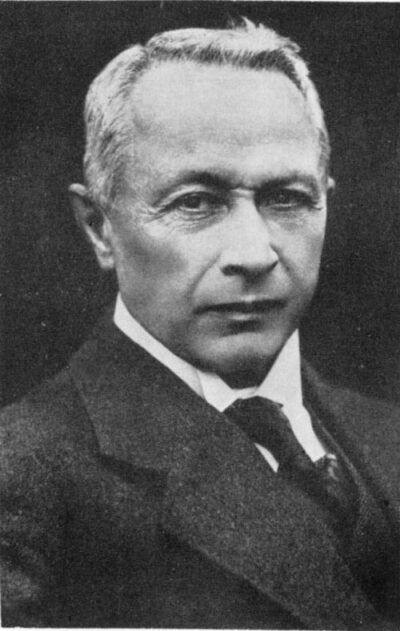
Hugo Junkers
Hugo Junkers was a German aviation pioneer. Born February 3, 1859, in Rheydt. Died February 3, 1935, in Gauting. Educated at RWTH Aachen University and Technische Universität Berlin. Awards include Werner von Siemens Ring, Wilhelm Exner Medal and International Air & Space Hall of Fame.
Facts
22 facts · 2 confirmed by two sources · 6 cited · 14 from one source
Where this comes from
Papalocal keeps its own record. It started from these sources; what each one said is kept here as it was copied, so a change on their side never changes this page by itself. Tap one to read its version.
What Wikidata says · copied November 16, 2026 · revision 2569061574
- Described as
- German aviation pioneer (1859–1935)
- Born
- February 3, 1859 · 10 references
- Died
- February 3, 1935 · 10 references
- Born in
- Rheydt
- Died in
- Gauting · 1 reference
- Buried in
- Munich Waldfriedhof
- Citizen of
- Germany
- Occupation
- military flight engineer; inventor; university teacher · 1 reference; engineer · 2 references; entrepreneur · 1 reference; technician · 1 reference
- Worked for
- RWTH Aachen University
- Education
- RWTH Aachen University; Technische Universität Berlin
- Member of
- Royal Prussian Academy of Sciences
- Awards
- Werner von Siemens Ring (1930); Wilhelm Exner Medal (1927) · 1 reference; International Air & Space Hall of Fame (1976); Grashof Commemorative Medal (1927) · 1 reference; Iron Cross on white ribbon
- Field
- aerospace engineering
- Wikipedias with a page
- 43
Wikidata item Q60363 (wikidata.org/wiki/Q60363), public domain (CC0). Copied November 16, 2026.
What Wikipedia says · copied November 16, 2026 · revision 1386028785
Hugo Junkers (3 February 1859 – 3 February 1935) was a German aircraft engineer and aircraft designer who pioneered the design of all-metal airplanes and flying wings. His company, Junkers Flugzeug- und Motorenwerke AG (Junkers Aircraft and Motor Works), was one of the mainstays of the German aircraft industry in the years between World War I and World War II. His multi-engined, all-metal passenger and freight planes helped establish airlines in Germany and around the world.
In addition to aircraft, Junkers also built both diesel and petrol engines and held various thermodynamic and metallurgical patents. He was also one of the main sponsors of the Bauhaus movement and facilitated the move of the Bauhaus from Weimar to Dessau (where his factory was situated) in 1925.
Amongst the highlights of his career were the Junkers J 1 of 1915, the world's first practical all-metal aircraft, incorporating a cantilever wing design with virtually no external bracing, the Junkers F 13 of 1919 (the world's first all-metal passenger aircraft), the Junkers W 33 (which made the first successful heavier-than-air east-to-west crossing of the Atlantic Ocean), the Junkers G.38, and the Junkers Ju 52, affectionately nicknamed "Tante Ju", one of the most famous airliners of the 1930s.
When the Nazis came into power in 1933, they requested Junkers and his businesses aid in the German re-armament. When Junkers declined, the Nazis placed him under house arrest in 1934 and eventually seized control of his patents and company. He died the following year. Under Nazi control, his company produced some of the most successful German warplanes of the Second World War.
- Born, in its opening lines
- February 3, 1859
- Died, in its opening lines
- February 3, 1935
From the Wikipedia article “Hugo Junkers” (en.wikipedia.org/wiki/Hugo_Junkers), by its contributors, under CC BY-SA 4.0 (creativecommons.org/licenses/by-sa/4.0/). Copied November 16, 2026; not changed.
Confirmed Two sources agree. Cited One source, and it names where it got it. One source One source, without a reference of its own. Sources disagree The sources disagree. We show the best-supported value and keep theirs below.
