
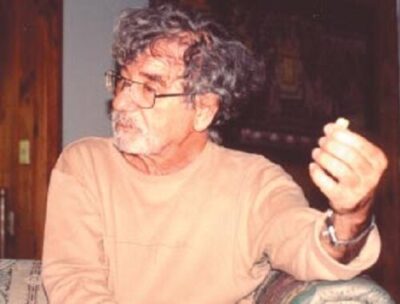
Humberto Maturana
Humberto Maturana was a Chilean biologist and philosopher. Born September 14, 1928, in Santiago. Died May 6, 2021, in Santiago. Educated at University College London and Harvard University. Awards include Guggenheim Fellowship, National Prize for Sciences (Chile) and honorary doctorate of the Vrije Universiteit Brussel.
Facts
22 facts · 2 confirmed by two sources · 11 cited · 9 from one source
Where this comes from
Papalocal keeps its own record. It started from these sources; what each one said is kept here as it was copied, so a change on their side never changes this page by itself. Tap one to read its version.
What Wikidata says · copied November 17, 2026 · revision 2567375436
- Described as
- Chilean biologist and philosopher (1928–2021)
- Born
- September 14, 1928 · 3 references
- Died
- May 6, 2021
- Born in
- Santiago · 1 reference
- Died in
- Santiago
- Cause of death
- pneumonia
- Citizen of
- Chile · 1 reference
- Occupation
- biologist · 2 references; philosopher · 2 references; university teacher; writer · 1 reference
- Worked for
- University of Chile
- Education
- University College London; Harvard University; Liceo Manuel de Salas
- Awards
- Guggenheim Fellowship · 1 reference; National Prize for Sciences (Chile) (1994); honorary doctorate of the Vrije Universiteit Brussel (1987) · 1 reference
- Field
- biology · 1 reference; epistemology; philosophical anthropology · 1 reference; philosophy · 1 reference; cybernetics · 1 reference
- Wikipedias with a page
- 25
Wikidata item Q376452 (wikidata.org/wiki/Q376452), public domain (CC0). Copied November 17, 2026.
What Wikipedia says · copied November 17, 2026 · revision 1385632870
Humberto Maturana Romesín (September 14, 1928 – May 6, 2021) was a Chilean biologist and philosopher. Some name him a second-order cybernetics theoretician alongside the likes of Heinz von Foerster, Gordon Pask, Herbert Brün and Ernst von Glasersfeld.
Maturana, along with Francisco Varela and Ricardo B. Uribe, was known for creating the term "autopoiesis" about the self-generating, self-maintaining structure in living systems, and concepts such as structural determinism and structural coupling. His work was influential in many fields, mainly the field of systems thinking and cybernetics. Overall, his work is concerned with the biology of cognition. Maturana (2002) insisted that autopoiesis exists only in the molecular domain, and he did not agree with the extension into sociology and other fields:The molecular domain is the only domain of entities that through their interactions give rise to an open ended diversity of entities (with different dynamic architectures) of the same kind in a dynamic that can give rise to an open ended diversity of recursive processes that in their turn give rise to the composition of an open ended diversity of singular dynamic entities.
- Born, in its opening lines
- September 14, 1928
- Died, in its opening lines
- May 6, 2021
From the Wikipedia article “Humberto Maturana” (en.wikipedia.org/wiki/Humberto_Maturana), by its contributors, under CC BY-SA 4.0 (creativecommons.org/licenses/by-sa/4.0/). Copied November 17, 2026; not changed.
Confirmed Two sources agree. Cited One source, and it names where it got it. One source One source, without a reference of its own. Sources disagree The sources disagree. We show the best-supported value and keep theirs below.
