
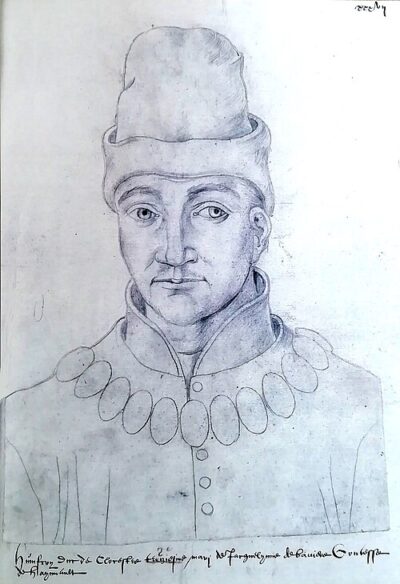
Humphrey of Lancaster, 1st Duke of Gloucester
Humphrey of Lancaster, 1st Duke of Gloucester was the 15th-century English nobleman. Born October 3, 1390, in London. Died February 23, 1447, in Bury St Edmunds. Positions held include Lord Warden of the Cinque Ports (1415–1447) and Duke of Gloucester (1414–1447). Awards include Knight of the Garter.
Facts
23 facts · 2 confirmed by two sources · 11 cited · 10 from one source
Where this comes from
Papalocal keeps its own record. It started from these sources; what each one said is kept here as it was copied, so a change on their side never changes this page by itself. Tap one to read its version.
What Wikidata says · copied November 18, 2026 · revision 2562907417
- Described as
- 15th-century English nobleman (1390-1447)
- Other names
- Humphrey Plantagenet, Duke of Gloucester
- Born
- October 3, 1390
- Died
- February 23, 1447
- Born in
- London
- Died in
- Bury St Edmunds
- Buried in
- St Albans Cathedral
- Citizen of
- Kingdom of England
- Occupation
- military personnel; politician
- Positions held
- Lord Warden of the Cinque Ports (1415–1447); Duke of Gloucester (1414–1447) · 1 reference
- Awards
- Knight of the Garter (1400) · 1 reference
- Spouse
- Jacqueline, Countess of Hainaut · 2 references; Eleanor, Duchess of Gloucester · 2 references
- Children
- Antigone of Gloucester · 1 reference; Arthur of Gloucester · 1 reference; child Plantagenet · 1 reference
- Father
- Henry IV of England · 1 reference
- Mother
- Mary de Bohun · 1 reference
- Siblings
- Philippa of England; Blanche of England · 1 reference; Henry V of England · 1 reference; John of Lancaster, Duke of Bedford; Thomas of Lancaster, 1st Duke of Clarence · 1 reference
- Wikipedias with a page
- 24
Wikidata item Q447541 (wikidata.org/wiki/Q447541), public domain (CC0). Copied November 18, 2026.
What Wikipedia says · copied November 18, 2026 · revision 1386283263
Humphrey of Lancaster, Duke of Gloucester (3 October 1390 – 23 February 1447) was an English prince, soldier and literary patron. He was, and styled himself as, "son, brother and uncle of kings", being the fourth and youngest son of Henry IV of England, the brother of Henry V, and the uncle of Henry VI. Gloucester fought in the Hundred Years' War and acted as Lord Protector of England during the minority of his nephew. He was a controversial political figure whose actions and policies generated both support and opposition among his contemporaries and later historians. Assessments of his career note his involvement in political conflicts as well as his engagement with intellectual circles, including his role as an early English patron of humanist scholarship, in the context of the Renaissance.
Unlike his brothers, Humphrey was given no major military command by his father, instead receiving an intellectual upbringing. Created Duke of Gloucester in 1414, he participated in Henry V's campaigns during the Hundred Years' War in France: he fought at Agincourt in 1415 and at the conquest of Normandy in 1417–9. Following the king's death in 1422, Gloucester, as Lord Protector, became one of the leading figures during the minority of Henry VI. He proved a rash, impulsive, unscrupulous and troublesome figure, he quarrelled constantly with his brother, John, Duke of Bedford and uncle, Cardinal Henry Beaufort and went so far as to violently prosecute a dispute with the Duke of Burgundy, a key English ally in France, over conflicting claims to lands in the Low Countries.
Humphrey was associated with contemporary ideals of chivalry and was regarded by some as embodying aspects of that tradition. His marriage to Jacqueline, Countess of Hainaut, played a significant role in his political and military activities in the Low Countries. His learned, widely read, scholarly approach to the early renaissance cultural expansion demonstrated the quintessential well-rounded princely character. He was a paragon for Eton College and an exemplar for the University of Oxford, accomplished, diplomatic, with political cunning. Despite the errors in his public and private life and the mischief he caused in politics, Gloucester is also at times praised as a patron of learning and a benefactor to the University of Oxford. He was popular among the literary figures of his age for his scholarly activity and with the common people for his advocacy of a spirited foreign policy. For these causes, he was known as the "good Duke Humphrey".
Gloucester never fully achieved his desired dominance in England, and his attempts to gain a foreign principality for himself were fruitless. A staunch opponent of concessions in the French conflict and a proponent of offensive warfare, Gloucester gradually lost favour among the political community, and King Henry VI after the end of his minority, following defeats in France. The trial in 1441 of Eleanor Cobham, his second wife, under charges of witchcraft, destroyed Gloucester's political influence. In 1447, he was accused, probably falsely, of treason and died a few days later while under arrest.
- Born, in its opening lines
- October 3, 1390
- Died, in its opening lines
- February 23, 1447
From the Wikipedia article “Humphrey, Duke of Gloucester” (en.wikipedia.org/wiki/Humphrey,_Duke_of_Gloucester), by its contributors, under CC BY-SA 4.0 (creativecommons.org/licenses/by-sa/4.0/). Copied November 18, 2026; not changed.
Confirmed Two sources agree. Cited One source, and it names where it got it. One source One source, without a reference of its own. Sources disagree The sources disagree. We show the best-supported value and keep theirs below.
