
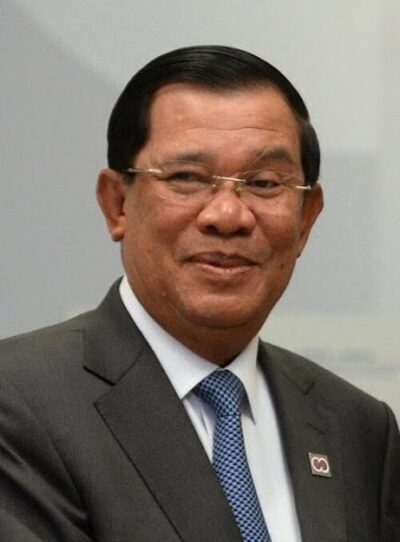
Hun Sen
Hun Sen is a Prime Minister of Cambodia (1985–1993; 1998–2023). Born August 5, 1952, in Peam Kaoh Sna Commune. Positions held include Prime Minister of Cambodia (1985–2023). Awards include Order of José Martí, Confucius Peace Prize and Gold Medal of the Nation.
Facts
38 facts · 1 confirmed by two sources · 5 cited · 32 from one source
Where this comes from
Papalocal keeps its own record. It started from these sources; what each one said is kept here as it was copied, so a change on their side never changes this page by itself. Tap one to read its version.
What Wikidata says · copied November 16, 2026 · revision 2562787956
- Described as
- Prime Minister of Cambodia (1985–1993; 1998–2023)
- Other names
- Aka Moha Sena Padei Techo Hun Sen, Samdech Techo Hun Sen, Sen Hun
- Born
- August 5, 1952 · 3 references
- Born in
- Peam Kaoh Sna Commune
- Name at birth
- ហ៊ុន ប៊ុនណាល់
- Citizen of
- Cambodia
- Occupation
- diplomat; politician · 1 reference
- Positions held
- Prime Minister of Cambodia (1985–2023) · 2 references
- Political party
- Cambodian People's Party; Communist Party of the Cambodia (Khmer Rouge)
- Awards
- Order of José Martí; Confucius Peace Prize (2017); Gold Medal of the Nation (2008); honorary doctor of the Guangxi University for Nationalities (2015) · 1 reference; Grand Order of National Merit (1996) · 1 reference; Order of Prince Yaroslav the Wise, 3rd class · 1 reference; Royal Order of Cambodia · 1 reference; Royal Order of Sowathara · 1 reference; Royal Order of Monisaraphon · 1 reference; Order of Sikatuna · 1 reference; Royal Order of the Polar Star · 1 reference; Order of the White Elephant · 1 reference; Order of the Crown of Thailand · 1 reference; Order of the Condor of the Andes · 1 reference; Order of Prince Yaroslav the Wise · 1 reference
- Spouse
- Bun Rany
- Children
- Hun Manet; Hun Manith; Hun Mana; Hun Mani; Hun Mali
- Father
- Hun Neang
- Religion
- Theravāda
- Military branch
- Communist Party of the Cambodia (Khmer Rouge); Kampuchean People's Revolutionary Armed Forces · 1 reference; Royal Cambodian Armed Forces · 1 reference
- Military rank
- Major · 1 reference; general of the army · 1 reference
- Website
- http://www.samdechhunsen.gov.kh
- Wikipedias with a page
- 68
Wikidata item Q57788 (wikidata.org/wiki/Q57788), public domain (CC0). Copied November 16, 2026.
What Wikipedia says · copied November 16, 2026 · revision 1384898710
Hun Sen (born 5 August 1952) is a Cambodian politician and former military officer who currently serves as the president of the Senate. He previously served as the prime minister of Cambodia (1985–1993), the second prime minister (1993–1998) and the prime minister again (1998–2023). Hun Sen is the longest-serving head of government in Cambodia's history. He is the president of the Cambodian People's Party (CPP), originally known as the Kampuchean People's Revolutionary Party (KPRP), which has governed Cambodia since 1979, and has served as a member of the Senate since 2024. Hun Sen has been regarded as the de facto leader of Cambodia since circa 1993; since 2023, he is also seen as de facto Minister of Foreign Affairs in his capacity as the President of Senate.
Born Hun Bunal, he changed his name to Hun Sen in 1972, two years after joining the Khmer Rouge as a soldier. He fought for the Khmer Rouge in the Cambodian Civil War and was a battalion commander in Democratic Kampuchea until defecting in 1977 and fighting alongside Vietnamese forces in the Cambodian–Vietnamese War. From 1979 to 1986 and again from 1987 to 1990, he served as Cambodia's foreign minister in the puppet government installed by Vietnam. At age 26, he was also the world's youngest foreign minister.
Hun Sen rose to the premiership in January 1985 when the one-party National Assembly appointed him to succeed Chan Sy, who had died in office in December 1984. He held the position until the 1993 UN-backed elections which resulted in a hung parliament, with the monarchist opposition party FUNCINPEC winning the majority of votes. Hun Sen refused to accept the result. After negotiations with FUNCINPEC, Norodom Ranariddh and Hun Sen agreed to simultaneously serve as First and Second Prime Minister, until the coalition broke down and Sen orchestrated a coup d'état in 1997 which toppled Ranariddh. Between 1998 and 2023, Hun Sen led the CPP to consecutive and often contentious election victories, overseeing rapid economic growth and development, but also corruption, deforestation and human rights violations. In 2013, Hun Sen and the CPP were reelected with a significantly reduced majority amidst a resurgent opposition. Allegations of voter fraud and irregularities led to unprecedented anti-government protests. In 2018, he was elected to a sixth and final term in a largely unopposed poll after the Supreme Court dissolved the main opposition party, with the CPP winning every seat in the National Assembly. He led the country during the onset of the COVID-19 pandemic and Cambodia's third chairmanship of ASEAN; and, after the 2023 election formally announced his resignation as prime minister in favour of his son, Hun Manet. He remains as party leader and in 2024, was appointed president of the Senate, ensuring his continued influence over the country's politics.
Hun Sen has been prominent in communist, Marxist–Leninist, and now state capitalist and national conservative political parties, and although Khmer nationalism has been a consistent trait of all of them, he is thought to lack a core political ideology. He has been described as a "wily operator who destroys his political opponents" by The Sydney Morning Herald and as a dictator who has assumed highly centralized power in Cambodia and considerable personal wealth using violence and corruption, including a personal guard said to rival the country's regular army.
- Born, in its opening lines
- August 5, 1952
From the Wikipedia article “Hun Sen” (en.wikipedia.org/wiki/Hun_Sen), by its contributors, under CC BY-SA 4.0 (creativecommons.org/licenses/by-sa/4.0/). Copied November 16, 2026; not changed.
Confirmed Two sources agree. Cited One source, and it names where it got it. One source One source, without a reference of its own. Sources disagree The sources disagree. We show the best-supported value and keep theirs below.
