
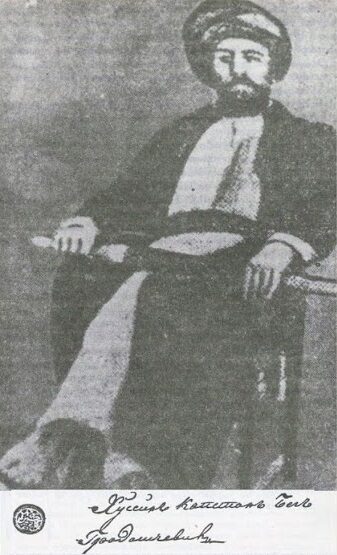
Husein Gradaščević
Husein Gradaščević was a Bosnian Muslim general. Born August 31, 1802, in Gradačac. Died August 17, 1834, in Constantinople. Positions held include bey.
Facts
9 facts · 2 confirmed by two sources · 0 cited · 7 from one source
Where this comes from
Papalocal keeps its own record. It started from these sources; what each one said is kept here as it was copied, so a change on their side never changes this page by itself. Tap one to read its version.
What Wikidata says · copied November 17, 2026 · revision 2535458132
- Described as
- Bosnian Muslim general (1802–1834)
- Born
- August 31, 1802
- Died
- August 17, 1834
- Born in
- Gradačac
- Died in
- Constantinople
- Buried in
- Eyüpsultan Cemetery
- Occupation
- military officer
- Positions held
- bey
- Religion
- Islam
- Military rank
- general
- Wikipedias with a page
- 26
Wikidata item Q470948 (wikidata.org/wiki/Q470948), public domain (CC0). Copied November 17, 2026.
What Wikipedia says · copied November 17, 2026 · revision 1380375412
Husein Gradaščević (Husein-kapetan) (31 August 1802 – 17 August 1834), also known as Zmaj od Bosne (lit. 'Dragon of Bosnia'), was an Ottoman Bosnian military commander who led an uprising against the Tanzimat, a system of political reforms with aim to modernise the Ottoman Empire. Born into a Bosnian noble family, Gradaščević became the captain of Gradačac in the early 1820s, succeeding his relatives (among whom was his father) in the position. He grew up surrounded by a political climate of turmoil in the western reaches of the Ottoman Empire. With the Russo-Turkish war (1828–29), Gradaščević's importance rose; the Bosnian governor gave him the task of mobilising an army between the Drina and Vrbas.
By 1830, Gradaščević became the spokesman of all Ottoman captains in Bosnia and coordinated the defence in light of a possible Serbian invasion. Sparked by Ottoman Sultan Mahmud II's reforms that abolished the Janissaries and weakened the privileges of the nobility, and the autonomy and territory granted to the Principality of Serbia, much of the Bosnian nobility united and revolted. Gradaščević was chosen as the leader and claimed the title of Vizier. This uprising, with goals of autonomy, lasted three years and included the termination of Ottoman loyals mainly in Herzegovina. Among notable accomplishments, Gradaščević led forces victorious against the Ottoman field marshal in Kosovo. The uprising failed, and all captaincies were abolished by 1835. Temporarily exiled to Austria, he negotiated his return with the Sultan and was allowed to enter all of the Ottoman Empire except Bosnia. He died under controversial circumstances in 1834 and was most probably buried in the backyard of the Eyup Mosque in Istanbul, or nearby Eyüp Cemetery.
Gradaščević received the honorific "the Dragon of Bosnia" (Zmaj od Bosne), and is considered a Bosniak national hero.
- Born, in its opening lines
- August 31, 1802
- Died, in its opening lines
- August 17, 1834
From the Wikipedia article “Husein Gradaščević” (en.wikipedia.org/wiki/Husein_Gradaščević), by its contributors, under CC BY-SA 4.0 (creativecommons.org/licenses/by-sa/4.0/). Copied November 17, 2026; not changed.
Confirmed Two sources agree. Cited One source, and it names where it got it. One source One source, without a reference of its own. Sources disagree The sources disagree. We show the best-supported value and keep theirs below.
