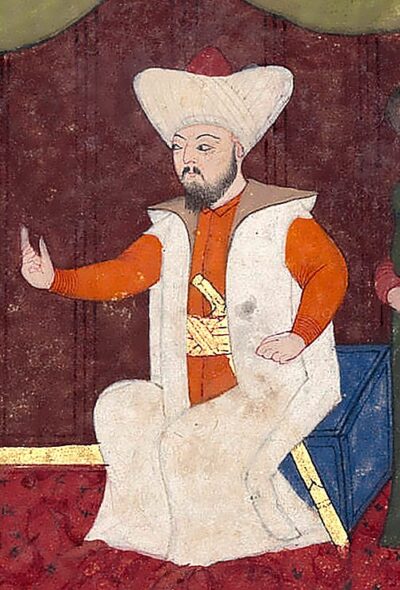
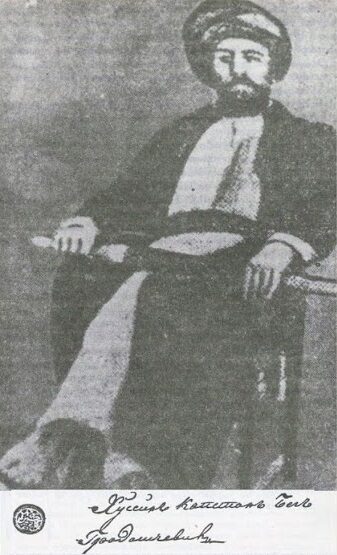
bey
Bey is a Turkish title of noblety and courtesy, Ottoman style for military officers below pasha (general) and over captain.
- Country
- Turkey
All 6 facts, and where they come from
Facts
6 facts · 0 confirmed by two sources · 0 cited · 6 from one source
Where this comes from
Papalocal keeps its own record. It started from these sources; what each one said is kept here as it was copied, so a change on their side never changes this page by itself. Tap one to read its version.
What Wikidata says · copied November 17, 2026 · revision 2563086842
- Described as
- Turkish title of noblety and courtesy, Ottoman style for military officers below pasha (general) and over captain
- What it is
- noble title; style; honorific
- Language
- Turkish
- Country
- Turkey; Ottoman Empire
- Wikipedias with a page
- 74
Wikidata item Q181217 (wikidata.org/wiki/Q181217), public domain (CC0). Copied 2026-11-17.
What Wikipedia says · copied November 17, 2026 · revision 1381877145
Bey, also spelled as Baig, Bayg, Beigh, Beig, Bek, Baeg, Begh, Beg, or Beğ, is a Turkic title for a chieftain, and a royal, aristocratic title traditionally applied to people with special lineages to the leaders or rulers of variously sized areas in the numerous Turkic kingdoms, emirates, sultanates and empires in Central Asia, South Asia, Southeast Europe, and the Middle East, such as the Seljuks, Ottomans, Timurids or the various khanates and emirates in Central Asia and the Eurasian Steppe. The feminine equivalent title was begum. The regions or provinces where "beys" ruled or which they administered were called beylik, roughly meaning "governorate" or "region" (the equivalent of a county, duchy, grand duchy or principality in Europe, depending on the size and importance of the beylik). However, the exact scope of power handed to the beys varied with each country; thus, there was no clear-cut system rigidly applied to all countries defining the power and prestige that came along with the title.
Today, the word is still used formally as a social title for men, similar to the way the titles "sir" and "mister" are used in the English language. Additionally, it is widely used in the naming customs of Central Asia, namely in countries such as Uzbekistan, Kazakhstan and Kyrgyzstan. Notably, the ethnic designation of Uzbeks comes from the name of Öz Beg Khan of the Golden Horde, being an example of the usage of this word in personal names and even names of whole ethnic groups. The general rule is that the honorific is used with first names and not with surnames or last names.
From the Wikipedia article “Bey” (en.wikipedia.org/wiki/Bey), by its contributors, under CC BY-SA 4.0 (creativecommons.org/licenses/by-sa/4.0/). Copied 2026-11-17; not changed.
Confirmed Two sources agree. Cited One source, and it names where it got it. One source One source, without a reference of its own. Sources disagree The sources disagree. We show the best-supported value and keep theirs below.
Picture: Wikimedia Commons: Bundesarchiv Bild 102-10111, Paris, Bey von Thunis mit Ehrenwache.jpg · See Commons file page