
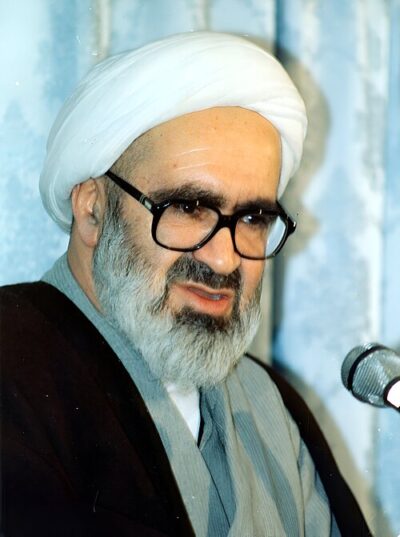
Hussein-Ali Montazeri
Hussein-Ali Montazeri was a cleric and Deputy Supreme Leader of Iran from 1985 to 1989. Born September 22, 1922, in Najafabad. Died December 20, 2009, in Qom. Positions held include Deputy Supreme Leader of Iran (1985–1989) and Tehran's Friday Prayer Imam (1979–1980). Educated at Isfahan Seminary and Qom Hawza.
Facts
32 facts · 0 confirmed by two sources · 2 cited · 28 from one source · 2 where the sources disagree
What’s different
- Born: we show September 22, 1922 (Sources disagree). Wikipedia says September 24, 1922
- Died: we show December 20, 2009 (Sources disagree). Wikipedia says December 19, 2009
Where this comes from
Papalocal keeps its own record. It started from these sources; what each one said is kept here as it was copied, so a change on their side never changes this page by itself. Tap one to read its version.
What Wikidata says · copied November 16, 2026 · revision 2557926252
- Described as
- cleric and Deputy Supreme Leader of Iran from 1985 to 1989
- Other names
- Âyetullāh Hüseyn Alî Muntazırî, Ḥusayn ʿAlī Muntaẓarī
- Born
- September 22, 1922 · 1 reference
- Died
- December 20, 2009 · 1 reference
- Born in
- Najafabad · 1 reference
- Died in
- Qom · 1 reference
- Buried in
- Fatima Masumeh Shrine
- Cause of death
- cardiovascular disease
- Citizen of
- Iran
- Occupation
- theologian; philosopher; writer; akhoond; politician; human rights defender · 1 reference
- Positions held
- Deputy Supreme Leader of Iran (1985–1989); Tehran's Friday Prayer Imam (1979–1980)
- Political party
- Society of Seminary Teachers of Qom (1961–2009); Islamic Republican Party (1980–1987)
- Worked for
- Feyziyeh Madrasa; Qom Hawza
- Education
- Isfahan Seminary; Qom Hawza
- Field
- fiqh; Irfan; Islamic philosophy; Islamic ethics; science of hadith
- Spouse
- Mahsoltan Rabani (1942–2009)
- Children
- Mohammad Montazeri; Ahmad Montazeri
- Religion
- Shia Islam; Twelver Shiism
- Website
- http://www.amontazeri.com
- Wikipedias with a page
- 39
Wikidata item Q311160 (wikidata.org/wiki/Q311160), public domain (CC0). Copied November 16, 2026.
What Wikipedia says · copied November 16, 2026 · revision 1384682488
Hussein-Ali Montazeri Najafabadi (24 September 1922 – 19 December 2009) was an Iranian cleric, politician, theologian, writer, human rights activist and democracy advocate who served as the only deputy supreme leader of Iran from 1985 to 1989. A Grand Ayatollah and reformist, he was one of the major leaders of the Iranian Revolution, the spiritual leader of the Iranian Green Movement, and one of the highest-ranking authorities in Shia Islam.
Born in Najafabad to a poor family, he began his religious education at Isfahan Seminary and began studying the Quran and Arabic from a young age. He opposed the White Revolution and supported anti-Shah leaders, more notably Ruhollah Khomeini. After Khomeini's exile in 1964, Montazeri "sat at the center of the clerical network", which Khomeini had established to oppose the Shah's rule. After gaining popularity in the late 1960's, the SAVAK arrested him and he was sent to Evin Prison in 1974 but was released amid the Iranian Revolution in 1978. After the Shah's fall, he served major positions such as the Speaker of the Assembly of Experts for Constitution in 1979 and rose the ranks to then being elected deputy supreme leader by the Assembly of Experts in 1985.
Montazeri was once designated by Ruhollah Khomeini as the successor to the supreme leadership; however, they had a falling-out in 1989 over Montazeri strongly opposing the 1988 mass execution of political prisoners, arguing that the executions were incompatible with Islamic principles. Khomeini formally dismissed him as his successor in 1989, declaring that he had come to regret his appointment. Montazeri spent his later years in Qom and remained politically influential in Iran but was placed under house arrest in 1997 for questioning "the unaccountable rule exercised by the supreme leader", Ali Khamenei, who succeeded Ruhollah Khomeini. He was known as the most knowledgeable senior Islamic scholar in Iran, a grand marja (religious authority) of Shia Islam, and was said to be one of Khamenei's teachers.
For more than two decades, Montazeri was one of the main critics of the Islamic Republic's domestic and foreign policy. He had also been an active advocate of Baháʼí Faith rights, civil rights, and women's rights in Iran. Montazeri was a prolific writer of books and articles. He was a staunch proponent of an Islamic state, and he argued that post-revolutionary Iran was not being ruled as an Islamic state. His death and funeral in December 2009 was said to have marked "a new phase" in the presidential election protests due to his support for the Green Movement, led by former prime minister Mir-Hossein Mousavi.
- Born, in its opening lines
- September 24, 1922
- Died, in its opening lines
- December 19, 2009
From the Wikipedia article “Hussein-Ali Montazeri” (en.wikipedia.org/wiki/Hussein-Ali_Montazeri), by its contributors, under CC BY-SA 4.0 (creativecommons.org/licenses/by-sa/4.0/). Copied November 16, 2026; not changed.
Confirmed Two sources agree. Cited One source, and it names where it got it. One source One source, without a reference of its own. Sources disagree The sources disagree. We show the best-supported value and keep theirs below.
