
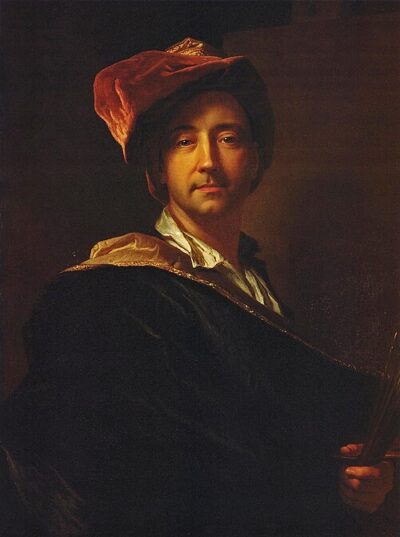
Hyacinthe Rigaud
Hyacinthe Rigaud was a Catalan-French baroque painter. Born July 18, 1659, in Perpignan. Died December 29, 1743, in Paris. Positions held include court painter. Known for Le prévôt et les échevins de la ville de Paris délibérant d'une fête en l'honneur du dîner de Louis XIV à l'hôtel de ville après sa guérison en 1689, Portrait of d'Anne-Jules de Noailles and Portrait of Everhard Jabach. Awards include first Prix de Rome for painting.
Facts
30 facts · 2 confirmed by two sources · 14 cited · 14 from one source
Where this comes from
Papalocal keeps its own record. It started from these sources; what each one said is kept here as it was copied, so a change on their side never changes this page by itself. Tap one to read its version.
What Wikidata says · copied November 16, 2026 · revision 2569333642
- Described as
- Catalan-French baroque painter (1659–1743)
- Other names
- Jacint Rigau-Ros i Serra, Jyacintho Rigau, Híacint Francesc Honrat Mathias Pere Martyr Andreu Joan Rigau, Hyacinthe Francois Honore Mathias Pierre Andre Jean Rigault, Hyacinthe Riguad, Hyacinthe Rigault, Hyacinthe-François-Honoré-Mathias-Pierre-André-Jean Rigau y Ros, Hyacinthe Rigo, Hyacinthe-François-Honoré-Mathias-Pierre-André-Jean Rigault, Hyacinthe-François-Honoré-Mathias-Pierre-André-Jean Rigaud, Hyancinth Rigaud, Hyacinthe Rigand
- Born
- July 18, 1659 · 5 references
- Died
- December 29, 1743 · 7 references
- Born in
- Perpignan · 3 references
- Died in
- Paris · 3 references
- Name at birth
- Jacint Rigau-Ros i Serra
- Citizen of
- France · 1 reference; Principality of Catalonia
- Occupation
- painter · 3 references; portraitist · 1 reference; architectural drafter · 1 reference; draftsperson · 2 references; visual artist · 1 reference
- Positions held
- court painter
- Member of
- Académie royale de peinture et de sculpture (1684–)
- Genre
- history painting; portrait painting; portrait · 1 reference; still life · 1 reference; religious painting · 1 reference
- Known for
- Le prévôt et les échevins de la ville de Paris délibérant d'une fête en l'honneur du dîner de Louis XIV à l'hôtel de ville après sa guérison en 1689; Portrait of d'Anne-Jules de Noailles; Portrait of Everhard Jabach; Gio. Francesco II Brignole-Sale · 1 reference; Bettina Raggi Brignole-Sale · 1 reference
- Awards
- first Prix de Rome for painting (1680) · 1 reference
- Field
- history painting
- Spouse
- Élisabeth de Gouy · 1 reference
- Mother
- Maria Serra
- Siblings
- Gaspard Rigaud · 1 reference
- Website
- http://www.hyacinthe-rigaud.com/
- Wikipedias with a page
- 42
Wikidata item Q49898 (wikidata.org/wiki/Q49898), public domain (CC0). Copied November 16, 2026.
What Wikipedia says · copied November 16, 2026 · revision 1384848449
Jacint Rigau-Ros i Serra (Catalan pronunciation: [ʒəˈsin riˈɣaw ˈrɔz i ˈsɛrə]; 18 July 1659 – 29 December 1743), known in French as Hyacinthe Rigaud (pronounced [jasɛ̃t ʁiɡo]), was a French baroque painter most famous for his portraits of Louis XIV and other members of the French nobility.
Born in the province of Roussillon, Jacint Rigau, whose name was Frenchified to Hyacinthe Rigaud, is considered one of the most celebrated French portrait painters of the classical period. According to Jacques Thuillier, professor at the Collège de France: "Hyacinthe Rigaud was one of those French painters who, under the Ancien Régime, achieved the highest fame as portraitists. This admiration was deserved both for the abundance of his output and for its constant perfection."
Rigaud owes his fame to the loyalty of the Bourbon dynasty, whose likenesses he painted across four generations. He drew most of his clientele from the wealthiest circles, among the bourgeoisie, financiers, nobles, industrialists, and ministers. His body of work provides an almost complete gallery of portraits of the leaders of the Kingdom of France between 1680 and 1740. A smaller part of his production, however, consists of more modest sitters: relatives, friends, artists, or ordinary merchants.
Inseparable from his famous 1701 Portrait of Louis XIV in Coronation Robes, Rigaud associated with all the great ambassadors of his century and several European monarchs. The exact number of paintings by the artist remains disputed, since his catalogue is extensive, but specialists agree that he painted more than a thousand different sitters. To this must be added the large number of copies recorded in the artist's account book, which nonetheless does not mention several hundred other canvases discovered since its publication in 1919.
Grandson of gilder painters in Roussillon, trained in his father's tailoring workshop, Hyacinthe Rigaud honed his skills under Antoine Ranc in Montpellier starting in 1671, before moving to Lyon four years later. It was in these two cities that he became familiar with Flemish, Dutch, and Italian painting, that of Rubens, Van Dyck, Rembrandt, and Titian, whose works he later collected.
Arriving in Paris in 1681, he won the Prix de Rome in 1682, but did not make the trip to Rome, on the advice of Charles Le Brun. Admitted to the Académie royale de peinture et de sculpture in 1700, he rose through every rank of that institution until his resignation in 1735.
According to the French art writer Louis Hourticq: "In dying, Rigaud left behind a gallery of great figures with whom our imagination now populates the Hall of Mirrors; Rigaud is essential to the glory of Louis XIV, and he shares in the radiance of a reign whose majesty he captured." True "photographs", faces that Diderot called "letters of recommendation written in a language common to all men", Rigaud's works now populate the greatest museums in the world.
- Born, in its opening lines
- July 18, 1659
- Died, in its opening lines
- December 29, 1743
From the Wikipedia article “Hyacinthe Rigaud” (en.wikipedia.org/wiki/Hyacinthe_Rigaud), by its contributors, under CC BY-SA 4.0 (creativecommons.org/licenses/by-sa/4.0/). Copied November 16, 2026; not changed.
Confirmed Two sources agree. Cited One source, and it names where it got it. One source One source, without a reference of its own. Sources disagree The sources disagree. We show the best-supported value and keep theirs below.
