
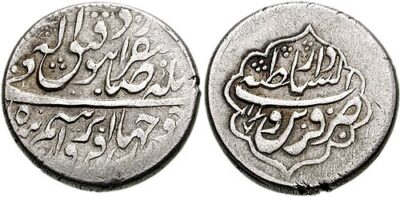
Ibrahim Afshar was The third Afsharid king. Born 1717, in Khorasan Province. Died May 20, 1749, in Mashhad. Positions held include shah (1748).
Facts
10 facts · 0 confirmed by two sources · 0 cited · 10 from one source
Where this comes from
Papalocal keeps its own record. It started from these sources; what each one said is kept here as it was copied, so a change on their side never changes this page by itself. Tap one to read its version.
What Wikidata says · copied November 18, 2026 · revision 2492464069
- Described as
- The third Afsharid king (1748–1749)
- Other names
- Ebrahim Afshar, Ibrahim Jan
- Born
- 1717
- Died
- May 20, 1749
- Born in
- Khorasan Province
- Died in
- Mashhad
- Buried in
- Mashhad · 1 reference
- Occupation
- sovereign
- Positions held
- shah (1748)
- Father
- Ebrahim Khan · 1 reference
- Religion
- Islam; Shia Islam · 1 reference
- Wikipedias with a page
- 23
Wikidata item Q197731 (wikidata.org/wiki/Q197731), public domain (CC0). Copied November 18, 2026.
What Wikipedia says · copied November 18, 2026 · revision 1358667486
Ebrahim Shah (Persian: ابراهیمشاه; c. 1725 – after June/July 1749) was the Afsharid shah of parts of Iran from 1748 to 1749.
Born Mohammad-Ali c. 1725, he was the second son of Ebrahim Khan Afshar, the younger brother of the first Afsharid ruler Nader Shah (r. 1736–1747). In 1739, Mohammad-Ali adopted the name "Ebrahim Beg" following the death of his father during an expedition. In the 1740s, while serving as the sardar (military commander) of the Azerbaijan province, Ebrahim led a victorious campaign at Ardabil against Sam Mirza, a claimant to the Safavid throne. In 1747, Nader Shah was assassinated and succeeded by Ebrahim's elder brother Adel Shah.
Preferring to revel in Mashhad, Adel Shah appointed Ebrahim as the governor of Isfahan and its surroundings. Soon thereafter, Ebrahim declared independence and joined forces with his cousin Amir Aslan Khan Afshar, the governor of Azerbaijan. Adel Shah eventually marched against his brother, but many of his men deserted, and consequently he was defeated (in June 1748) and fled to the town of Tehran. There he was captured and blinded by its governor, Mirza Mohsen Khan, who then gave him over to Mir Sayyed Mohammad. The latter took Adel Shah back to Mashhad, where a group of Turkic, Kurdish, and Arab tribal leaders had taken advantage of his absence and declared Shahrokh the new shah on 1 October. Adel Shah was executed at the request of Shahrokh and the mother of Nasrollah Mirza.
They summoned Ebrahim to acknowledge Shahrokh in person, but he declined. Pretending to have rebelled in support of Shahrokh, Ebrahim instead invited him to be crowned in Isfahan. The nobles of Khorasan, however, deciphered his true intentions and requested Ebrahim to appear at Mashhad as a token of goodwill. Seeing no further progress in the negotiations, Ebrahim revealed his real agenda and went to the city of Tabriz in Azerbaijan, where he was crowned shah on 8 December 1748. Following the counsel of the tribal leaders, Shahrokh assigned Musa Khan Afshar Taromi with the task to defeat Ebrahim Shah. A battle soon followed in June or July 1749 in the environs of Semnan, where Ebrahim Shah was forced to withdraw as a result of turmoil amongst his troops. Some of his Afghan and Uzbek troops deserted to Shahrokh, while others fled. Ebrahim Shah fled to the fortress of Qal'a-ye Qalapur, but was soon captured and given to Musa Khan Afshar Taromi, who had him blinded. He was then sent to Mashhad, but died en route.
From the Wikipedia article “Ebrahim Afshar” (en.wikipedia.org/wiki/Ebrahim_Afshar), by its contributors, under CC BY-SA 4.0 (creativecommons.org/licenses/by-sa/4.0/). Copied November 18, 2026; not changed.
Confirmed Two sources agree. Cited One source, and it names where it got it. One source One source, without a reference of its own. Sources disagree The sources disagree. We show the best-supported value and keep theirs below.
