
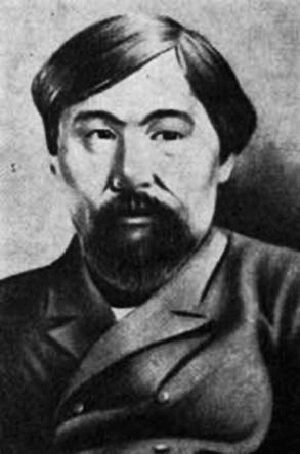
Ibrahim Altynsarin
Ibrahim Altynsarin was a Kazakh writer. Born November 1, 1841, in Kostanay. Died July 29, 1889, in Kostanay.
Facts
12 facts · 2 confirmed by two sources · 6 cited · 4 from one source
What’s different
- Born: we show November 1, 1841 (Confirmed). Wikidata also lists October 20, 1841
- Died: we show July 29, 1889 (Confirmed). Wikidata also lists July 17, 1889
Where this comes from
Papalocal keeps its own record. It started from these sources; what each one said is kept here as it was copied, so a change on their side never changes this page by itself. Tap one to read its version.
What Wikidata says · copied November 18, 2026 · revision 2564215485
- Described as
- Kazakh writer (1841-1889)
- Born
- October 20, 1841; November 1, 1841 · 1 reference
- Died
- July 17, 1889; July 29, 1889 · 1 reference
- Born in
- Kostanay · 1 reference
- Died in
- Kostanay
- Citizen of
- Russian Empire
- Occupation
- writer; pedagogue · 1 reference; folklorist · 1 reference; ethnographer · 1 reference
- Field
- creative and professional writing · 1 reference; folkloristics · 1 reference; ethnography · 1 reference
- Wikipedias with a page
- 20
Wikidata item Q2628401 (wikidata.org/wiki/Q2628401), public domain (CC0). Copied November 18, 2026.
What Wikipedia says · copied November 18, 2026 · revision 1375167026
Ybyrai Altynsarin (born Ibrahim Altynsarin; 1 November [O.S. 20 October] 1841 – 29 July [O.S. 17 July] 1889) was a major figure in pre-Soviet Kazakh history. He was the most prominent Kazakh educator of the 19th century, at the period of Russian colonization of and cultural influence in modern-day Kazakhstan.
Altynsarin was born in the Araqaraghai region of Turgay Oblast (now Kostanay Province) of modern-day Kazakhstan and in his early career he was an inspector of Torghai schools. Like all ethnic Kazakhs, Ibrahim was raised in a Muslim family.
Altynsarin is best known for introducing the transition from the Perso-Arabic alphabet to the Cyrillic alphabet for the Kazakh language, and was a proponent of teaching in the Western style. Being a Muslim, though, he opposed the teaching of Orthodox Christian doctrines to non-Russian Kazakhs, but at the same time urged resistance to the Tatar language and culture, in favor of Russian and Western influences. As an educator, he opened numerous Kazakh–Russian boarding schools, technical schools and schools for girls.
Altynsarin is also known as the author of the first Kazakh grammar book, the first Kazakh–Russian newspaper, and translator of a large number of textbooks and reference works. He was honored by the Imperial Russian government with numerous awards, including the title statski sovetnik (State Counsellor).
A number of Kazakh institutions, including the Kazakh Academy of Education, Arkalyk State Pedagogical Institute and some streets, schools, and academic awards, are named after Altynsarin. There is an Altynsarin museum in Kostanay.
Altynsarin grew up with his grandfather, Balgoja biy, because of the premature death of his father. He exceeded his studies at an Orenburg school.
In his last years, he decides to move 3 kilometers away from Kostanay and built a house there, near the river Tobyl. He works here until his death. He was buried near the river, near his father's coffin.
- Born, in its opening lines
- November 1, 1841
- Died, in its opening lines
- July 29, 1889
From the Wikipedia article “Ybyrai Altynsarin” (en.wikipedia.org/wiki/Ybyrai_Altynsarin), by its contributors, under CC BY-SA 4.0 (creativecommons.org/licenses/by-sa/4.0/). Copied November 18, 2026; not changed.
Confirmed Two sources agree. Cited One source, and it names where it got it. One source One source, without a reference of its own. Sources disagree The sources disagree. We show the best-supported value and keep theirs below.
