
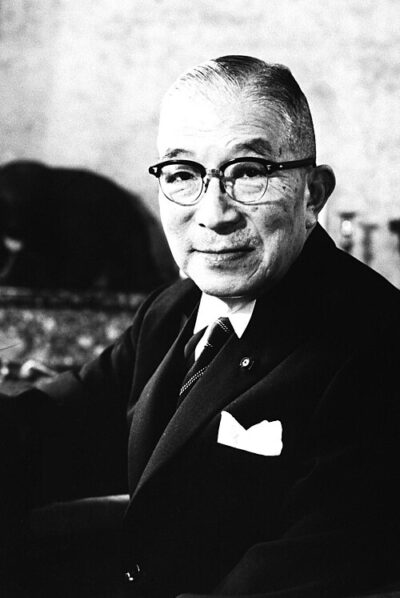
Ichirō Hatoyama
Ichirō Hatoyama was a Prime Minister of Japan from 1954 to 1956. Born January 1, 1883, in Higashi-Gokenchō. Died March 7, 1959, in Tokyo. Positions held include Prime Minister of Japan (1954–1956) and member of the House of Representatives of Japan (1915–). Educated at Tokyo Imperial University and First Higher School. Awards include Grand Cordon of the Supreme Order of the Chrysanthemum, Order of the Sacred Treasure, 4th class and Order of the Sacred Treasure, 3rd class.
Facts
32 facts · 2 confirmed by two sources · 11 cited · 19 from one source
Where this comes from
Papalocal keeps its own record. It started from these sources; what each one said is kept here as it was copied, so a change on their side never changes this page by itself. Tap one to read its version.
What Wikidata says · copied November 16, 2026 · revision 2562815111
- Described as
- Prime Minister of Japan from 1954 to 1956
- Other names
- Ichiro Hatoyama, Ichirou Hatoyama
- Born
- January 1, 1883 · 5 references
- Died
- March 7, 1959 · 7 references
- Born in
- Higashi-Gokenchō
- Died in
- Tokyo · 1 reference
- Buried in
- Yanaka Cemetery
- Citizen of
- Japan
- Occupation
- politician · 1 reference; lawyer · 1 reference
- Positions held
- Prime Minister of Japan (1954–1956); member of the House of Representatives of Japan (1915–) · 1 reference
- Political party
- Liberal Democratic Party · 1 reference; Rikken Seiyūkai · 1 reference; Japan Democratic Party · 1 reference; Liberal Party · 1 reference
- Education
- Tokyo Imperial University · 1 reference; First Higher School
- Awards
- Grand Cordon of the Supreme Order of the Chrysanthemum (1959); Order of the Sacred Treasure, 4th class (1916); Order of the Sacred Treasure, 3rd class (1924); Order of the Sacred Treasure, 1st Class (1934); Order of the Rising Sun, 2nd class (1928); Order of the Rising Sun, 1st class (1934); Military Medal of Honor (1934); 2600th National Anniversary Commemorative Medal (1940)
- Spouse
- Kaoru Hatoyama
- Children
- Iichirō Hatoyama; Reiko Hatoyama · 1 reference
- Father
- Kazuo Hatoyama · 1 reference
- Mother
- Haruko Hatoyama
- Siblings
- Hideo Hatoyama
- Religion
- Baptists
- Lived in
- Hatoyama Hall
- Wikipedias with a page
- 48
Wikidata item Q333589 (wikidata.org/wiki/Q333589), public domain (CC0). Copied November 16, 2026.
What Wikipedia says · copied November 16, 2026 · revision 1385452656
Ichirō Hatoyama (鳩山 一郎, Hatoyama Ichirō; 1 January 1883 – 7 March 1959) was a Japanese politician who served as prime minister of Japan from 1954 to 1956. During his tenure he oversaw the formation of the Liberal Democratic Party (LDP) and restored official relations with the Soviet Union.
Hatoyama was born in Tokyo as the eldest son of politician Kazuo Hatoyama. After graduating from Tokyo Imperial University, he practiced law before entering political life, and was first elected to the Diet in 1915 as a member of the Rikken Seiyūkai. He served as chief cabinet secretary under Giichi Tanaka from 1927 to 1929, and minister of education under Tsuyoshi Inukai and Makoto Saitō from 1931 to 1934. He was one of the leading members of the Seiyukai prior to its dissolution in 1940, and during the Pacific War opposed the cabinet of Hideki Tōjō. In 1945, Hatoyama founded the Liberal Party, which became the largest party in the first post-war election, but he was purged by the American occupation authorities before taking office, and handed the post to Shigeru Yoshida. Hatoyama was de-purged in 1951, but his conflict with Yoshida over the leadership split the Liberal Party in two. Hatoyama then founded the Democratic Party in 1954.
In 1954, Hatoyama ousted Yoshida and finally succeeded him as prime minister. In 1955, his Democratic Party and the Liberal Party, formerly led by Yoshida, merged to form the Liberal Democratic Party, which has dominated Japanese politics ever since. During his tenure, Hatoyama attempted to push through an electoral reform to ensure a two-party system in order to revise the constitution's pacifist Article 9, but failed in both efforts. In 1956, he restored diplomatic relations with the Soviet Union, ending the formal state of war which had existed since 1945, and secured Japan's entry into the United Nations before he resigned.
Hatoyama is the grandfather of Yukio Hatoyama, who served as prime minister from 2009 to 2010.
- Born, in its opening lines
- January 1, 1883
- Died, in its opening lines
- March 7, 1959
From the Wikipedia article “Ichirō Hatoyama” (en.wikipedia.org/wiki/Ichirō_Hatoyama), by its contributors, under CC BY-SA 4.0 (creativecommons.org/licenses/by-sa/4.0/). Copied November 16, 2026; not changed.
Confirmed Two sources agree. Cited One source, and it names where it got it. One source One source, without a reference of its own. Sources disagree The sources disagree. We show the best-supported value and keep theirs below.
