
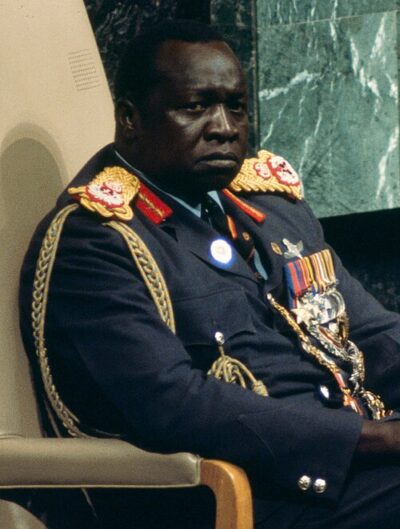
Idi Amin
Idi Amin was a President of Uganda. Born 1925, in Koboko. Died August 16, 2003, in King Faisal Specialist Hospital and Research Centre. Positions held include President of Uganda (1971–1979), chairperson of the Organisation of African Unity (1975–1976) and president. Awards include National Order of Merit, Order of the Republic and Order of the Umayyads.
Facts
36 facts · 1 confirmed by two sources · 8 cited · 25 from one source · 2 where the sources disagree
What’s different
- Born: we show 1925 (Sources disagree). Wikipedia says May 30, 1928
- Born in: we show Koboko (Sources disagree). Wikidata also lists Kampala
Where this comes from
Papalocal keeps its own record. It started from these sources; what each one said is kept here as it was copied, so a change on their side never changes this page by itself. Tap one to read its version.
What Wikidata says · copied November 16, 2026 · revision 2569420308
- Described as
- President of Uganda (1971-1979)
- Other names
- Idi Amin Dada, Idi Amin Dada Oumee
- Born
- 1925 · 10 references
- Died
- August 16, 2003 · 6 references
- Born in
- Koboko · 2 references; Kampala
- Died in
- King Faisal Specialist Hospital and Research Centre
- Buried in
- Jeddah · 1 reference
- Citizen of
- Uganda (1979); Saudi Arabia (1979–1989); Uganda Protectorate
- Occupation
- politician · 1 reference; military officer; military personnel · 1 reference
- Positions held
- President of Uganda (1971–1979); chairperson of the Organisation of African Unity (1975–1976); president · 1 reference
- Political party
- independent politician · 1 reference
- Sport
- boxing
- Awards
- National Order of Merit · 1 reference; Order of the Republic · 1 reference; Order of the Umayyads · 1 reference; Order of Merit · 1 reference; Great Chain of Badr; Victoria Cross; Distinguished Service Order; Military Cross
- Field
- military affairs · 1 reference
- Spouse
- Sarah Kyolaba (1975–1982) · 1 reference; Kay Adroa (1966–1973) · 1 reference; Malyamu Amin (1953–1973) · 1 reference; Madina Amin; Norah Amin
- Military branch
- British Army (1946–1962); Uganda People's Defence Force (1962–1979)
- Military rank
- field marshal (1975–); major general (1971); general · 1 reference
- Lived in
- Jeddah (1980–2003)
- Wikipedias with a page
- 113
Wikidata item Q48231 (wikidata.org/wiki/Q48231), public domain (CC0). Copied November 16, 2026.
What Wikipedia says · copied November 16, 2026 · revision 1384717470
Awon'go Idi Amin Dada Oumee (30 May 1928 – 16 August 2003) was a Ugandan military officer and dictator who served as the third president of Uganda from 1971 until his overthrow in 1979. He gained power after the 1971 Ugandan coup d'état and subsequently ruled the country under a regime characterized by rampant human rights abuses, economic mismanagement and corruption. International observers and human rights groups estimate that between 100,000 and 500,000 people were killed under his regime.
Amin was born to a Kakwa father and a Lugbara mother. In 1946, he joined the King's African Rifles, part of the British Colonial Army, as a cook. He rose to the rank of lieutenant, taking part in British actions against Somali rebels and then the Mau Mau Uprising in Kenya. Uganda gained independence from the United Kingdom in 1962, and Amin remained in the army, rising to the position of deputy army commander in 1964 and being appointed commander two years later. He became aware that Ugandan president Milton Obote was planning to arrest him for misappropriating army funds, so he overthrew Obote in 1971 and declared himself president.
During his years in power, Amin shifted from being a pro-Western ruler enjoying considerable support from Israel to being backed by Libya's Muammar Gaddafi, Zaire's Mobutu Sese Seko, the Soviet Union, and East Germany. In 1972, Amin expelled Asians, a majority of whom were Indian-Ugandans, leading India to sever diplomatic relations with his regime. In 1975, Amin assumed chairmanship of the Organisation of African Unity, an intergovernmental organisation designed to promote solidarity among African states (an annually rotating role). Uganda was a member of the United Nations Commission on Human Rights from 1977 to 1979. The United Kingdom broke diplomatic relations with Uganda in 1977, and Amin declared that he had defeated the British and added "CBE" to his title, for "Conqueror of the British Empire".
During the late 1970s there was increased unrest in Uganda, prompted by Amin's persecution of political dissidents and certain ethnic groups and also by the country's very poor international standing, a result of Amin's support for the 1976 hijacking that led to Israel's Operation Entebbe. He then attempted to annex Tanzania's Kagera Region in 1978. Tanzanian president Julius Nyerere ordered his troops to invade Uganda in response. Tanzanian Army and rebel forces successfully captured Kampala in 1979 and ousted Amin from power. Amin went into exile, first in Libya, then Iraq, and finally in Saudi Arabia, where he lived until his death in 2003.
- Born, in its opening lines
- May 30, 1928
- Died, in its opening lines
- August 16, 2003
From the Wikipedia article “Idi Amin” (en.wikipedia.org/wiki/Idi_Amin), by its contributors, under CC BY-SA 4.0 (creativecommons.org/licenses/by-sa/4.0/). Copied November 16, 2026; not changed.
Confirmed Two sources agree. Cited One source, and it names where it got it. One source One source, without a reference of its own. Sources disagree The sources disagree. We show the best-supported value and keep theirs below.
