
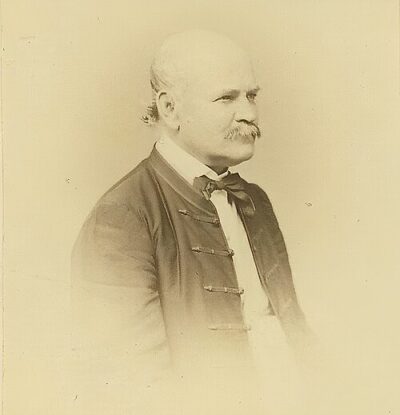
Ignaz Semmelweis
Ignaz Semmelweis was a Hungarian physician, early pioneer of antiseptic procedures. Born July 1, 1818, in Tabán. Died August 13, 1865, in Oberdöbling. Educated at University of Vienna and Eötvös Loránd University.
Facts
24 facts · 2 confirmed by two sources · 5 cited · 16 from one source · 1 where the sources disagree
What’s different
- Buried in: we show Fiume Road Graveyard (2 times) (1891–1963) (Sources disagree). Wikidata also lists Semmelweis Museum of Medical History
Where this comes from
Papalocal keeps its own record. It started from these sources; what each one said is kept here as it was copied, so a change on their side never changes this page by itself. Tap one to read its version.
What Wikidata says · copied November 16, 2026 · revision 2568741908
- Described as
- Hungarian physician, early pioneer of antiseptic procedures (1818–1865)
- Other names
- Ignatius Philipp Semmelweis, Semmelweis Ignác Fülöp, Ignaz Philipp Semmelweis, Semmelweis, Ignác Fülöp Semmelweis
- Born
- July 1, 1818 · 6 references
- Died
- August 13, 1865 · 8 references
- Born in
- Tabán
- Died in
- Oberdöbling · 1 reference
- Buried in
- Semmelweis Museum of Medical History; Fiume Road Graveyard (2 times) (1891–1963) · 1 reference
- Cause of death
- pyaemia
- Citizen of
- Austrian Empire; Hungary
- Occupation
- physician · 2 references; botanist; university teacher; gynecologist · 1 reference; obstetrician; hygienist
- Worked for
- Eötvös Loránd University
- Education
- University of Vienna (–1844); Eötvös Loránd University (–1841) · 1 reference; Budapesti Egyetemi Katolikus Gimnázium (–1835) · 1 reference
- Field
- midwifery · 1 reference; gynaecology · 1 reference; surgery · 1 reference
- Spouse
- Mária Weidenhofer
- Father
- Josef Semmelweis · 1 reference
- Mother
- Theresa Müller
- Wikipedias with a page
- 80
Wikidata item Q59736 (wikidata.org/wiki/Q59736), public domain (CC0). Copied November 16, 2026.
What Wikipedia says · copied November 16, 2026 · revision 1383434529
Ignaz Philipp Semmelweis (German: [ˈɪɡnaːts ˈfɪlɪp ˈzɛml̩vaɪs]; Hungarian: Semmelweis Ignác Fülöp [ˈsɛm(ː)ɛlvɛjs ˈiɡnaːts ˈfyløp]; 1 July 1818 – 13 August 1865) was a Hungarian medical doctor and scientist of German descent who was an early pioneer of antiseptic procedures, known as the "saviour of mothers". Postpartum infection, also known as puerperal fever or childbed fever, was common in the 19th century, and often fatal. Semmelweis demonstrated that the incidence of infection could be drastically reduced by requiring healthcare workers in obstetrical clinics to disinfect their hands. In 1847, he proposed hand washing with chlorinated lime solutions at Vienna General Hospital's First Obstetrical Clinic, where doctors' wards had thrice the mortality of midwives' wards. The maternal mortality rate dropped from 18% to less than 2%, and he published a book of his findings, Etiology, Concept and Prophylaxis of Childbed Fever, in 1861.
Despite his research, Semmelweis's observations conflicted with the established scientific views of the time, and his ideas were rejected by the medical community. He could not offer a theoretical explanation for his findings of reduced mortality due to hand washing; additionally, some doctors were offended by the suggestion that they should wash their hands, and mocked him for it. In 1865, the increasingly outspoken Semmelweis purportedly suffered a nervous breakdown and was committed to an asylum by his colleagues. In the asylum, he was beaten by the guards. He died 14 days later from a gangrenous wound on his right hand that may have been caused by the beating.
Semmelweis's findings only gained widespread acceptance years after his death, when Louis Pasteur confirmed the germ theory of disease, giving Semmelweis's observations a scientific explanation, and Joseph Lister, acting on Pasteur's research, pioneered antiseptic surgical methods with great success.
- Born, in its opening lines
- July 1, 1818
- Died, in its opening lines
- August 13, 1865
From the Wikipedia article “Ignaz Semmelweis” (en.wikipedia.org/wiki/Ignaz_Semmelweis), by its contributors, under CC BY-SA 4.0 (creativecommons.org/licenses/by-sa/4.0/). Copied November 16, 2026; not changed.
Confirmed Two sources agree. Cited One source, and it names where it got it. One source One source, without a reference of its own. Sources disagree The sources disagree. We show the best-supported value and keep theirs below.
