
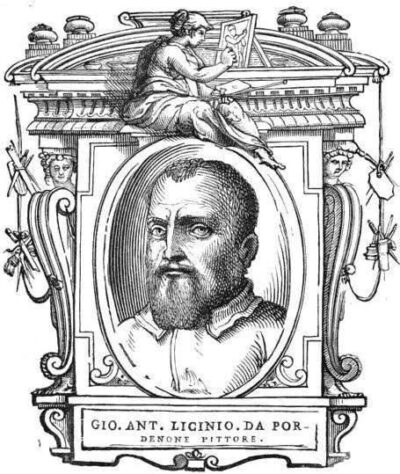
Il Pordenone was an Italian painter. Born 1484, in Pordenone. Died January 14, 1539, in Ferrara. Known for Golgotha, Lamentation over the Dead Christ and St. Prosdocimus and St. Peter.
Facts
17 facts · 2 confirmed by two sources · 5 cited · 10 from one source
Where this comes from
Papalocal keeps its own record. It started from these sources; what each one said is kept here as it was copied, so a change on their side never changes this page by itself. Tap one to read its version.
What Wikidata says · copied November 18, 2026 · revision 2564789773
- Described as
- Italian painter (1484-1539)
- Other names
- Pordenone, Giovanni Antonio Pordenone, Giovanni Antonio de Corticellis, Bordenone, Giovanni Antionio da Pordenone, Perdonese, Giovanni Antonio Sacchis, Pordone, Giovanni Antonio de Lodesanis Pordenone, Pordenono, Giovanni Antonio de Sacchi, da Pordenone Regillo
- Born
- 1484 · 2 references
- Died
- January 14, 1539 · 1 reference
- Born in
- Pordenone · 1 reference
- Died in
- Ferrara · 1 reference
- Citizen of
- Republic of Venice
- Occupation
- painter · 1 reference; wood sculptor · 1 reference; artist · 1 reference
- Known for
- Golgotha; Lamentation over the Dead Christ; St. Prosdocimus and St. Peter; Judith with the Head of Holofernes; Virgin and Child; Saints Martin and Christopher · 1 reference; Transfiguration of Christ · 1 reference
- Field
- painting · 1 reference
- Children
- Graziosa de' Sacchis
- Wikipedias with a page
- 23
Wikidata item Q983352 (wikidata.org/wiki/Q983352), public domain (CC0). Copied November 18, 2026.
What Wikipedia says · copied November 18, 2026 · revision 1370412910
Pordenone, Il Pordenone in Italian, is the byname of Giovanni Antonio de’ Sacchis (c. 1484 – 14 January 1539), an Italian Mannerist painter, loosely of the Venetian school. Vasari, his main biographer, wrongly identifies him as Giovanni Antonio Licinio. He painted in several cities in northern Italy "with speed, vigor, and deliberate coarseness of expression and execution—intended to shock".
He appears to have visited Rome, and learnt from its High Renaissance masterpieces, but lacked a good training in anatomical drawing. Like Polidoro da Caravaggio, he was one of the artists often commissioned to paint the exteriors of buildings; of such work at most a shadow survives after centuries of weather. Michelangelo is said to have approved of one palace facade in 1527; it is now only known from a preparatory drawing. Much of his work was lost when the Doge's Palace in Venice was largely destroyed by fires in 1574 and 1577. A number of fresco cycles survive, for example part of one at Cremona Cathedral, where his Passion scenes have a violence hardly repeated until Goya. Another cycle was at the Scuola Grande della Carità in Venice, now the Gallerie dell'Accademia, the main art museum, where he worked with the young Tintoretto.
His life was as energetic and restless as his art; he married three times, and was accused in court of hiring criminals to kill his brother to avoid sharing their inheritance. He perhaps had some influence on later works by Titian and more clearly on Tintoretto, who to some extent took over his position as the leading painter of large mural commissions in Venice. Titian and Pordenone were rivals in his last decade and gossip even claimed that his death was suspicious.
- Born, in its opening lines
- c. 1484
- Died, in its opening lines
- January 14, 1539
From the Wikipedia article “Il Pordenone” (en.wikipedia.org/wiki/Il_Pordenone), by its contributors, under CC BY-SA 4.0 (creativecommons.org/licenses/by-sa/4.0/). Copied November 18, 2026; not changed.
Confirmed Two sources agree. Cited One source, and it names where it got it. One source One source, without a reference of its own. Sources disagree The sources disagree. We show the best-supported value and keep theirs below.
