
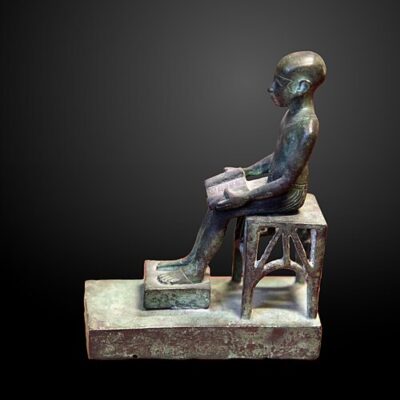
Imhotep
Imhotep was an Egyptian architect, physician, astronomer, and god of medicine in ancient Egyptian mythology.. Born 28th century BC, in Memphis. Died 27th century BC, in Ancient Egypt. Positions held include sage.
Facts
13 facts · 0 confirmed by two sources · 5 cited · 8 from one source
Where this comes from
Papalocal keeps its own record. It started from these sources; what each one said is kept here as it was copied, so a change on their side never changes this page by itself. Tap one to read its version.
What Wikidata says · copied November 16, 2026 · revision 2569146421
- Described as
- Egyptian architect, physician, astronomer, and god of medicine in ancient Egyptian mythology.
- Born
- 28th century BC
- Died
- 27th century BC
- Born in
- Memphis
- Died in
- Ancient Egypt
- Citizen of
- Ancient Egypt
- Occupation
- architect · 1 reference; engineer · 1 reference; astronomer; physician · 1 reference; master builder · 1 reference; writer · 1 reference
- Positions held
- sage
- Mother
- Khereduankh
- Wikipedias with a page
- 76
Wikidata item Q131171 (wikidata.org/wiki/Q131171), public domain (CC0). Copied November 16, 2026.
What Wikipedia says · copied November 16, 2026 · revision 1382264995
Imhotep (; Ancient Egyptian: ỉỉ-m-ḥtp "(the one who) comes in peace"; fl. late 27th century BC) was an Egyptian chancellor to the King Djoser, possible architect of Djoser's step pyramid, and high priest of the sun god Ra at Heliopolis. Very little is known of Imhotep as a historical figure, but in the 3,000 years following his death, he was gradually glorified and deified.
Traditions from long after Imhotep's death treated him as a great author of wisdom texts and especially as a physician. No extant text from his lifetime mentions these capacities, and none mention his name in the first 1,200 years following his death. The Westcar Papyrus of the Hyksos period, written in classical Middle Egyptian (likely around the 13th Dynasty), contains a story about an official performing a miracle for Djoser, possibly Imhotep. However, this section is badly damaged and no mention of this character's name survived.
Apart from the two short contemporary inscriptions that establish him as chancellor to the Pharaoh, the first surviving text to name Imhotep dates to the time of Amenhotep III (c. 1391–1353 BC). It is addressed to the owner of a tomb and reads:The wab-priest may give offerings to your ka. The wab-priests may stretch to you their arms with libations on the soil, as it is done for Imhotep with the remains of the water bowl.
It appears that this libation to Imhotep was done regularly, as they are attested on papyri associated with statues of Imhotep until the Late Period (c. 664–332 BC). Wildung (1977) explains the origin of this cult as a slow evolution of intellectuals' memory of Imhotep, from his death onward. Gardiner finds the cult of Imhotep during the New Kingdom (c. 1550–1077 BC) sufficiently distinct from the usual offerings made to other commoners that the epithet "demigod" is likely justified to describe his veneration.
The first references to the healing abilities of Imhotep occur from the Thirtieth Dynasty (c. 380–343 BC) onward, some 2,200 years after his death.
Imhotep is among fewer than a dozen non-royal Egyptians who were deified after their deaths. The center of his cult was in Memphis. The location of his tomb remains unknown, despite efforts to find it.
From the Wikipedia article “Imhotep” (en.wikipedia.org/wiki/Imhotep), by its contributors, under CC BY-SA 4.0 (creativecommons.org/licenses/by-sa/4.0/). Copied November 16, 2026; not changed.
Confirmed Two sources agree. Cited One source, and it names where it got it. One source One source, without a reference of its own. Sources disagree The sources disagree. We show the best-supported value and keep theirs below.
