
sage
Sage is a someone who has attained the wisdom which a philosopher seeks.
All 2 facts, and where they come from
Facts
2 facts · 0 confirmed by two sources · 0 cited · 2 from one source
Where this comes from
Papalocal keeps its own record. It started from these sources; what each one said is kept here as it was copied, so a change on their side never changes this page by itself. Tap one to read its version.
What Wikidata says · copied November 17, 2026 · revision 2532506361
- Described as
- someone who has attained the wisdom which a philosopher seeks
- Other names
- sophos, Sage, wise person
- What it is
- stock character; occupation
- Wikipedias with a page
- 14
Wikidata item Q2624172 (wikidata.org/wiki/Q2624172), public domain (CC0). Copied 2026-11-17.
What Wikipedia says · copied November 17, 2026 · revision 1368295512
A sage (Ancient Greek: σοφός, sophós), in classical philosophy, is someone who has attained wisdom. The term has also been used interchangeably with a 'good person' (Ancient Greek: ἀγαθός, agathós), and a 'virtuous person' (Ancient Greek: σπουδαῖος, spoudaîos). Some of the earliest accounts of the sage begin with Empedocles' Sphairos. Horace describes the Sphairos as "Completely within itself, well-rounded and spherical, so that nothing extraneous can adhere to it, because of its smooth and polished surface." Alternatively, the sage is one who lives "according to an ideal which transcends the everyday."
Several of the schools of Hellenistic philosophy have the sage as a featured figure. Karl Ludwig Michelet wrote that "Greek religion culminated with its true god, the sage"; Pierre Hadot develops this idea, stating that "the moment philosophers achieve a rational conception of God based on the model of the sage, Greece surpasses its mythical representation of its gods." Indeed, the actions of the sage are propounded to be how a god would act in the same situation.
From the Wikipedia article “Sage (philosophy)” (en.wikipedia.org/wiki/Sage_(philosophy)), by its contributors, under CC BY-SA 4.0 (creativecommons.org/licenses/by-sa/4.0/). Copied 2026-11-17; not changed.
Confirmed Two sources agree. Cited One source, and it names where it got it. One source One source, without a reference of its own. Sources disagree The sources disagree. We show the best-supported value and keep theirs below.
People connected 2
Held this office
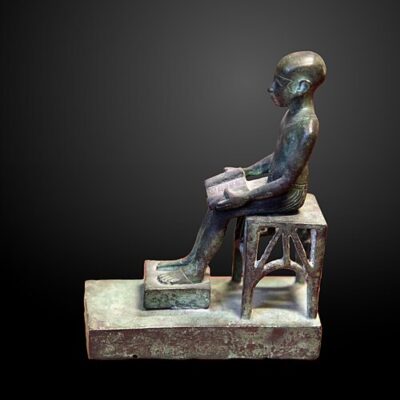 ImhotepEgyptian architect, physician, astronomer, and god of medicine in ancient Egyptian mythology.
