
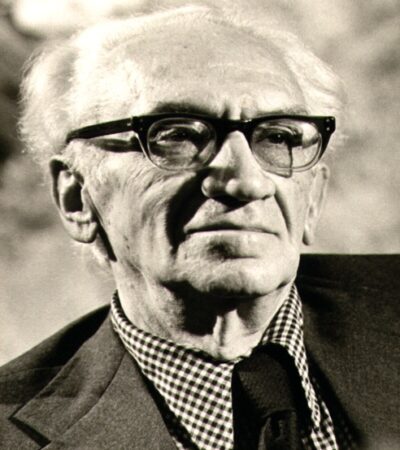
Immanuel Velikovsky
Immanuel Velikovsky was a Russian, Israeli and American author. Born June 10, 1895, in Vitebsk. Died November 17, 1979, in Princeton. Known for Worlds in Collision and Ages in Chaos. Educated at Medvednevskaya gymnasium and Lomonosov Moscow State University.
Facts
24 facts · 2 confirmed by two sources · 11 cited · 11 from one source
Where this comes from
Papalocal keeps its own record. It started from these sources; what each one said is kept here as it was copied, so a change on their side never changes this page by itself. Tap one to read its version.
What Wikidata says · copied November 15, 2026 · revision 2567734506
- Described as
- Russian, Israeli and American author (1895–1979)
- Born
- June 10, 1895 · 4 references
- Died
- November 17, 1979 · 6 references
- Born in
- Vitebsk · 2 references
- Died in
- Princeton · 2 references
- Citizen of
- Russian Empire; Mandatory Palestine; United States
- Occupation
- psychotherapist; publisher; writer; mythographer; naturalist · 1 reference; psychoanalyst · 1 reference
- Education
- Medvednevskaya gymnasium (–1912) · 1 reference; Lomonosov Moscow State University (1915–1921) · 1 reference
- Known for
- Worlds in Collision; Ages in Chaos
- Field
- catastrophism; historical revisionism
- Lived in
- Vitebsk (1895–1900) · 1 reference; Moscow (3 times) (1900–1922) · 1 reference; Montpellier (1912–1913) · 1 reference; Edinburgh (1913–1914) · 1 reference; Berlin (1922–1923) · 1 reference
- Wikipedias with a page
- 31
Wikidata item Q349749 (wikidata.org/wiki/Q349749), public domain (CC0). Copied November 15, 2026.
What Wikipedia says · copied November 15, 2026 · revision 1384121141
Immanuel Velikovsky (; Russian: Иммануи́л Велико́вский, IPA: [ɪmənʊˈil vʲɪlʲɪˈkofskʲɪj]; 10 June [O.S. 29 May] 1895 – 17 November 1979) was a Russian and American psychoanalyst, writer, and catastrophist. He is the author of several books offering pseudohistorical interpretations of ancient history, including the U.S. bestseller Worlds in Collision published in 1950. Velikovsky's work is frequently cited as a canonical example of pseudoscience and has been used as an example of the demarcation problem.
His books use comparative mythology and ancient literary sources (including the Old Testament) to argue that Earth suffered catastrophic close contacts with other planets (principally Venus and Mars) in ancient history. In positioning Velikovsky among catastrophists including Hans Bellamy, Ignatius Donnelly, and Johann Gottlieb Radlof, the British astronomers Victor Clube and Bill Napier noted "... Velikovsky is not so much the first of the new catastrophists ...; he is the last in a line of traditional catastrophists going back to mediaeval times and probably earlier." Velikovsky argued that electromagnetic effects play an important role in celestial mechanics. He also proposed a revised chronology for ancient Egypt, Greece, Israel, and other cultures of the ancient Near East. The revised chronology aimed at explaining the so-called "dark age" of the eastern Mediterranean (c. 1100–750 BC) and reconciling biblical accounts with widely accepted archaeology and Egyptian chronology.
In general, Velikovsky's ideas have been ignored or vigorously rejected by the academic community. Nonetheless, his books often sold well and gained enthusiastic support in lay circles, often fuelled by claims of unfair treatment of Velikovsky by orthodox academia. The controversy surrounding his work and its reception is often referred to as "the Velikovsky affair".
- Born, in its opening lines
- June 10, 1895
- Died, in its opening lines
- November 17, 1979
From the Wikipedia article “Immanuel Velikovsky” (en.wikipedia.org/wiki/Immanuel_Velikovsky), by its contributors, under CC BY-SA 4.0 (creativecommons.org/licenses/by-sa/4.0/). Copied November 15, 2026; not changed.
Confirmed Two sources agree. Cited One source, and it names where it got it. One source One source, without a reference of its own. Sources disagree The sources disagree. We show the best-supported value and keep theirs below.
