
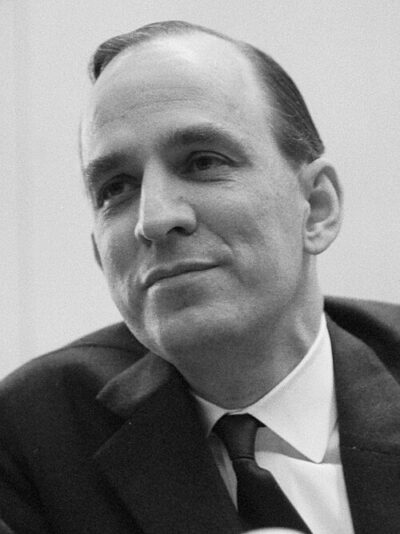
Ingmar Bergman
Ingmar Bergman was a Swedish director and screenwriter. Born July 14, 1918, in Uppsala. Died July 30, 2007, in Fårö parish. Known for The Seventh Seal, Persona and Fanny and Alexander. Educated at Stockholm University and Palmgrenska samskolan. Awards include Golden Bear, Erasmus Prize and Irving G. Thalberg Memorial Award.
Facts
57 facts · 2 confirmed by two sources · 23 cited · 32 from one source
Where this comes from
Papalocal keeps its own record. It started from these sources; what each one said is kept here as it was copied, so a change on their side never changes this page by itself. Tap one to read its version.
What Wikidata says · copied November 16, 2026 · revision 2567720294
- Described as
- Swedish director and screenwriter (1918–2007)
- Other names
- Ernst Ingmar Bergman
- Born
- July 14, 1918 · 21 references
- Died
- July 30, 2007 · 16 references
- Born in
- Uppsala · 2 references
- Died in
- Fårö parish · 1 reference
- Buried in
- Grave of Ingmar Bergman
- Name at birth
- Ernst Ingmar Bergman
- Citizen of
- Sweden · 3 references
- Occupation
- film director · 5 references; theatre director · 2 references; screenwriter · 5 references; playwright; actor; film producer; autobiographer; director · 4 references
- Education
- Stockholm University (1937–); Palmgrenska samskolan
- Member of
- American Academy of Arts and Sciences
- Known for
- The Seventh Seal; Persona; Fanny and Alexander; Autumn Sonata
- Awards
- Golden Bear (1958); Erasmus Prize (1965) · 1 reference; Irving G. Thalberg Memorial Award (1970); Goethe Prize of the City of Frankfurt (1976); César Award (1984); BAFTA Fellowship (1988); European Film Academy Lifetime Achievement Award (1988) · 1 reference; Praemium Imperiale (1991) · 1 reference; International Federation of Film Critics; Sonning Prize; Fellow of the American Academy of Arts and Sciences; Guldbagge Award for Best Director (2 times) (1964, 1983) · 1 reference; Guldbagge Award for Best Screenplay (1992) · 1 reference; honorary doctor of the University Lille-III (1995) · 1 reference; Cannes Best Director Award (1958)
- Field
- performing arts
- Spouse
- Else Fisher (1943–1945) · 1 reference; Ellen Bergman (1945–1950) · 1 reference; Gun Bergman (1951–1959) · 1 reference; Käbi Laretei (1959–1969) · 2 references; Ingrid von Rosen (1971–1995) · 2 references
- Children
- Lena Bergman; Eva Bergman · 1 reference; Jan Bergman · 1 reference; Anna Bergman · 1 reference; Mats Bergman · 1 reference; Maria von Rosen · 1 reference; Daniel Bergman · 2 references; Linn Ullmann · 2 references
- Father
- Erik Bergman
- Mother
- Karin Bergman
- Siblings
- Margareta Bergman · 1 reference; Dag Bergman
- Religion
- agnosticism
- Website
- https://ingmarbergman.se
- Wikipedias with a page
- 165
Wikidata item Q7546 (wikidata.org/wiki/Q7546), public domain (CC0). Copied November 16, 2026.
What Wikipedia says · copied November 16, 2026 · revision 1385793766
Ernst Ingmar Bergman (14 July 1918 – 30 July 2007) was a Swedish filmmaker and theatre director. He is considered one of the greatest and most important filmmakers in the history of cinema, most notably as a prominent figure of both European film industry and Swedish cinema. His films have been described as "profoundly personal meditations into the myriad struggles facing the psyche and the soul."
Among his most acclaimed works are The Seventh Seal (1957), Wild Strawberries (1957), Persona (1966) and Fanny and Alexander (1982), which were included in the 2012 edition of Sight & Sound's Greatest Films of All Time. He was also ranked No. 8 on the magazine's 2002 "Greatest Directors of All Time" list. Other notable works include Sawdust and Tinsel (1953), A Lesson in Love (1954), Smiles of a Summer Night (1955), The Virgin Spring (1960), Through a Glass Darkly (1961), Winter Light and The Silence (both 1963), Shame (1968) which was called the director's ultimate personal vision of war, Cries and Whispers (1972), Scenes from a Marriage (1973) and Autumn Sonata (1978). His films led to international acclaim and garnered Academy Award wins and nominations throughout his career, including his personal Irving G. Thalberg Memorial Award and three competitive wins accepted for Best Foreign Language Film to Swedish entries.
Bergman directed more than 60 films and documentaries, most of which he also wrote, for both cinema releases and television screenings. Most of his films were set in Sweden, and many of his films from 1961 onward were filmed on the island of Fårö. He forged a creative partnership with his cinematographers Gunnar Fischer and Sven Nykvist. Bergman also had a theatrical career that included periods as Leading Director of Sweden's Royal Dramatic Theatre in Stockholm and of Germany's Residenztheater in Munich. He directed more than 170 plays. Among his company of actors were Harriet Andersson, Bibi Andersson, Liv Ullmann, Gunnar Björnstrand, Erland Josephson, Ingrid Thulin, Gunnel Lindblom and Max von Sydow.
- Born, in its opening lines
- July 14, 1918
- Died, in its opening lines
- July 30, 2007
From the Wikipedia article “Ingmar Bergman” (en.wikipedia.org/wiki/Ingmar_Bergman), by its contributors, under CC BY-SA 4.0 (creativecommons.org/licenses/by-sa/4.0/). Copied November 16, 2026; not changed.
Confirmed Two sources agree. Cited One source, and it names where it got it. One source One source, without a reference of its own. Sources disagree The sources disagree. We show the best-supported value and keep theirs below.
