
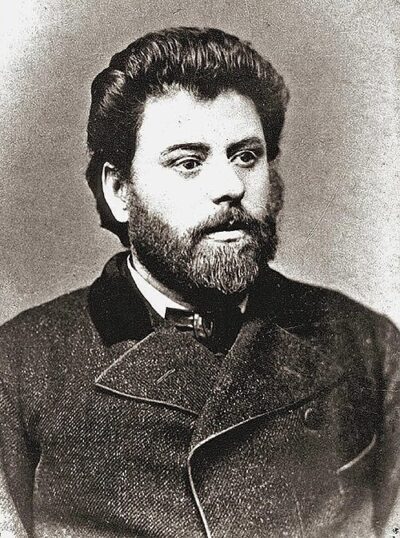
Ion Creangă
Ion Creangă was a Romanian writer, raconteur and schoolteacher. Born March 1, 1837, in Humulești. Died December 31, 1889, in Iași. Educated at Theological Seminary at Socola Monastery.
Facts
28 facts · 2 confirmed by two sources · 3 cited · 23 from one source
What’s different
- Born: we show March 1, 1837 (Confirmed). Wikidata also lists June 10, 1839
Where this comes from
Papalocal keeps its own record. It started from these sources; what each one said is kept here as it was copied, so a change on their side never changes this page by itself. Tap one to read its version.
What Wikidata says · copied November 16, 2026 · revision 2559986526
- Described as
- Romanian writer, raconteur and schoolteacher (1837–1889)
- Other names
- Ionică Torcălău
- Born
- March 1, 1837 · 2 references; June 10, 1839 · 2 references
- Died
- December 31, 1889 · 4 references
- Born in
- Humulești
- Died in
- Iași · 1 reference
- Buried in
- Eternitatea Cemetery
- Cause of death
- seizure · 1 reference
- Citizen of
- Principality of Moldavia; United Principalities of Moldavia and Wallachia; Kingdom of Romania · 1 reference
- Occupation
- writer · 1 reference; autobiographer; children's writer; poet; collector of fairy tales; short story writer
- Political party
- independent politician; Free and Independent Faction · 1 reference
- Education
- Theological Seminary at Socola Monastery
- Member of
- Romanian Academy
- Genre
- anecdote; children's literature; erotic literature; fable; fairy tale; lyric poetry
- Spouse
- Ileana Grigoriu (1859–1867)
- Children
- Constantin Creangă
- Religion
- Eastern Orthodoxy
- Wikipedias with a page
- 36
Wikidata item Q204810 (wikidata.org/wiki/Q204810), public domain (CC0). Copied November 16, 2026.
What Wikipedia says · copied November 16, 2026 · revision 1378026165
Ion Creangă (Romanian pronunciation: [iˈon ˈkre̯aŋɡə]; also known as Nică al lui Ștefan a Petrei, Ion Torcălău and Ioan Ștefănescu; March 1, 1837 – December 31, 1889) was a Moldavian, later Romanian writer, raconteur and schoolteacher. A main figure in 19th-century Romanian literature, he is best known for his Childhood Memories volume, his novellas and short stories, and his many anecdotes. Creangă's main contribution to fantasy and children's literature includes narratives structured around eponymous protagonists ("Harap Alb", "Ivan Turbincă", "Dănilă Prepeleac", "Stan Pățitul"), as well as fairy tales indebted to conventional forms ("The Story of the Pig", "The Goat and Her Three Kids", "The Mother with Three Daughters-in-Law", "The Old Man's Daughter and the Old Woman's Daughter"). Widely seen as masterpieces of the Romanian language and local humor, his writings occupy the middle ground between a collection of folkloric sources and an original contribution to a literary realism of rural inspiration. They are accompanied by a set of contributions to erotic literature, collectively known as his "corrosives".
A defrocked Romanian Orthodox priest with an unconventional lifestyle, Creangă made an early impact as an innovative educator and textbook author, while pursuing a short career in nationalist politics with the Free and Independent Faction. His literary debut came late in life, closely following the start of his close friendship with Romania's national poet Mihai Eminescu and their common affiliation with the influential conservative literary society Junimea. Although viewed with reserve by many of his colleagues there, and primarily appreciated for his records of oral tradition, Creangă helped propagate the group's cultural guidelines in an accessible form. Later critics have often described him, alongside Eminescu, Ion Luca Caragiale and Ioan Slavici, as one of the most accomplished representatives of Junimist literature.
Ion Creangă was posthumously granted several honors, and is commemorated by a number of institutions in both Romania and neighboring Moldova. These include the Bojdeuca building in Iași, which, in 1918, was opened as the first memorial house in Romania. His direct descendants include Horia Creangă, one of the leading Romanian architects during the interwar period.
- Born, in its opening lines
- March 1, 1837
- Died, in its opening lines
- December 31, 1889
From the Wikipedia article “Ion Creangă” (en.wikipedia.org/wiki/Ion_Creangă), by its contributors, under CC BY-SA 4.0 (creativecommons.org/licenses/by-sa/4.0/). Copied November 16, 2026; not changed.
Confirmed Two sources agree. Cited One source, and it names where it got it. One source One source, without a reference of its own. Sources disagree The sources disagree. We show the best-supported value and keep theirs below.
