
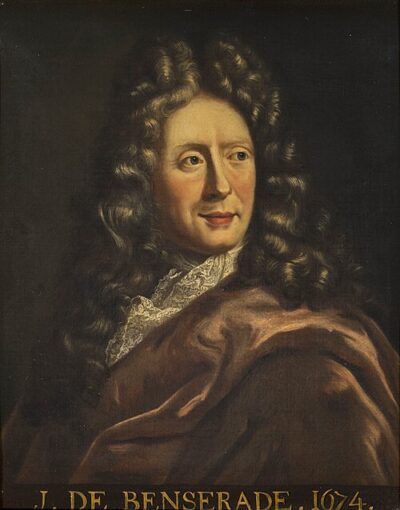
Isaac de Benserade
Isaac de Benserade was a French writer. Born November 5, 1613, in Lyons-la-Forêt. Died October 10, 1691, in Gentilly. Positions held include Member of the Académie française (1674–1691). Known for Iphis et Iante.
Facts
17 facts · 2 confirmed by two sources · 13 cited · 2 from one source
Where this comes from
Papalocal keeps its own record. It started from these sources; what each one said is kept here as it was copied, so a change on their side never changes this page by itself. Tap one to read its version.
What Wikidata says · copied November 18, 2026 · revision 2568746594
- Described as
- French writer (1613–1691)
- Other names
- Isaac de Bensérade
- Born
- November 5, 1613 · 5 references
- Died
- October 10, 1691 · 4 references
- Born in
- Lyons-la-Forêt · 1 reference
- Died in
- Gentilly · 1 reference
- Citizen of
- Kingdom of France · 1 reference
- Occupation
- poet · 1 reference; playwright · 1 reference; librettist · 1 reference; choreographer; writer · 3 references
- Positions held
- Member of the Académie française (1674–1691) · 1 reference
- Member of
- Académie Française (1674–1691) · 1 reference
- Known for
- Iphis et Iante
- Field
- literature · 1 reference; drama · 1 reference; libretto · 1 reference; ballet · 1 reference
- Wikipedias with a page
- 23
Wikidata item Q982037 (wikidata.org/wiki/Q982037), public domain (CC0). Copied November 18, 2026.
What Wikipedia says · copied November 18, 2026 · revision 1371713854
Isaac de Benserade (French: [bɛ̃.sʁad]; baptized 5 November 1613 – 10 October 1691) was a French poet and playwright.
Born in Lyons-la-Forêt, Normandy, his family appears to have been connected with Richelieu, who bestowed on him a pension of 600 livres. On Richelieu's death, Benserade lost his pension but became more and more a favourite at court, especially with Anne of Austria.
He wrote his first tragedy at the age of 23 in 1636, Cleopatra, for the actress Mademoiselle Bellerose. His first comedy was Iphis and Iante, which first opened in the Hôtel de Bourgogne in 1634. This play touches on female homosexuality in the form of cross-dressing, which was a commonplace in French literature in the 17th century.
Benserade provided the words for the court ballets and was in 1674 admitted to the French Academy, where he wielded considerable influence. In 1675, he provided the quatrains to accompany the 39 hydraulic sculpture groups depicting Aesop's fables in the labyrinth of Versailles. In 1676, the failure of his Métamorphoses d'Ovide in the form of rondeaux gave a blow to his reputation but by no means destroyed his vogue with his contemporaries. Benserade may be best known for his sonnet on Job (1651). The sonnet, which he sent to a young lady with his paraphrase on Job, was placed in competition with the Urania of Voiture and led to a dispute on their relative merits that long divided the whole court and the wits into two parties, styled respectively the Jobelins and the Uranists. The partisans of Benserade were headed by the prince de Conti and Mlle de Scudéry, and Mme de Montausier and Jean-Louis Guez de Balzac took the side of Voiture.
Some years before his death, Benserade retired to Gentilly and devoted himself to a translation of the Psalms, which he nearly completed.
- Born, in its opening lines
- November 5, 1613
- Died, in its opening lines
- October 10, 1691
From the Wikipedia article “Isaac de Benserade” (en.wikipedia.org/wiki/Isaac_de_Benserade), by its contributors, under CC BY-SA 4.0 (creativecommons.org/licenses/by-sa/4.0/). Copied November 18, 2026; not changed.
Confirmed Two sources agree. Cited One source, and it names where it got it. One source One source, without a reference of its own. Sources disagree The sources disagree. We show the best-supported value and keep theirs below.
