
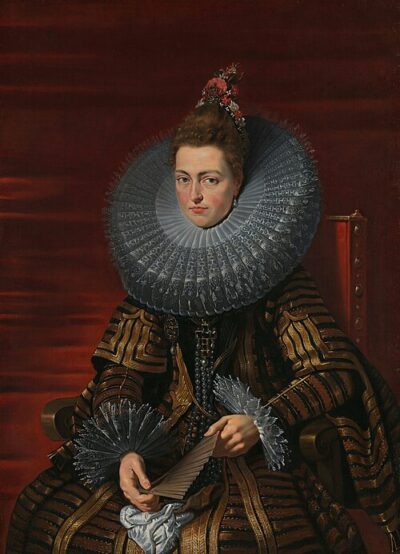
Isabella Clara Eugenia of Spain
Isabella Clara Eugenia of Spain was an Infanta of Spain, Archduchess of Austria. Born August 12, 1566, in Segovia. Died December 1, 1633, in Brussels. Positions held include Governor of the Spanish Netherlands (1598–1633).
Facts
24 facts · 2 confirmed by two sources · 4 cited · 18 from one source
Where this comes from
Papalocal keeps its own record. It started from these sources; what each one said is kept here as it was copied, so a change on their side never changes this page by itself. Tap one to read its version.
What Wikidata says · copied November 16, 2026 · revision 2564637493
- Described as
- Infanta of Spain, Archduchess of Austria (1566-1633)
- Other names
- Infanta Isabella Clara Eugenia of Spain, Infanta of Spain Isabel Clara Eugenia, Infanta of Spain and Archduchess of Austria Isabella, Isabella, Isabel Clara Eugenia of Spain, Isabella Clara Eugenia
- Born
- August 12, 1566 · 1 reference
- Died
- December 1, 1633 · 7 references
- Born in
- Segovia · 1 reference
- Died in
- Brussels · 1 reference
- Buried in
- Cathedral of St. Michael and St. Gudula
- Name at birth
- Isabel Clara Eugenia de Austria
- Citizen of
- Spain
- Occupation
- politician
- Positions held
- Governor of the Spanish Netherlands (1598–1633)
- Member of
- Albert and Isabella
- Spouse
- Albert VII, Archduke of Austria (1598–1621) · 2 references
- Children
- Anna Mauritia von Habsburg · 1 reference; Philipp von Habsburg · 1 reference; Albrecht von Habsburg · 1 reference
- Father
- Philip II of Spain
- Mother
- Elisabeth of Valois
- Siblings
- Catalina Micaela of Spain; Carlos, Prince of Asturias; Philip III of Spain; Ferdinand, Prince of Asturias; Diego, Prince of Asturias; Infanta Maria of Spain; Infante Carlos Lorenzo of Spain
- Religion
- Catholic Church
- Wikipedias with a page
- 38
Wikidata item Q158256 (wikidata.org/wiki/Q158256), public domain (CC0). Copied November 16, 2026.
What Wikipedia says · copied November 16, 2026 · revision 1386080326
Isabella Clara Eugenia (Spanish: Isabel Clara Eugenia; 12 August 1566 – 1 December 1633), sometimes referred to as Clara Isabella Eugenia, was sovereign of the Habsburg Netherlands, and the Free County of Burgundy, from 1598 to 1621, ruling jointly with her husband Archduke Albert VII of Austria. After Albert's death, those regions were returned to the Spanish Habsburgs, and she continued to rule as governess of the Spanish Netherlands until her death.
Their reign is considered the Golden Age of the Habsburg Netherlands, which saw a revival of its economy and arts after a peace was concluded with the break-away Dutch Republic. Isabella was one of the most powerful women in 16th- and 17th-century Europe.
- Born, in its opening lines
- August 12, 1566
- Died, in its opening lines
- December 1, 1633
From the Wikipedia article “Isabella Clara Eugenia” (en.wikipedia.org/wiki/Isabella_Clara_Eugenia), by its contributors, under CC BY-SA 4.0 (creativecommons.org/licenses/by-sa/4.0/). Copied November 16, 2026; not changed.
Confirmed Two sources agree. Cited One source, and it names where it got it. One source One source, without a reference of its own. Sources disagree The sources disagree. We show the best-supported value and keep theirs below.
