
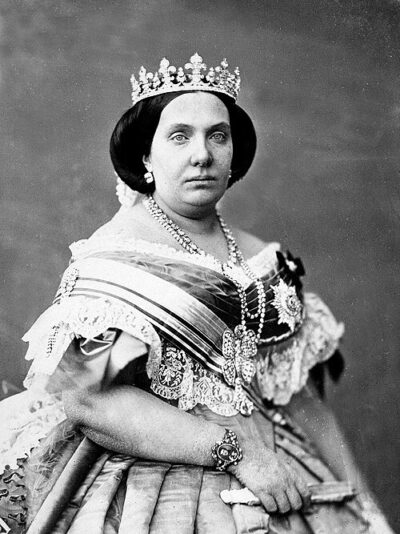
Isabella II of Spain
Isabella II of Spain was a Queen of Spain from 1833 to 1868. Born October 10, 1830, in Madrid. Died April 9, 1904, in Paris. Positions held include Monarch of Spain (1833–1868), Grand Master of the Order of Santiago and Head of State of Spain (1833–1868). Awards include Knight of the Order of the Golden Fleece, Golden Rose and Knight Grand Cross of the Order of Saints Maurice and Lazarus.
Facts
44 facts · 2 confirmed by two sources · 3 cited · 39 from one source
Where this comes from
Papalocal keeps its own record. It started from these sources; what each one said is kept here as it was copied, so a change on their side never changes this page by itself. Tap one to read its version.
What Wikidata says · copied November 16, 2026 · revision 2565564117
- Described as
- Queen of Spain from 1833 to 1868
- Other names
- Doña Isabel de Borbón Reina de España, Isabel II, Elisabeth II of Spain, Isabel II, Queen of Spain and the Indiess, Isabel II de España, Isabel de Borbón
- Born
- October 10, 1830 · 9 references
- Died
- April 9, 1904 · 4 references
- Born in
- Madrid · 3 references
- Died in
- Paris · 3 references
- Buried in
- Royal Crypt of the Royal Monastery of San Lorenzo de El Escorial
- Cause of death
- influenza
- Name at birth
- María Isabel Luisa de Borbón
- Citizen of
- Spain
- Occupation
- ruler
- Positions held
- Monarch of Spain (1833–1868); Grand Master of the Order of Santiago; Head of State of Spain (1833–1868)
- Member of
- Spanish Royal Family
- Awards
- Knight of the Order of the Golden Fleece; Golden Rose; Knight Grand Cross of the Order of Saints Maurice and Lazarus; Grand Cross of the Order of the Immaculate Conception of Vila Viçosa; Grand Cross of the Order of the Redeemer; Order of Guadalupe
- Spouse
- Francisco de Asís, Duke of Cádiz (1846–1902) · 1 reference
- Children
- Infante Luis, Prince of Asturias; Infante Fernando, Prince of Asturias; Infanta Isabel, Countess of Gergenti; Infanta María Cristina of Spain; Infanta Margarita of Spain; Infante Francisco de Asís, Prince of Asturias; Alfonso XII of Spain; Infanta María de la Concepción of Spain; Infanta María del Pilar of Spain; Infanta María de la Paz of Spain; Infanta Eulalia, Duchess of Galliera; Infante Francisco de Asís of Spain
- Father
- Ferdinand VII of Spain
- Mother
- Maria Christina of the Two Sicilies
- Siblings
- Agustín Muñoz, 1st Duke of Tarancón; Luisa Fernanda of Spain, Duchess of Montpensier · 1 reference; María Amparo Muñoz, 1st Countess of Vista Alegre; Infanta María Luisa Isabel of Spain; Juan Muñoz y de Borbón, Conde de Recuerdo; José Muñoz y Borbón, 1st conde de la Gracia; Fernando Muñoz, 2nd Duke of Tarancón; Maria de los Milagros Muñoz; María Cristina Muñoz y Borbón
- Religion
- Catholic Church
- Wikipedias with a page
- 78
Wikidata item Q183085 (wikidata.org/wiki/Q183085), public domain (CC0). Copied November 16, 2026.
What Wikipedia says · copied November 16, 2026 · revision 1382268713
Isabella II (Spanish: Isabel II, María Isabel Luisa de Borbón y Borbón-Dos Sicilias; 10 October 1830 – 9 April 1904) was Queen of Spain from 1833 until her deposition in 1868. She is the only queen regnant in the history of unified Spain.
Isabella was the elder daughter of King Ferdinand VII and Queen Maria Christina. Shortly before Isabella's birth, her father issued the Pragmatic Sanction to revert the Salic Law and ensure the succession of his firstborn daughter, due to his lack of a son. She came to the throne a month before her third birthday, but her succession was disputed by her uncle, Infante Carlos (founder of the Carlist movement), whose refusal to recognize a female sovereign led to the Carlist Wars. Under the regency of her mother, Spain transitioned from an absolute monarchy to a constitutional monarchy, adopting the Royal Statute of 1834 and Constitution of 1837.
In 1843, Isabella was declared of age and began her personal rule. Her reign was a period marked by palace intrigues, back-stairs and antechamber influences, barracks conspiracies, and military pronunciamientos. Her marriage to Francisco de Asís, Duke of Cádiz was an unhappy one, and her personal conduct as well as recurrent rumours of extramarital affairs damaged her reputation. In September 1868, a naval mutiny began in Cádiz, marking the beginning of the Glorious Revolution. The defeat of her forces by Marshal Francisco Serrano, 1st Duke of la Torre, brought her reign to an end, and she went into exile in France. In 1870, she formally abdicated the Spanish throne in favour of her son, Alfonso. In 1874, the First Spanish Republic was overthrown in a coup. The Bourbon monarchy was restored, and Alfonso ascended the throne as King Alfonso XII. Isabella returned to Spain two years later but soon again left for France, where she resided until her death in 1904.
- Born, in its opening lines
- October 10, 1830
- Died, in its opening lines
- April 9, 1904
From the Wikipedia article “Isabella II” (en.wikipedia.org/wiki/Isabella_II), by its contributors, under CC BY-SA 4.0 (creativecommons.org/licenses/by-sa/4.0/). Copied November 16, 2026; not changed.
Confirmed Two sources agree. Cited One source, and it names where it got it. One source One source, without a reference of its own. Sources disagree The sources disagree. We show the best-supported value and keep theirs below.
