
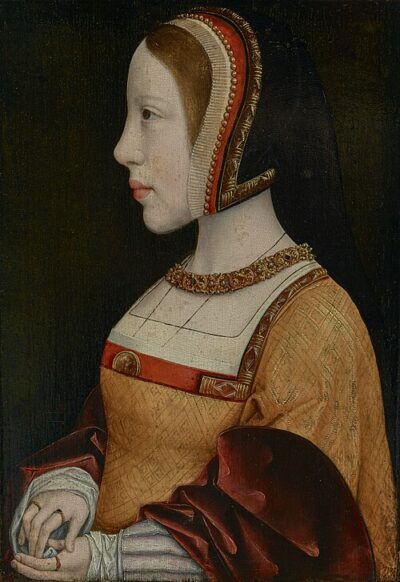
Isabella of Austria
Isabella of Austria was a Queen consort of Denmark, Norway and Sweden;. Born July 18, 1501, in Brussels. Died January 19, 1526, in Ghent. Positions held include Queen consort of Denmark (1515–1523).
Facts
24 facts · 2 confirmed by two sources · 10 cited · 12 from one source
Where this comes from
Papalocal keeps its own record. It started from these sources; what each one said is kept here as it was copied, so a change on their side never changes this page by itself. Tap one to read its version.
What Wikidata says · copied November 16, 2026 · revision 2568214444
- Described as
- Queen consort of Denmark, Norway and Sweden; (1501-1526)
- Born
- July 18, 1501 · 2 references
- Died
- January 19, 1526 · 6 references
- Born in
- Brussels · 2 references
- Died in
- Ghent · 1 reference
- Buried in
- Saint Peter's Abbey (1526–); St. Canute's Cathedral (–1883) · 1 reference
- Citizen of
- Holy Roman Empire · 1 reference
- Occupation
- consort
- Positions held
- Queen consort of Denmark (1515–1523)
- Spouse
- Christian II of Denmark (1515–) · 3 references
- Children
- Prince John of Denmark · 1 reference; Dorothea of Denmark, Electress Palatine; Christina of Denmark; stillborn son Oldenburg · 1 reference; Maximilian of Denmark · 1 reference; Prince Philip Ferdinand of Denmark · 1 reference
- Father
- Philip I of Castile · 1 reference
- Mother
- Juana I of Castile · 1 reference
- Siblings
- Eleanor of Austria; Mary of Hungary; Catherine of Austria, Queen of Portugal; Charles V, Holy Roman Emperor; Ferdinand I, Holy Roman Emperor; Rietje Koane
- Wikipedias with a page
- 47
Wikidata item Q157884 (wikidata.org/wiki/Q157884), public domain (CC0). Copied November 16, 2026.
What Wikipedia says · copied November 16, 2026 · revision 1383390755
Isabella of Austria (Isabel; 18 July 1501 – 19 January 1526), also known as Elizabeth, was born an Archduchess of Austria and Infanta of Castile from the House of Habsburg, and subsequently became Queen of Denmark, Norway and Sweden, under the Kalmar Union, as the wife of King Christian II. She was the daughter of King Philip I and Queen Joanna of Castile and the sister of Charles V, Holy Roman Emperor. She ruled Denmark as regent in 1520.
Her upbringing, overseen by her aunt Archduchess Margaret, was marked by a comprehensive education in Mechelen under the guidance of notable humanists like Juan Luis Vives and Adrian of Utrecht. In 1514, she entered into a strategic marriage with Christian II of Denmark, Norway, and Sweden. However, the marriage encountered early challenges with diplomatic tensions arising from Christian II's existing relationship with Dyveke Sigbritsdatter, his Dutch mistress. Following Dyveke's death in 1517, the relations between Isabella and her husband significantly improved, and Isabella was entrusted with the position of regent in 1520 and political advisor to the king.
In 1523, her husband, King Christian II, was deposed. The political upheaval prompted the Danish royal family, including Isabella and her children, to seek refuge in various European states, such as England, Saxony and the Habsburg Netherlands. During this exile, Isabella strongly advocated for her husband's cause. In 1524, she participated in the Imperial Diet in Nürnberg, where she campaigned on behalf of King Christian II, seeking support for his restoration to the Danish throne.
Her travels through Germany, England, and the Netherlands contributed to her evolving religious sympathies for the Protestant movement. Isabella's death in 1526 prompted widespread mourning. She received both Protestant and Catholic communion, but the Habsburgs declared that she had died a fervent Catholic.
- Born, in its opening lines
- July 18, 1501
- Died, in its opening lines
- January 19, 1526
From the Wikipedia article “Isabella of Austria” (en.wikipedia.org/wiki/Isabella_of_Austria), by its contributors, under CC BY-SA 4.0 (creativecommons.org/licenses/by-sa/4.0/). Copied November 16, 2026; not changed.
Confirmed Two sources agree. Cited One source, and it names where it got it. One source One source, without a reference of its own. Sources disagree The sources disagree. We show the best-supported value and keep theirs below.
