
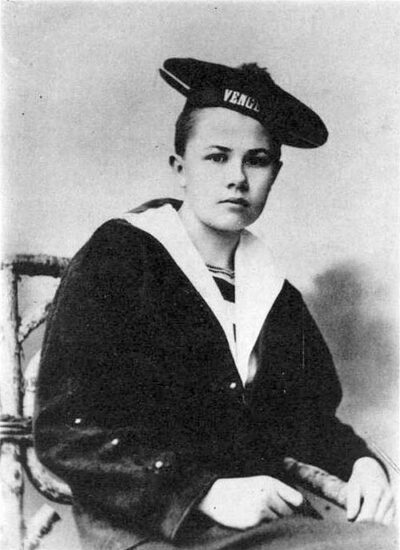
Isabelle Eberhardt
Isabelle Eberhardt was a Swiss explorer and author. Born February 17, 1877, in Geneva. Died October 21, 1904, in Aïn Sefra.
Facts
15 facts · 2 confirmed by two sources · 7 cited · 6 from one source
Where this comes from
Papalocal keeps its own record. It started from these sources; what each one said is kept here as it was copied, so a change on their side never changes this page by itself. Tap one to read its version.
What Wikidata says · copied November 16, 2026 · revision 2565435977
- Described as
- Swiss explorer and author (1877-1904)
- Other names
- Isabelle Wilhelmine Marie Eberhardt, Si Mahmoud Essadi
- Born
- February 17, 1877 · 5 references
- Died
- October 21, 1904 · 5 references
- Born in
- Geneva · 3 references
- Died in
- Aïn Sefra · 1 reference
- Buried in
- Aïn Sefra
- Cause of death
- drowning
- Name at birth
- Isabelle Wilhelmine Marie Eberhardt · 1 reference
- Citizen of
- Russian Empire; Switzerland; France · 2 references
- Occupation
- explorer; journalist; writer · 1 reference
- Mother
- Natalia Nicolaievna Eberhardt · 1 reference
- Religion
- Islam (1897–) · 1 reference
- Wikipedias with a page
- 35
Wikidata item Q271903 (wikidata.org/wiki/Q271903), public domain (CC0). Copied November 16, 2026.
What Wikipedia says · copied November 16, 2026 · revision 1378167207
Isabelle Wilhelmine Marie Eberhardt (17 February 1877 – 21 October 1904) was a Swiss explorer and author. As a teenager, Eberhardt, educated in Switzerland by her father, published short stories under a male pseudonym. She became interested in North Africa, and was considered a proficient writer on the subject despite learning about the region only through correspondence. After an invitation from photographer Louis David, Eberhardt moved to Algeria in May 1897. She dressed as a man and converted to Islam, eventually adopting the name Si Mahmoud Saadi. Eberhardt's unorthodox behaviour made her an outcast among European settlers in Algeria and the French administration.
Eberhardt's acceptance by the Qadiriyya, an Islamic order, convinced the French administration that she was a spy or an agitator. She survived an assassination attempt shortly thereafter. In 1901, the French administration ordered her to leave Algeria, but she was allowed to return the following year after marrying her partner, the Algerian soldier Slimane Ehnni. Following her return, Eberhardt wrote for a newspaper published by Victor Barrucand and worked for General Hubert Lyautey. In 1904, at the age of 27, she was killed by a flash flood in Aïn Séfra.
In 1906, Barrucand began publishing her remaining manuscripts, which received critical acclaim. She was seen posthumously as an advocate of decolonisation, and streets were named after her in Béchar and Algiers. Eberhardt's life has been the subject of several works, including the 1991 film Isabelle Eberhardt and the 2012 opera Song from the Uproar: The Lives and Deaths of Isabelle Eberhardt.
- Born, in its opening lines
- February 17, 1877
- Died, in its opening lines
- October 21, 1904
From the Wikipedia article “Isabelle Eberhardt” (en.wikipedia.org/wiki/Isabelle_Eberhardt), by its contributors, under CC BY-SA 4.0 (creativecommons.org/licenses/by-sa/4.0/). Copied November 16, 2026; not changed.
Confirmed Two sources agree. Cited One source, and it names where it got it. One source One source, without a reference of its own. Sources disagree The sources disagree. We show the best-supported value and keep theirs below.
