
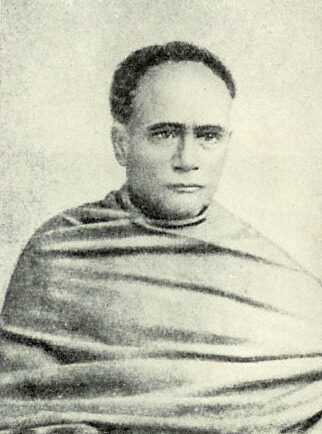
Ishwar Chandra Vidyasagar
Ishwar Chandra Vidyasagar was a Philosopher, academic, writer, translator, entrepreneur, social reformer and philanthropist. Born September 26, 1820, in Birsingha. Died July 29, 1891, in Kolkata. Educated at The Sanskrit College and University and Sanskrit Collegiate School.
Facts
18 facts · 2 confirmed by two sources · 0 cited · 16 from one source
Where this comes from
Papalocal keeps its own record. It started from these sources; what each one said is kept here as it was copied, so a change on their side never changes this page by itself. Tap one to read its version.
What Wikidata says · copied November 16, 2026 · revision 2562935007
- Described as
- Philosopher, academic, writer, translator, entrepreneur, social reformer and philanthropist (1820-1891)
- Born
- September 26, 1820 · 2 references
- Died
- July 29, 1891 · 2 references
- Born in
- Birsingha
- Died in
- Kolkata
- Citizen of
- British Raj
- Occupation
- writer; head teacher; professor; playwright; biographer; autobiographer; short story writer
- Education
- The Sanskrit College and University; Sanskrit Collegiate School
- Children
- Narayan Chandra Vidyaratna
- Siblings
- Shambhu Chandra Vidyaratna; Dinabandhu Nyaratna
- Religion
- Hinduism
- Wikipedias with a page
- 34
Wikidata item Q964111 (wikidata.org/wiki/Q964111), public domain (CC0). Copied November 16, 2026.
What Wikipedia says · copied November 16, 2026 · revision 1383362644
Ishwar Chandra Bandyopadhyay (26 September 1820 – 29 July 1891), popularly known as Ishwar Chandra Vidyasagar (Bengali pronunciation: [iʃːɔɾt͡ʃɔnd̪ɾo bid̪ːaʃaɡɔɾ]), was an Indian educator and social reformer of the 19th century.
He was renowned as one of the principal proponents of the Bengal Renaissance. Eminent scholar and Vidyasagar Society Bangladesh President Dr. Rashid Askari contends that despite his orientation as a Sanskritist, Vidyasagar embraced the Western Enlightenment ideas of secularism, agnosticism, rationalism, and liberty. He abhorred fundamentalism, orthodoxy, superstition and fanaticism and regarded most of the teachings of ancient Hindu scriptures as incongruous in the context of the modern age. The most striking aspects of his character were his indomitable passion for pursuit and dissemination of knowledge, unswerving reforming zeal, liberal attitudes and secular humanism.[1]
He was the most prominent campaigner for Hindu widow remarriage, petitioning the Legislative Council despite severe opposition, including a counter-petition (by Radhakanta Deb and the Dharma Sabha) which had nearly four times as many signatures. Even though widow remarriage was considered a flagrant breach of Hindu customs and was staunchly opposed, Lord Dalhousie personally finalised the bill, and the Hindu Widows' Remarriage Act, 1856, was passed. Against child marriage, the efforts of Vidyasagar led to the Age of Consent Act, 1891. In which the minimum age of consummation of marriage was 12 years.
A weekly newspaper, Somprakash Patrika, was started on 15 November 1858 (1 Agrahayan 1265 BS) by Dwarakanath Vidyabhusan. Dwarakanath (1819–1886) was a professor of the Sanskrit College in Calcutta, India. The original plan was mooted by Ishwar Chandra Vidyasagar (1820–1891), who continued to advise Dwarakanath in editorial matters. He was also associated as secretary with the Hindu Female School, which later came to be known as Bethune Female School.
He excelled in his undergraduate studies of Sanskrit and philosophy. The Sanskrit College and University, where he studied, gave him the honorific title Vidyasagar ('Ocean of Knowledge'; from the Sanskrit विद्या, vidyā, 'knowledge' and सागर, sāgara, 'ocean').
- Born, in its opening lines
- September 26, 1820
- Died, in its opening lines
- July 29, 1891
From the Wikipedia article “Ishwar Chandra Vidyasagar” (en.wikipedia.org/wiki/Ishwar_Chandra_Vidyasagar), by its contributors, under CC BY-SA 4.0 (creativecommons.org/licenses/by-sa/4.0/). Copied November 16, 2026; not changed.
Confirmed Two sources agree. Cited One source, and it names where it got it. One source One source, without a reference of its own. Sources disagree The sources disagree. We show the best-supported value and keep theirs below.
