
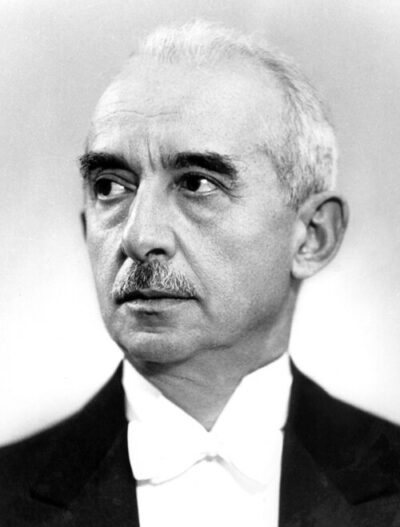
İsmet İnönü
İsmet İnönü was the 2nd President of the Republic of Turkey. Born September 24, 1884, in İnönü House Museum. Died December 25, 1973, in Pembe Köşk. Positions held include President of Turkey (1938–1950), member of the Grand National Assembly of Turkey and Minister of Foreign Affairs (1922–1924). Educated at Ottoman Military College and Turkish Military Academy.
Facts
32 facts · 2 confirmed by two sources · 9 cited · 21 from one source
Where this comes from
Papalocal keeps its own record. It started from these sources; what each one said is kept here as it was copied, so a change on their side never changes this page by itself. Tap one to read its version.
What Wikidata says · copied November 16, 2026 · revision 2567298759
- Described as
- 2nd President of the Republic of Turkey (1884–1973)
- Other names
- Mustafa İsmet İnönü
- Born
- September 24, 1884 · 6 references
- Died
- December 25, 1973 · 6 references
- Born in
- İnönü House Museum · 2 references
- Died in
- Pembe Köşk · 1 reference
- Buried in
- Anıtkabir
- Cause of death
- myocardial infarction
- Citizen of
- Turkey; Ottoman Empire
- Occupation
- politician · 1 reference; diplomat; military officer; statesperson
- Positions held
- President of Turkey (1938–1950); member of the Grand National Assembly of Turkey; Minister of Foreign Affairs (1922–1924) · 2 references; Prime Minister of Turkey (2 times) (1923–1965); Chief of the Turkish General Staff (1920–1921) · 1 reference; Minister of National Education (1929) · 1 reference; Ottoman Minister of War (1920–1921) · 1 reference
- Political party
- Republican People's Party
- Education
- Ottoman Military College; Turkish Military Academy
- Spouse
- Mevhibe İnönü (1916–1973) · 3 references
- Children
- Özden Toker; Erdal İnönü · 1 reference; Ömer İnönü; Izzet Inönü
- Religion
- Sunni Islam; Islam · 1 reference
- Military branch
- Turkish Land Forces
- Military rank
- birinci ferik (1926–1927) · 1 reference; general · 1 reference
- Wikipedias with a page
- 86
Wikidata item Q183297 (wikidata.org/wiki/Q183297), public domain (CC0). Copied November 16, 2026.
What Wikipedia says · copied November 16, 2026 · revision 1384301250
Mustafa İsmet İnönü (24 September 1884 – 25 December 1973) was a Turkish politician and military officer who served as the president of Turkey from 1938 to 1950, and as its prime minister three times: from 1923 to 1924, 1925 to 1937, and 1961 to 1965.
İnönü is acknowledged by many as Mustafa Kemal Atatürk's right-hand man, with their friendship going back to the Caucasus campaign. In the Greco-Turkish campaign of the Turkish War of Independence, he served as the first chief of the General Staff from 1920 to 1921 for the regular Turkish army, during which he commanded forces during the First and Second Battles of İnönü. Atatürk bestowed İsmet with the surname İnönü, the site of the battles, when the 1934 Surname Law was adopted. He served as the chief negotiator for the Ankara government, first as an army general following the defeat of invading forces during the Armistice of Mudanya talks, later as Minister of Foreign Affairs at the Lausanne Conferences (1922–1923). He secured recognition of the Turkish victory by the Allies and replacing the imposed Treaty of Sèvres with the Treaty of Lausanne. As prime minister for most of Atatürk's presidency, İnönü executed many of Atatürk's modernizing and nationalist reforms.
İnönü succeeded Atatürk as president of Turkey after his death in 1938 and was granted the official title of Millî Şef ("National Chief") by the parliament. As president and chairman of the Republican People's Party (CHP), İnönü initially continued Turkey's one party state. Kemalist style programs continued to make great strides in education by supporting projects such as Village Institutes. His governments implemented notably heavy statist economic policies. The Hatay State was annexed in 1939, and Turkey was able to maintain an armed neutrality during World War II, joining the Allied powers only three months before the end of hostilities in the European Theater. The Turkish Straits crisis prompted İnönü to build closer ties with the Western powers, with the country eventually joining NATO in 1952, though by then he was no longer president.
Factionalism between statists and liberals in the CHP led to the creation of the Democrat Party in 1946. İnönü held the first multiparty elections in the Republic's history that year, beginning Turkey's multiparty period. 1950 saw a peaceful transfer of power to the Democrats when the CHP suffered defeat in the elections. For ten years, İnönü served as the leader of the opposition before returning to power as prime minister following the 1961 election, held after the 1960 coup-d'état. The 1960s saw İnönü reinvent the CHP as a political party, which was "Left of Center" as a new party cadre led by Bülent Ecevit became more influential. İnönü remained leader of the CHP until 1972, when he was defeated by Ecevit in a leadership contest. He died on 25 December 1973, of a heart attack, at the age of 89. He is interred opposite to Atatürk's mausoleum at Anıtkabir in Ankara.
- Born, in its opening lines
- September 24, 1884
- Died, in its opening lines
- December 25, 1973
From the Wikipedia article “İsmet İnönü” (en.wikipedia.org/wiki/İsmet_İnönü), by its contributors, under CC BY-SA 4.0 (creativecommons.org/licenses/by-sa/4.0/). Copied November 16, 2026; not changed.
Confirmed Two sources agree. Cited One source, and it names where it got it. One source One source, without a reference of its own. Sources disagree The sources disagree. We show the best-supported value and keep theirs below.
