
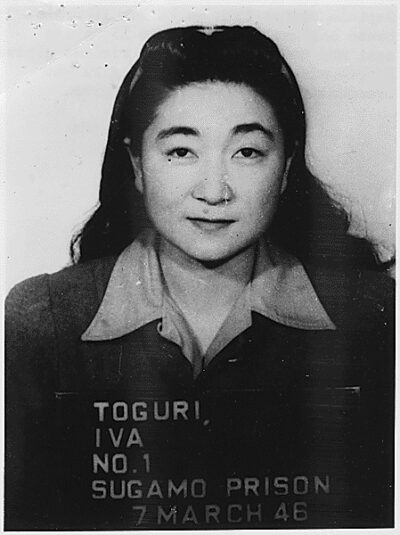
Iva Toguri D'Aquino
Iva Toguri D'Aquino was a World War II propaganda announcer "Orphan Ann", and best-known "Tokyo Rose" announcer. Born July 4, 1916, in Los Angeles. Died September 26, 2006, in Chicago. Educated at University of California, Los Angeles and Compton High School.
Facts
14 facts · 2 confirmed by two sources · 3 cited · 9 from one source
Where this comes from
Papalocal keeps its own record. It started from these sources; what each one said is kept here as it was copied, so a change on their side never changes this page by itself. Tap one to read its version.
What Wikidata says · copied November 16, 2026 · revision 2568782888
- Described as
- World War II propaganda announcer "Orphan Ann", and best-known "Tokyo Rose" announcer
- Other names
- Iva Toguri, Iva Ikuko Toguri D'Aquino, Orphan Ann, Iva Ikuko Toguri
- Born
- July 4, 1916 · 2 references
- Died
- September 26, 2006 · 3 references
- Born in
- Los Angeles · 1 reference
- Died in
- Chicago · 1 reference
- Buried in
- Montrose Cemetery · 1 reference
- Citizen of
- Japan; United States
- Occupation
- radio personality; announcer
- Political party
- Republican Party
- Worked for
- NHK
- Education
- University of California, Los Angeles; Compton High School; Compton College
- Wikipedias with a page
- 23
Wikidata item Q254713 (wikidata.org/wiki/Q254713), public domain (CC0). Copied November 16, 2026.
What Wikipedia says · copied November 16, 2026 · revision 1383318990
Iva Ikuko Toguri D'Aquino (Japanese: 戸栗郁子 アイバ; July 4, 1916 – September 26, 2006) was an American citizen visiting Japan when World War II began. Unable to return to the United States, she risked her life smuggling food to American service men held in prisoner of war camps.
The Japanese authorities forced Toguri to work as a disc jockey and radio personality on English-language radio broadcasts transmitted by Radio Tokyo to Allied troops in the South Pacific during World War II on the Zero Hour radio show. Toguri refused to broadcast anti-American propaganda, and tried to make a farce of the broadcasts. Toguri called herself "Orphan Annie", but she quickly became inaccurately identified with the name "Tokyo Rose", coined by Allied soldiers and which predated her broadcasts.
After the surrender of Japan, Toguri was detained for one year by the United States military for possible wrongdoing against the U.S. but was released for lack of evidence and U.S. Department of Justice officials agreed that her broadcasts were "innocuous".
However, when Toguri tried to return to the U.S. a popular uproar ensued, prompting the Federal Bureau of Investigation to renew its investigation of her wartime activities. She was subsequently charged by the U.S. Attorney's Office with eight counts of treason, which were based on false testimony forced from witnesses by the prosecutors. Her 1949 trial resulted in a conviction on one count, for which she served more than six years, out of a ten-year sentence in prison.
Journalistic and governmental investigators years later pieced together the history of irregularities with the indictment, trial, and conviction, including confessions from key witnesses that they had perjured themselves at the various stages of their testimonies due to government threats.
Toguri received a full pardon from President Gerald Ford in 1977.
- Born, in its opening lines
- July 4, 1916
- Died, in its opening lines
- September 26, 2006
From the Wikipedia article “Iva Toguri D'Aquino” (en.wikipedia.org/wiki/Iva_Toguri_D'Aquino), by its contributors, under CC BY-SA 4.0 (creativecommons.org/licenses/by-sa/4.0/). Copied November 16, 2026; not changed.
Confirmed Two sources agree. Cited One source, and it names where it got it. One source One source, without a reference of its own. Sources disagree The sources disagree. We show the best-supported value and keep theirs below.
