
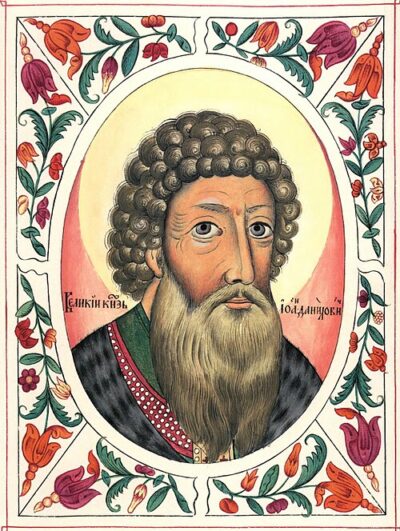
Ivan I of Moscow
Ivan I of Moscow was a Prince of Moscow and Grand Prince of Vladimir. Born 1288, in Moscow. Died March 31, 1340, in Moscow. Positions held include Prince of Moscow (1325–1340), Grand Prince of Novgorod (1328–1337) and Grand Duke of Vladimir (1328–1340).
Facts
23 facts · 2 confirmed by two sources · 4 cited · 17 from one source
What’s different
- Born: we show 1288 (Confirmed). Wikidata also lists 1304 and November 1, 1288
- Died: we show March 31, 1340 (Confirmed). Wikidata also lists March 31, 1341 and March 13, 1341
Where this comes from
Papalocal keeps its own record. It started from these sources; what each one said is kept here as it was copied, so a change on their side never changes this page by itself. Tap one to read its version.
What Wikidata says · copied November 16, 2026 · revision 2557936351
- Described as
- Prince of Moscow and Grand Prince of Vladimir
- Other names
- Ivan Kalita, Ivan Daniilovich Kalita, Ivan I
- Born
- 1288 · 1 reference; 1304 · 2 references; November 1, 1288
- Died
- March 31, 1340 · 1 reference; March 31, 1341 · 1 reference; March 13, 1341 · 1 reference
- Born in
- Moscow
- Died in
- Moscow · 1 reference
- Buried in
- Cathedral of the Archangel
- Citizen of
- Grand Principality of Moscow; Period of Appanages
- Occupation
- politician
- Positions held
- Prince of Moscow (1325–1340); Grand Prince of Novgorod (1328–1337); Grand Duke of Vladimir (1328–1340)
- Spouse
- Helena of Smolensk, Grand Princess of Moscow · 2 references; Ulyana · 1 reference
- Children
- Simeon of Moscow; Ivan II of Moscow · 1 reference; Andrei Ivanovich · 1 reference; Evdokia Ivanovna · 1 reference; Maria Ivanovna · 1 reference
- Father
- Daniel of Moscow · 1 reference
- Mother
- Agrippina
- Siblings
- Yury of Moscow; Afanasy Danilovich
- Religion
- Eastern Orthodox Church
- Wikipedias with a page
- 57
Wikidata item Q185316 (wikidata.org/wiki/Q185316), public domain (CC0). Copied November 16, 2026.
What Wikipedia says · copied November 16, 2026 · revision 1358909300
Ivan I Danilovich Kalita (Russian: Иван I Данилович Калита, lit. 'money bag'; c. 1288 – 31 March 1340) was Prince of Moscow from 1325 and Grand Prince of Vladimir from 1331 until his death in 1340.
Ivan inherited the Moscow principality following the death of his elder brother Yury. In 1327, following a popular uprising against Mongol rule in the neighboring principality of Tver, Ivan and Aleksandr of Suzdal were dispatched by Özbeg Khan of the Golden Horde to suppress the revolt and apprehend Aleksandr of Tver, who ultimately escaped. The following year, the khan divided the grand principality between Ivan and Aleksandr of Suzdal. Upon the death of the latter in 1331, Ivan became the sole grand prince. His heirs would continue to hold the title almost without interruption before the thrones of Vladimir and Moscow were permanently united in 1389.
As the grand prince, Ivan was able to collect tribute from other Russian princes, allowing him to use the funds he acquired to develop Moscow. At the start of his reign, Ivan forged an alliance with Metropolitan Peter, head of the Russian Church, who then moved his primary residence to Moscow from the former capital, Vladimir. This decision would allow Moscow to become the spiritual center of Russian Orthodoxy. Peter was succeeded by Theognostus, who supported Moscow's rise and sanctioned the construction of additional stone churches in the city. Aleksandr of Tver was executed at the Horde in 1339, marking the end of a 35-year-long struggle between the princes of Moscow and Tver. Ivan died the following year and was succeeded by his son Simeon.
- Born, in its opening lines
- c. 1288
- Died, in its opening lines
- March 31, 1340
From the Wikipedia article “Ivan I of Moscow” (en.wikipedia.org/wiki/Ivan_I_of_Moscow), by its contributors, under CC BY-SA 4.0 (creativecommons.org/licenses/by-sa/4.0/). Copied November 16, 2026; not changed.
Confirmed Two sources agree. Cited One source, and it names where it got it. One source One source, without a reference of its own. Sources disagree The sources disagree. We show the best-supported value and keep theirs below.
