
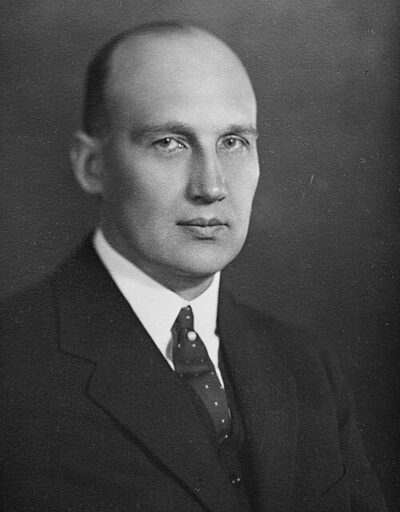
Ivar Kreuger
Ivar Kreuger was a Swedish businessperson. Born March 2, 1880, in Kalmar. Died March 12, 1932, in Paris. Educated at Royal Institute of Technology. Awards include Commander 1st class of the Order of Vasa, Knight of the Order of the Polar Star and Grand Cross of the Order of the Crown (Romania).
Facts
27 facts · 2 confirmed by two sources · 6 cited · 19 from one source
Where this comes from
Papalocal keeps its own record. It started from these sources; what each one said is kept here as it was copied, so a change on their side never changes this page by itself. Tap one to read its version.
What Wikidata says · copied November 17, 2026 · revision 2557939543
- Described as
- Swedish businessperson (1880-1932)
- Born
- March 2, 1880 · 7 references
- Died
- March 12, 1932 · 8 references
- Born in
- Kalmar · 1 reference
- Died in
- Paris · 3 references
- Buried in
- Norra begravningsplatsen (1932–) · 2 references
- Citizen of
- Sweden
- Occupation
- business executive · 1 reference; engineer; entrepreneur; industrialist; financier; civil engineer · 1 reference
- Education
- Royal Institute of Technology (1896–1899)
- Member of
- Royal Swedish Academy of Engineering Sciences
- Awards
- Commander 1st class of the Order of Vasa; Knight of the Order of the Polar Star; Grand Cross of the Order of the Crown (Romania); Grand Cross of the Legion of Honour; Member of the Order of the Three Stars; Commander First Class of the Order of the White Rose of Finland; Knight Officer of the Order of the Polar Star; Commander of the Order of Vasa; Knight 1st class of the Order of Vasa
- Father
- Ernst August Kreuger · 1 reference
- Mother
- Jenny Emelie Kreuger · 1 reference
- Siblings
- Torsten Kreuger; Helga Hallin
- Wikipedias with a page
- 24
Wikidata item Q703091 (wikidata.org/wiki/Q703091), public domain (CC0). Copied November 17, 2026.
What Wikipedia says · copied November 17, 2026 · revision 1374341982
Ivar Kreuger (Swedish: [ˈǐːvar ˈkry̌ːɡɛr]; 2 March 1880 – 12 March 1932) was a Swedish civil engineer, financier, entrepreneur and industrialist. In 1908, he co-founded the construction company Kreuger & Toll Byggnads AB, which specialized in new building techniques. By aggressive investments and innovative financial instruments, he built a global match and financial empire. Between the two world wars, he negotiated match monopolies with European, Central American and South American governments, and finally controlled between two thirds and three quarters of worldwide match production, becoming known as the "Match King".
Kreuger's financial empire has been described by one biographer as a Ponzi scheme, based on the supposedly fantastic profitability of his match monopolies. In a Ponzi scheme, early investors are paid dividends from their own money or that of subsequent investors. Although Kreuger did this to some extent, he also controlled many legitimate and often very profitable businesses. He owned banks, real estate, a gold mine, and pulp industrial companies. He also owned many match companies. Many of them have survived to this day. Kreuger & Toll, for example, was composed of bona fide businesses, and there were others like it. Another biographer called Kreuger a "genius and swindler", and John Kenneth Galbraith wrote that he was the "Leonardo of larcenists". Kreuger's financial empire collapsed during the Great Depression. The Price Waterhouse autopsy of his financial empire stated: "The manipulations were so childish that anyone with but a rudimentary knowledge of bookkeeping could see the books were falsified." In March 1932, he was found dead in the bedroom of his flat in Paris. The police concluded that he had committed suicide, but decades later, his brother Torsten claimed that he had been murdered, which spawned some controversial literature on the subject.
- Born, in its opening lines
- March 2, 1880
- Died, in its opening lines
- March 12, 1932
From the Wikipedia article “Ivar Kreuger” (en.wikipedia.org/wiki/Ivar_Kreuger), by its contributors, under CC BY-SA 4.0 (creativecommons.org/licenses/by-sa/4.0/). Copied November 17, 2026; not changed.
Confirmed Two sources agree. Cited One source, and it names where it got it. One source One source, without a reference of its own. Sources disagree The sources disagree. We show the best-supported value and keep theirs below.
