
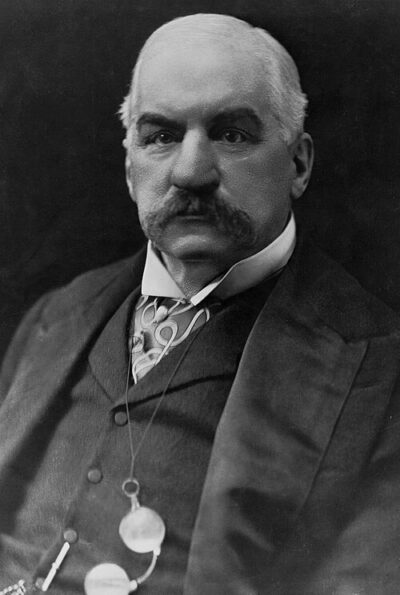
J. P. Morgan
J. P. Morgan was an American financier, banker, and art collector. Born April 17, 1837, in Hartford. Died March 31, 1913, in Rome. Known for The Morgan Library & Museum. Educated at Cheshire Academy and Boston English High School.
Facts
35 facts · 2 confirmed by two sources · 22 cited · 11 from one source
Where this comes from
Papalocal keeps its own record. It started from these sources; what each one said is kept here as it was copied, so a change on their side never changes this page by itself. Tap one to read its version.
What Wikidata says · copied November 13, 2026 · revision 2568892094
- Described as
- American financier, banker, and art collector (1837–1913)
- Other names
- John Pierpont Morgan, J.P. [II] Morgan, J.P. Morgan, pierpont morgan, J. Pierpont Morgan, J. Pierpont, Sr. Morgan, J. Pierpont, Jr. Morgan, J.P., estate of Morgan, J.P. [I] Morgan, J. Pierpont [II] Morgan, J. Pierpont, estate of Morgan, J. Pierpont [I] Morgan
- Born
- April 17, 1837 · 10 references
- Died
- March 31, 1913 · 9 references
- Born in
- Hartford · 2 references
- Died in
- Rome · 3 references
- Buried in
- Cedar Hill Cemetery · 1 reference
- Citizen of
- United States · 1 reference
- Occupation
- entrepreneur · 1 reference; art collector · 2 references; banker · 2 references; financier; patron of the arts · 1 reference
- Education
- Cheshire Academy (–1851) · 1 reference; Boston English High School (1851–1854) · 1 reference; University of Göttingen (1854–1856)
- Member of
- Roxburghe Club (1912–1913) · 1 reference; Grolier Club; Bibliographical Society (1908–1913)
- Known for
- The Morgan Library & Museum
- Field
- finance · 1 reference; economics of banking · 1 reference; investment · 1 reference; money management · 1 reference
- Spouse
- Frances Tracy Morgan · 1 reference; Amelia Sturges Morgan · 1 reference
- Children
- John Pierpont Morgan, Jr. · 1 reference; Anne Morgan; Juliet Pierpont Hamilton · 1 reference; Louisa Pierpont Morgan
- Father
- Junius Spencer Morgan · 1 reference
- Mother
- Juliet Pierpont · 1 reference
- Siblings
- Mary Lyman Morgan; Sarah Spencer Morgan · 1 reference; Junius Spencer Morgan Jr.; Juliet Pierpont Morgan
- Religion
- Episcopal Church
- Wikipedias with a page
- 78
Wikidata item Q54168 (wikidata.org/wiki/Q54168), public domain (CC0). Copied November 13, 2026.
What Wikipedia says · copied November 13, 2026 · revision 1385298242
John Pierpont Morgan Sr. (April 17, 1837 – March 31, 1913) was an American financier and investment banker who dominated corporate finance on Wall Street throughout the Gilded Age and Progressive Era. As the head of the banking firm that ultimately became known as JPMorgan Chase & Co., he was driving the force behind a wave of industrial consolidations in the United States at the turn of the twentieth century.
Over the course of his career on Wall Street, Morgan spearheaded the formation of several prominent multinational corporations including U.S. Steel, International Harvester, and General Electric. He and his partners also held controlling interests in numerous other American businesses including Aetna, Western Union, the Pullman Car Company, and 21 railroads. His grandfather Joseph Morgan was one of the co-founders of Aetna. Through his holdings, Morgan exercised enormous influence over capital markets in the United States. During the Panic of 1907, he organized a coalition of financiers that saved the American monetary system from collapse.
As the Progressive Era's leading banker, Morgan's dedication to efficiency and modernization helped transform the shape of the American economy. Adrian Wooldridge characterized Morgan as America's "greatest banker". Morgan died in Rome, Italy, in his sleep in 1913 at the age of 75, leaving his fortune and business to his son, J. P. Morgan Jr. Biographer Ron Chernow estimated his fortune at $80 million (equivalent to $1.9 billion in 2025).
- Born, in its opening lines
- April 17, 1837
- Died, in its opening lines
- March 31, 1913
From the Wikipedia article “J. P. Morgan” (en.wikipedia.org/wiki/J._P._Morgan), by its contributors, under CC BY-SA 4.0 (creativecommons.org/licenses/by-sa/4.0/). Copied November 13, 2026; not changed.
Confirmed Two sources agree. Cited One source, and it names where it got it. One source One source, without a reference of its own. Sources disagree The sources disagree. We show the best-supported value and keep theirs below.
