
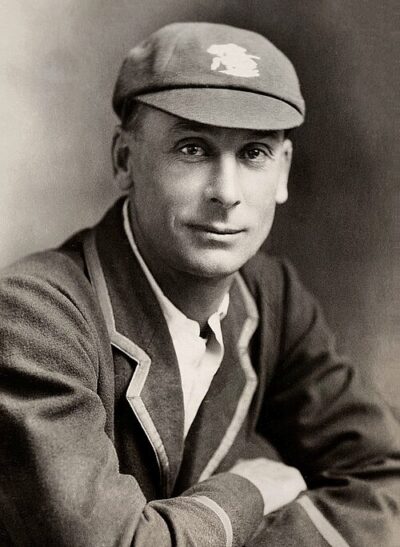
Jack Hobbs
Jack Hobbs was an English cricketer. Born December 16, 1882, in Cambridge. Died December 21, 1963, in Hove. Teams include England cricket team (1908–1930) and Surrey County Cricket Club (1905–1934). Awards include Wisden Cricketer of the Year (2 times) and Knight Bachelor.
Facts
13 facts · 2 confirmed by two sources · 2 cited · 9 from one source
Where this comes from
Papalocal keeps its own record. It started from these sources; what each one said is kept here as it was copied, so a change on their side never changes this page by itself. Tap one to read its version.
What Wikidata says · copied November 18, 2026 · revision 2560059293
- Described as
- English cricketer (1882–1963)
- Other names
- Sir John Hobbs, John Hobbs, Sir Jack Hobbs, John Berry Hobbs, Sir John Berry Hobbs
- Born
- December 16, 1882 · 2 references
- Died
- December 21, 1963 · 2 references
- Born in
- Cambridge
- Died in
- Hove
- Buried in
- Hove Cemetery · 1 reference
- Citizen of
- United Kingdom
- Occupation
- cricketer
- Teams
- England cricket team (1908–1930); Surrey County Cricket Club (1905–1934)
- Sport
- cricket
- Awards
- Wisden Cricketer of the Year (2 times) (1909, 1926) · 1 reference; Knight Bachelor
- Military branch
- British Army
- Wikipedias with a page
- 20
Wikidata item Q967556 (wikidata.org/wiki/Q967556), public domain (CC0). Copied November 18, 2026.
What Wikipedia says · copied November 18, 2026 · revision 1385117094
Sir John Berry Hobbs (16 December 1882 – 21 December 1963) was an English professional cricketer who played for Surrey from 1905 to 1934 and for England in 61 Test matches between 1908 and 1930. Known as "The Master", he is widely regarded as one of the greatest batsmen in the history of cricket. He is the leading run-scorer and century-maker in first-class cricket, with 61,760 runs and 199 centuries. A right-handed batsman and an occasional right-arm medium pace bowler, Hobbs also excelled as a fielder, particularly in the position of cover point. Hobbs was named as one of the five Wisden Cricketers of the Century alongside Sir Donald Bradman, Sir Garfield Sobers, Shane Warne, and Sir Viv Richards.
His early batting was undistinguished, but a sudden improvement in 1901 brought him to the attention of local teams. In 1903, he successfully applied to join Surrey, with the support of England batsman Tom Hayward. His reputation grew and when he qualified to play for Surrey, he scored 88 on his first-class debut and a century in his next game. Over the following seasons, he established himself as a successful county player and in 1908 made his Test debut for England, scoring 83 in his first innings. After some mixed early performances for England, Hobbs's success against South African googly bowlers made his place secure, and by 1911–12, when he scored three centuries in the Test series against Australia, critics judged him the world's best batsman. In county cricket, he developed an attacking, dynamic style of play and was very successful up until 1914. After serving in the Royal Flying Corps during the First World War, he maintained his reputation when cricket resumed in 1919, but his career was threatened by appendicitis, which caused him to miss most of the 1921 season. When he returned, he was a more cautious batsman and used a safer style of play. Subsequently, he became more consistent and scored prolifically in both Test and domestic cricket until his retirement. During this period, he played some of his most acclaimed innings.
Hobbs's success was based on fast footwork, an ability to play many different shots, and excellent placement of the ball. Among the first batsmen to succeed against previously devastating googly bowlers, he adapted his technique to meet the new styles of bowling that arose early in his career; he mixed classical shots with an effective defence. He was particularly successful on difficult pitches for batting. An opening batsman, Hobbs established several effective opening partnerships; with Tom Hayward and Andy Sandham for Surrey and with Wilfred Rhodes and Herbert Sutcliffe for England. Despite batting against "ruthless bowlers on very hostile pitches with [fewer] safety regulations", his partnership with Sutcliffe remains in 2022 the highest average for a first-wicket partnership in Test history by a wide margin. Contemporaries rated Hobbs extremely highly, and critics continue to list him among the best batsmen of all time.
Hobbs was very close to Ada, his wife of 56 years; the pair were able to live comfortably in later life through Hobbs's substantial wage from Surrey, his commercial endorsements, and the proceeds of the sporting goods shop he opened in 1921 and ran for nearly the rest of his life. After his retirement from cricket, he also worked in journalism. Knighted in 1953—the first professional cricketer to be so honoured—he spent his later years nursing his wife. He died, aged 81, a few months after her in 1963.
- Born, in its opening lines
- December 16, 1882
- Died, in its opening lines
- December 21, 1963
From the Wikipedia article “Jack Hobbs” (en.wikipedia.org/wiki/Jack_Hobbs), by its contributors, under CC BY-SA 4.0 (creativecommons.org/licenses/by-sa/4.0/). Copied November 18, 2026; not changed.
Confirmed Two sources agree. Cited One source, and it names where it got it. One source One source, without a reference of its own. Sources disagree The sources disagree. We show the best-supported value and keep theirs below.
