
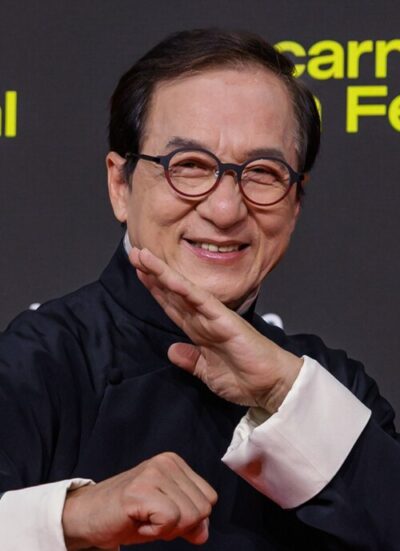
Jackie Chan
Jackie Chan is a Hong Kong actor and martial artist. Born April 7, 1954, in Victoria Peak. Positions held include UNICEF Goodwill Ambassador and member of the National Committee of the Chinese People's Political Consultative Conference. Known for Drunken Master, The Young Master and Project A. Educated at Dickson College. Awards include Silver Bauhinia Star, Chevalier des Arts et des Lettres and Member of the Order of the British Empire.
Facts
49 facts · 1 confirmed by two sources · 6 cited · 42 from one source
Where this comes from
Papalocal keeps its own record. It started from these sources; what each one said is kept here as it was copied, so a change on their side never changes this page by itself. Tap one to read its version.
What Wikidata says · copied November 13, 2026 · revision 2562528090
- Described as
- Hong Kong actor and martial artist (born 1954)
- Other names
- Sing Lung, Y'uen Lo, Pao Pao, Kong-sang Chan, Kung-Fu Master, Yuan-Lou Chen, Yuan Lung Chen, Yuen Lung Chen, Chen Yuan Lung, Chen Yuen Lung, Jacky Chan, Chen Yuan-lung
- Born
- April 7, 1954 · 8 references
- Born in
- Victoria Peak · 2 references
- Name at birth
- 陳港生; 陳港生
- Citizen of
- United States; People's Republic of China; British Hong Kong (–1997)
- Occupation
- film actor · 1 reference; film producer · 2 references; screenwriter; stunt performer; film director · 1 reference; choreographer; judoka; taekwondo athlete
- Positions held
- UNICEF Goodwill Ambassador; member of the National Committee of the Chinese People's Political Consultative Conference
- Worked for
- UNICEF
- Education
- Dickson College
- Sport
- kung fu
- Genre
- comedy; action film; drama fiction; martial arts film; cantopop; mandopop
- Instrument
- voice
- Known for
- Drunken Master; The Young Master; Project A; Police Story; Rush Hour; Armour of God
- Awards
- Silver Bauhinia Star; Chevalier des Arts et des Lettres; Member of the Order of the British Empire (1989) · 1 reference; Golden Horse Award for Best Leading Actor (2 times) (1983, 1992) · 1 reference; Academy Honorary Award (2016); star on Hollywood Walk of Fame · 1 reference; Order of the British Empire · 1 reference; American Choreography Awards; Golden Rooster Award for Best Actor
- Spouse
- Joan Lin (1982–)
- Children
- Liu Kang; Etta Ng
- Father
- Charles Chan
- Mother
- Lee-Lee Chan
- Religion
- Buddhism
- Height
- 1.74 m (5 ft 9 in)
- Website
- http://www.jackiechan.com/
- Wikipedias with a page
- 163
Wikidata item Q36970 (wikidata.org/wiki/Q36970), public domain (CC0). Copied November 13, 2026.
What Wikipedia says · copied November 13, 2026 · revision 1385264373
Chan Kong-sang (born 7 April 1954), also known as Fang Shilong and known professionally as Jackie Chan and Sing Lung, is a Hong Kong martial artist, actor and filmmaker, known for his slapstick, acrobatic fighting style, comic timing, and innovative stunts, which he typically performs himself. With a film career spanning seven decades, he is regarded as one of the most iconic and influential martial artists in the history of cinema. Films in which he has appeared have grossed over $6 billion worldwide.
Starting as one of the Seven Little Fortunes at the China Drama Academy, where he was trained in acrobatics, martial arts and acting, Chan entered the Hong Kong film industry as a stuntman before making the transition to acting. His breakthrough came with the action comedy Snake in the Eagle's Shadow (1978). He then starred in similar action comedies such as Drunken Master (1978) and The Young Master (1980). He made his directorial debut with The Fearless Hyena (1979), which was a box office success. Throughout the 1980s, he was part of the "Three Dragons" along with Sammo Hung and Yuen Biao; the three starred in six Hong Kong films together. Project A (1983) saw the official formation of the Jackie Chan Stunt Team and established Chan's signature style of elaborate, dangerous stunts combined with martial arts and slapstick humor, a style he further developed in a more modern setting with Wheels on Meals (1984) and Police Story (1985). Rumble in the Bronx (1995), which had a successful worldwide theatrical run, brought Chan into the North American mainstream. By the mid-1990s, he was the most popular action movie star in Eurasia.
Chan gained Hollywood success for portraying Chief Inspector Lee in the American buddy cop action comedy film Rush Hour (1998), a role he reprised in two sequels. He went on to work both in American and Chinese films, appearing in the Shanghai film series (2000–2003), New Police Story (2004), Rob-B-Hood (2006), Little Big Soldier (2010), Shaolin (2011), and The Shadow's Edge (2025), among others. The Forbidden Kingdom (2008) marked his first collaboration with fellow martial arts star Jet Li. He has played martial arts mentor Mr. Han in two Karate Kid films, the 2010 remake The Karate Kid and Karate Kid: Legends (2025). For CZ12 (2012), he earned two Guinness World Records for "Most Stunts Performed by a Living Actor" and "Most Credits in One Movie". He played against type in Shinjuku Incident (2009) and The Foreigner (2017). His voice acting work includes all three Chinese versions of Mulan (1998), the first three films in the Kung Fu Panda franchise (2008–2016), and Teenage Mutant Ninja Turtles: Mutant Mayhem (2023).
One of the most recognizable and influential film personalities in the world, Chan was described by film scholar Andrew Willis in 2004 as perhaps "the most recognized star in the world." He has received fame stars on the Hong Kong Avenue of Stars and the Hollywood Walk of Fame, as well as an honorary Academy Award in 2016. Chan has been referenced in various pop songs, films, television series, and video games. He has an award named after him, the Jackie Chan Action Movie Awards. He is an operatically trained vocalist who has released several pop music albums and performed theme songs for some of the films in which he starred. He is also a philanthropist and was named one of the top 10 most charitable celebrities by Forbes in 2011. In 2016, Forbes ranked him the second-highest-paid actor in the world.
- Born, in its opening lines
- April 7, 1954
From the Wikipedia article “Jackie Chan” (en.wikipedia.org/wiki/Jackie_Chan), by its contributors, under CC BY-SA 4.0 (creativecommons.org/licenses/by-sa/4.0/). Copied November 13, 2026; not changed.
Confirmed Two sources agree. Cited One source, and it names where it got it. One source One source, without a reference of its own. Sources disagree The sources disagree. We show the best-supported value and keep theirs below.
