
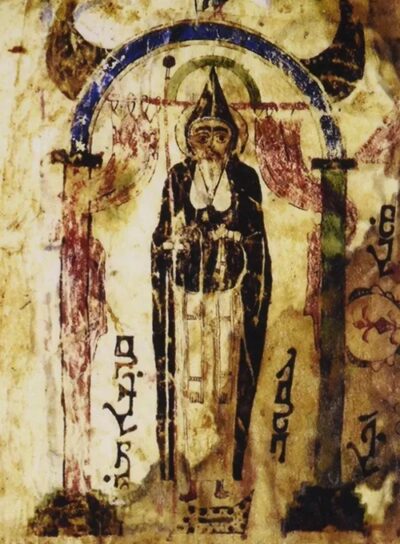
Jacob of Serugh
Jacob of Serugh was a Syriac writer and bishop. Born 451, in Suruç. Died November 29, 521, in Suruç. Positions held include bishop.
Facts
15 facts · 1 confirmed by two sources · 8 cited · 5 from one source · 1 where the sources disagree
What’s different
- Born: we show 451 (Sources disagree). Wikipedia says 452
Where this comes from
Papalocal keeps its own record. It started from these sources; what each one said is kept here as it was copied, so a change on their side never changes this page by itself. Tap one to read its version.
What Wikidata says · copied November 17, 2026 · revision 2568761768
- Described as
- Syriac writer and bishop
- Other names
- Iacobus of Batnae, Iakobos of Batnae
- Born
- 451 · 5 references
- Died
- November 29, 521 · 1 reference
- Born in
- Suruç
- Died in
- Suruç · 1 reference
- Occupation
- writer · 1 reference; matenagir · 1 reference; poet · 1 reference; Christian minister · 1 reference; presbyter · 1 reference
- Positions held
- bishop
- Field
- Christianity · 1 reference; sermon · 1 reference; Christian literature · 1 reference; Christian poetry · 1 reference
- Religion
- Syriac Orthodox Church
- Wikipedias with a page
- 25
Wikidata item Q947711 (wikidata.org/wiki/Q947711), public domain (CC0). Copied November 17, 2026.
What Wikipedia says · copied November 17, 2026 · revision 1385959246
Jacob of Serugh (Syriac: ܝܥܩܘܒ ܕܣܪܘܓ, romanized: Yaʿquḇ daSruḡ, Classical Syriac pronunciation: [ˌjaˤˈquβ das'ruɣ]; Latin: Iacobus Sarugiensis; c. 452–521), also called Jacob of Sarug or Mar Jacob (Syriac: ܡܪܝ ܝܥܩܘܒ, romanized: Mār Yaʿquḇ), was one of the foremost poets and theologians of the Syriac Christian tradition and authors of Syriac literature, second only to Ephrem the Syrian and equal to Narsai. He lived most of his life as an ecclesiastical official in Suruç, in modern-day Turkey. He became a bishop (of Batnan) near the end of his life in 519. He was a Miaphysite (Oriental Orthodox Non-Chalcedonian Christianity), albeit moderate compared to his contemporaries.
Jacob is best known for the homilies he wrote in the late fifth and early sixth centuries. He wrote in prose, as well as in 12-syllable (dodecasyllabic) meter, which he invented, and he was known for his eloquence. According to Jacob of Edessa, he composed 763 works during his lifetime. Around 400 survive, and over 200 of those have been published. The longest is about 1,400 verses. By the time of his death, he had a great reputation. His works were so popular that of any author from late antiquity, only the writings of Augustine of Hippo and John Chrysostom survive in a greater number of manuscripts than Jacob's.
His work earned him many nicknames, including "Flute of the Holy Spirit" (which also belonged to his predecessor Ephrem the Syrian), and "Lyre of the Believing Church" (in Antiochene Syriac Orthodox Christianity). Both Non Chalcedonian and Chalcedonian traditions of Christianity now take him as a saint.
- Born, in its opening lines
- 452
- Died, in its opening lines
- 521
From the Wikipedia article “Jacob of Serugh” (en.wikipedia.org/wiki/Jacob_of_Serugh), by its contributors, under CC BY-SA 4.0 (creativecommons.org/licenses/by-sa/4.0/). Copied November 17, 2026; not changed.
Confirmed Two sources agree. Cited One source, and it names where it got it. One source One source, without a reference of its own. Sources disagree The sources disagree. We show the best-supported value and keep theirs below.
