
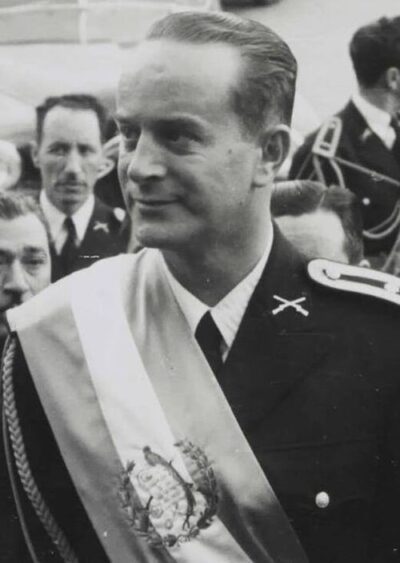
Jacobo Árbenz
Jacobo Árbenz was a president of Guatemala in 1951–54. Born September 14, 1913, in Quetzaltenango. Died January 27, 1971, in Mexico City. Positions held include president of Guatemala (1951–1954). Educated at Escuela Politécnica (Guatemala). Awards include Order of the Quetzal and Legion of Merit.
Facts
21 facts · 2 confirmed by two sources · 3 cited · 16 from one source
Where this comes from
Papalocal keeps its own record. It started from these sources; what each one said is kept here as it was copied, so a change on their side never changes this page by itself. Tap one to read its version.
What Wikidata says · copied November 16, 2026 · revision 2560207759
- Described as
- president of Guatemala in 1951–54
- Other names
- Jacobo Arbenz, Jacobo Arbenz Guzman, Jacobo Árbenz Guzmán
- Born
- September 14, 1913 · 11 references
- Died
- January 27, 1971 · 10 references
- Born in
- Quetzaltenango · 2 references
- Died in
- Mexico City · 2 references
- Buried in
- Guatemala City General Cemetery
- Citizen of
- Guatemala
- Occupation
- university teacher; military personnel; politician · 1 reference
- Positions held
- president of Guatemala (1951–1954)
- Political party
- Revolutionary Action Party
- Education
- Escuela Politécnica (Guatemala)
- Awards
- Order of the Quetzal; Legion of Merit
- Spouse
- María Cristina Vilanova
- Children
- Arabella Árbenz; Jacobo Árbenz Vilanova; Leonora Árbenz
- Religion
- Catholic Church · 1 reference
- Military branch
- Guatemalan military · 1 reference
- Military rank
- colonel
- Wikipedias with a page
- 55
Wikidata item Q216943 (wikidata.org/wiki/Q216943), public domain (CC0). Copied November 16, 2026.
What Wikipedia says · copied November 16, 2026 · revision 1378933620
Juan Jacobo Árbenz Guzmán (Spanish: [xwaŋ xaˈkoβo ˈaɾβens ɣusˈman]; 14 September 1913 – 27 January 1971) was a Guatemalan military officer and politician who served as the 25th president of Guatemala. He was Minister of National Defense from 1944 to 1950, before he became the second democratically elected President of Guatemala, from 1951 to 1954. He was a major figure in the ten-year Guatemalan Revolution, which represented some of the few years of representative democracy in Guatemalan history. The landmark program of agrarian reform Árbenz enacted as president was very influential across Latin America.
Árbenz was born in 1913 to a wealthy family, son of a Swiss German father and a Guatemalan mother. He graduated with high honors from a military academy in 1935, and served in the army until 1944, quickly rising through the ranks. During this period, he witnessed the violent repression of agrarian laborers by the United States-backed dictator Jorge Ubico, and was personally required to escort chain-gangs of prisoners, an experience that contributed to his progressive views. In 1938, he met and married María Vilanova, who was a great ideological influence on him, as was José Manuel Fortuny, a Guatemalan communist. In October 1944, several civilian groups and progressive military factions led by Árbenz and Francisco Arana rebelled against Ubico's repressive policies. In the elections that followed, Juan José Arévalo was elected president, and began a highly popular program of social reform. Árbenz was appointed Minister of Defense, and played a crucial role in putting down a military coup in 1949.
After the death of Arana, Árbenz ran in the presidential elections that were held in 1950 and without significant opposition defeated Miguel Ydígoras Fuentes, his nearest challenger, by a margin of over 50%. He took office on 15 March 1951, and continued the social reform policies of his predecessor. These reforms included an expanded right to vote, the ability of workers to organize, legitimizing political parties, and allowing public debate. The centerpiece of his policy was an agrarian reform law under which uncultivated portions of large land-holdings were expropriated in return for compensation and redistributed to poverty-stricken agricultural laborers. Approximately 500,000 people benefited from the decree. The majority of them were indigenous people, whose forebears had been dispossessed after the Spanish invasion.
His policies ran afoul of the United Fruit Company, which lobbied the United States government to have him overthrown. The U.S. was also opposed to the presence of communists in the Guatemalan government, and Árbenz was ousted in the 1954 Guatemalan coup d'état engineered by the government of U.S. president Dwight D. Eisenhower through the U.S. Department of State and the Central Intelligence Agency. Árbenz went into exile, passing through several countries; his family gradually fell apart, and his daughter died by suicide. He died in Mexico in 1971. In October 2011, the Guatemalan government issued an apology for Árbenz's overthrow.
- Born, in its opening lines
- September 14, 1913
- Died, in its opening lines
- January 27, 1971
From the Wikipedia article “Jacobo Árbenz” (en.wikipedia.org/wiki/Jacobo_Árbenz), by its contributors, under CC BY-SA 4.0 (creativecommons.org/licenses/by-sa/4.0/). Copied November 16, 2026; not changed.
Confirmed Two sources agree. Cited One source, and it names where it got it. One source One source, without a reference of its own. Sources disagree The sources disagree. We show the best-supported value and keep theirs below.
