
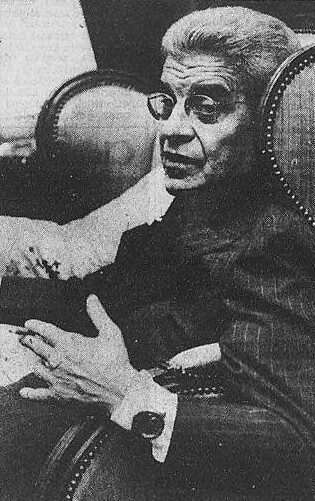
Jacques Lacan
Jacques Lacan was a French psychoanalyst and writer. Born April 13, 1901, in 3rd arrondissement of Paris. Died September 9, 1981, in 6th arrondissement of Paris. Positions held include president. Known for Écrits and Seminars of Jacques Lacan. Educated at Collège Stanislas de Paris and Paris Medical Faculty.
Facts
27 facts · 2 confirmed by two sources · 12 cited · 13 from one source
Where this comes from
Papalocal keeps its own record. It started from these sources; what each one said is kept here as it was copied, so a change on their side never changes this page by itself. Tap one to read its version.
What Wikidata says · copied November 16, 2026 · revision 2565532544
- Described as
- French psychoanalyst and writer (1901–1981)
- Other names
- Jacques Marie Émile Lacan, Lacan
- Born
- April 13, 1901 · 15 references
- Died
- September 9, 1981 · 15 references
- Born in
- 3rd arrondissement of Paris · 3 references
- Died in
- 6th arrondissement of Paris · 2 references
- Buried in
- Guitrancourt
- Cause of death
- colorectal cancer · 1 reference
- Name at birth
- Jacques Lacan · 1 reference
- Citizen of
- France · 1 reference
- Occupation
- psychiatrist · 3 references; psychoanalyst · 3 references; translator; docent · 1 reference
- Positions held
- president · 1 reference
- Worked for
- Sainte-Anne Hospital Center - GHU Paris
- Education
- Collège Stanislas de Paris (1907–1918); Paris Medical Faculty (1919–1932) · 1 reference
- Known for
- Écrits; Seminars of Jacques Lacan
- Field
- psychoanalysis; psychiatry · 1 reference; linguistics
- Spouse
- Sylvia Bataille (1953–1981) · 1 reference; Marie-Louise Blondin (1934–1941) · 1 reference
- Children
- Judith Bataille; Sibylle Lacan · 1 reference; Caroline Roger-Lacan
- Siblings
- Marc-François Lacan · 1 reference
- Wikipedias with a page
- 83
Wikidata item Q169906 (wikidata.org/wiki/Q169906), public domain (CC0). Copied November 16, 2026.
What Wikipedia says · copied November 16, 2026 · revision 1384965092
Jacques Marie Émile Lacan (UK: , US: lə-KAHN; French: [ʒak maʁi emil lakɑ̃]; 13 April 1901 – 9 September 1981) was a French psychoanalyst and psychiatrist. Described as "the most controversial psycho-analyst since Freud", Lacan gave annual seminars in Paris from 1952 to 1980 and published papers that were later collected in the book Écrits. Transcriptions of the seminars 1953–1980 were published. His work made a significant impact on continental philosophy and cultural theory in areas such as post-structuralism, critical theory, feminist theory and film theory, as well as on the practice of psychoanalysis itself.
Lacan discussed the whole range of Freudian concepts, emphasizing the philosophical dimension of Freud's thought and applying concepts derived from structuralism in linguistics and anthropology to his own work, which he augmented with predicate logic and topology. Taking this new direction, and introducing controversial innovations in clinical practice, led to expulsion for Lacan and his followers from the International Psychoanalytic Association. In consequence, Lacan went on to establish new psychoanalytic institutions to promote and develop his work, which he declared to be a "return to Freud", in opposition to prevalent trends in psychology and institutional psychoanalysis which adapted Freud's ideas to social norms.
- Born, in its opening lines
- April 13, 1901
- Died, in its opening lines
- September 9, 1981
From the Wikipedia article “Jacques Lacan” (en.wikipedia.org/wiki/Jacques_Lacan), by its contributors, under CC BY-SA 4.0 (creativecommons.org/licenses/by-sa/4.0/). Copied November 16, 2026; not changed.
Confirmed Two sources agree. Cited One source, and it names where it got it. One source One source, without a reference of its own. Sources disagree The sources disagree. We show the best-supported value and keep theirs below.
