
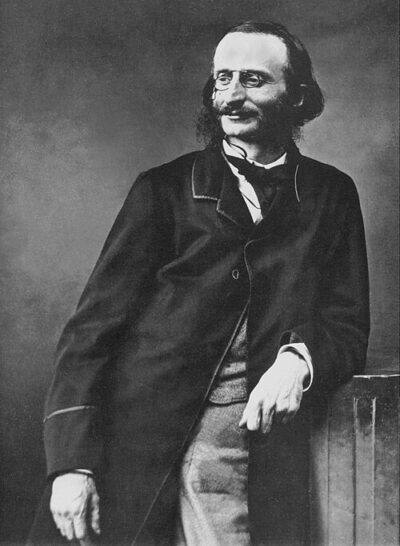
Jacques Offenbach
Jacques Offenbach was a German-born French composer. Born June 20, 1819, in Cologne. Died October 5, 1880, in Paris. Known for The Tales of Hoffmann and Orpheus in the Underworld. Educated at Conservatoire de Paris. Awards include Knight of the Legion of Honour.
Facts
34 facts · 2 confirmed by two sources · 9 cited · 23 from one source
Where this comes from
Papalocal keeps its own record. It started from these sources; what each one said is kept here as it was copied, so a change on their side never changes this page by itself. Tap one to read its version.
What Wikidata says · copied November 16, 2026 · revision 2568966656
- Described as
- German-born French composer (1819–1880)
- Other names
- Jacques Offenback, Jakob Eberscht, Jaques Offenbach
- Born
- June 20, 1819 · 11 references
- Died
- October 5, 1880 · 10 references
- Born in
- Cologne · 2 references
- Died in
- Paris · 4 references
- Buried in
- Montmartre Cemetery · 1 reference
- Cause of death
- heart failure
- Citizen of
- France (1860–) · 1 reference; Kingdom of Prussia
- Occupation
- composer · 3 references; cellist · 2 references; conductor · 1 reference; theatre entrepreneur; theatre manager · 1 reference; chapelmaster · 1 reference
- Worked for
- Théâtre de l'Ambigu-Comique; Opéra-Comique; Théâtre des Bouffes-Parisiens; Comédie-Française; Théâtre des Variétés-Amusantes
- Education
- Conservatoire de Paris
- Genre
- opera; opéra bouffe; operetta; classical music
- Instrument
- cello
- Known for
- The Tales of Hoffmann; Orpheus in the Underworld
- Awards
- Knight of the Legion of Honour (1861) · 1 reference
- Field
- music
- Spouse
- Herminia de Alcain
- Children
- Minna Offenbach-Hettich; Charles Ignace Auguste Jacques Offenbach; Pepita Offenbach
- Father
- Isaac Offenbach
- Wikipedias with a page
- 105
Wikidata item Q41555 (wikidata.org/wiki/Q41555), public domain (CC0). Copied November 16, 2026.
What Wikipedia says · copied November 16, 2026 · revision 1369613065
Jacques Offenbach (; 20 June 1819 – 5 October 1880) was a German-born French composer, cellist and impresario. He is remembered for his nearly 100 operettas of the 1850s to the 1870s, and his uncompleted opera The Tales of Hoffmann. He was a powerful influence on later composers of the operetta genre, particularly Franz von Suppé, Johann Strauss II and Arthur Sullivan. His best-known works were continually revived during the 20th century, and many of his operettas continue to be staged in the 21st. The Tales of Hoffmann remains part of the standard opera repertory.
Born in Cologne, Kingdom of Prussia, the son of a synagogue cantor, Offenbach showed early musical talent. At the age of 14, he was accepted as a student at the Paris Conservatoire; he found academic study unfulfilling and left after a year, but remained in Paris. From 1835 to 1855 he earned his living as a cellist, achieving international fame, and as a conductor. His ambition, however, was to compose comic pieces for the musical theatre. Finding the management of Paris's Opéra-Comique company uninterested in staging his works, in 1855 he leased a small theatre in the Champs-Élysées. There, during the next three years, he presented a series of more than two dozen of his own small-scale pieces, many of which became popular.
In 1858 Offenbach produced his first full-length operetta, Orphée aux enfers ("Orpheus in the Underworld"), with its celebrated can-can; the work was exceptionally well received and has remained his most played. During the 1860s, he produced at least eighteen full-length operettas, as well as more one-act pieces. His works from this period include La belle Hélène (1864), La Vie parisienne (1866), La Grande-Duchesse de Gérolstein (1867) and La Périchole (1868). The risqué humour (often about sexual intrigue) and mostly gentle satiric barbs in these pieces, together with Offenbach's facility for melody, made them internationally known, and translated versions were successful in Vienna, London, elsewhere in Europe and in the US.
Offenbach became associated with the Second French Empire of Napoleon III: the emperor and his court were genially satirised in many of Offenbach's operettas, and Napoleon personally granted him French citizenship and the Légion d'honneur. With the outbreak of the Franco-Prussian War in 1870, and the fall of the empire, Offenbach found himself out of favour in Paris because of his imperial connections and his German birth. He remained successful in Vienna, London and New York. He re-established himself in Paris during the 1870s, with revivals of some of his earlier favourites and a series of new works, and undertook a popular US tour. In his last years he strove to finish The Tales of Hoffmann, but died before the premiere of the opera, which has entered the standard repertory in versions completed or edited by other musicians.
- Born, in its opening lines
- June 20, 1819
- Died, in its opening lines
- October 5, 1880
From the Wikipedia article “Jacques Offenbach” (en.wikipedia.org/wiki/Jacques_Offenbach), by its contributors, under CC BY-SA 4.0 (creativecommons.org/licenses/by-sa/4.0/). Copied November 16, 2026; not changed.
Confirmed Two sources agree. Cited One source, and it names where it got it. One source One source, without a reference of its own. Sources disagree The sources disagree. We show the best-supported value and keep theirs below.
