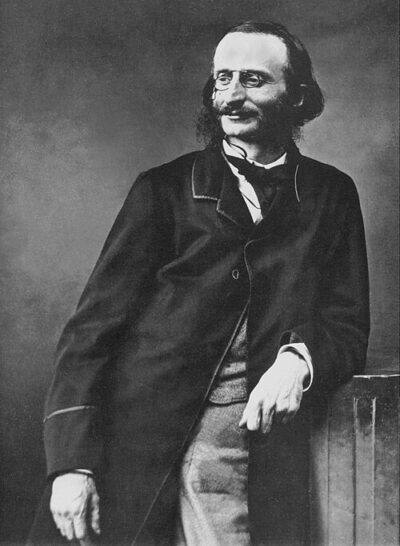
Orpheus in the Underworld
Orpheus in the Underworld is an opéra bouffon by Jacques Offenbach.
- Released
- 19th century
- Genre
- opéra bouffon
- Country of origin
- France
All 9 facts, and where they come from
Facts
9 facts · 0 confirmed by two sources · 0 cited · 9 from one source
Where this comes from
Papalocal keeps its own record. It started from these sources; what each one said is kept here as it was copied, so a change on their side never changes this page by itself. Tap one to read its version.
What Wikidata says · copied November 16, 2026 · revision 2515659572
- Described as
- opéra bouffon by Jacques Offenbach
- Other names
- Orphée aux enfers, Orphee aux enfers
- What it is
- dramatico-musical work
- Music by
- Jacques Offenbach
- Genre
- opéra bouffe; operetta; opéra bouffon
- Released
- 19th century
- Language
- French
- Country of origin
- France
- Based on
- Orpheus
- Wikipedias with a page
- 30
Wikidata item Q1137065 (wikidata.org/wiki/Q1137065), public domain (CC0). Copied 2026-11-16.
What Wikipedia says · copied November 16, 2026 · revision 1384398287
Orphée aux enfers (French: [ɔʁfe oz‿ɑ̃fɛʁ], Orpheus in the Underworld or Orpheus in Hell) is a comic opera with music by Jacques Offenbach and words by Hector Crémieux and Ludovic Halévy. It was first performed as a two-act "opéra bouffon" at the Théâtre des Bouffes-Parisiens, Paris, on 21 October 1858, and was extensively revised and expanded in a four-act "opéra féerie" version, presented at the Théâtre de la Gaîté, Paris, on 7 February 1874.
The opera is a lampoon of the ancient legend of Orpheus and Eurydice. In this version Orpheus is not the son of Apollo but a rustic violin teacher. He is glad to be rid of his wife, Eurydice, when she is abducted by the god of the underworld, Pluto. Orpheus has to be bullied by Public Opinion into trying to rescue Eurydice. The reprehensible conduct of the gods of Olympus in the opera was widely seen as a veiled satire of the court and government of Napoleon III, Emperor of the French. Some critics expressed outrage at the librettists' disrespect for classic mythology and the composer's parody of Gluck's opera Orfeo ed Euridice; others praised the piece highly.
Orphée aux enfers was Offenbach's first full-length opera. The original 1858 production became a box-office success, and ran well into the following year, rescuing Offenbach and his Bouffes company from financial difficulty. The 1874 revival broke records at the Gaîté's box-office. The work was frequently staged in France and internationally during the composer's lifetime and throughout the 20th century. It is one of his most often performed operas, and continues to be revived in the 21st century.
In the last decade of the 19th century the Paris cabarets the Moulin Rouge and Folies Bergère adopted the music of the "Galop infernal" from the culminating scene of the opera to accompany the can-can, and ever since then the tune has been popularly associated with the dance.
From the Wikipedia article “Orpheus in the Underworld” (en.wikipedia.org/wiki/Orpheus_in_the_Underworld), by its contributors, under CC BY-SA 4.0 (creativecommons.org/licenses/by-sa/4.0/). Copied 2026-11-16; not changed.
Confirmed Two sources agree. Cited One source, and it names where it got it. One source One source, without a reference of its own. Sources disagree The sources disagree. We show the best-supported value and keep theirs below.
Picture: Wikimedia Commons: Orphee adv.jpg · See Commons file page