
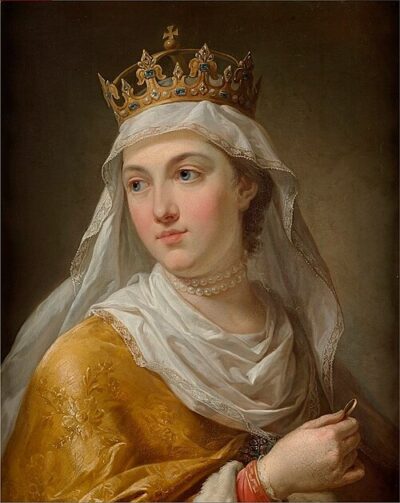
Jadwiga I of Poland was a Queen of Poland. Born 1370s, in Buda. Died July 17, 1399, in Kraków. Positions held include Queen Consort of Poland (1384–1399), queen regnant and King of Poland (1384–1399).
Facts
21 facts · 0 confirmed by two sources · 3 cited · 18 from one source
Where this comes from
Papalocal keeps its own record. It started from these sources; what each one said is kept here as it was copied, so a change on their side never changes this page by itself. Tap one to read its version.
What Wikidata says · copied November 16, 2026 · revision 2568894579
- Described as
- Queen of Poland (1384–1399)
- Other names
- Saint of European unification, Hedwig of Hungary
- Born
- 1370s
- Died
- July 17, 1399 · 1 reference
- Born in
- Buda · 2 references
- Died in
- Kraków · 2 references
- Buried in
- Wawel Cathedral
- Cause of death
- obstetric labor complication
- Citizen of
- Hungary; Kingdom of Poland · 1 reference
- Occupation
- queen regnant · 1 reference
- Positions held
- Queen Consort of Poland (1384–1399); queen regnant; King of Poland (1384–1399)
- Spouse
- Władysław II Jagiełło (1386–) · 4 references; Kęstutis Kubertavičius; Jonas Purvaneckas
- Children
- Elizabeth Bonifacia of Poland
- Father
- Louis I of Hungary · 1 reference
- Mother
- Elizabeth of Bosnia
- Siblings
- Mary I of Hungary; Catherine of Hungary
- Religion
- Catholic Church
- Wikipedias with a page
- 60
Wikidata item Q53449 (wikidata.org/wiki/Q53449), public domain (CC0). Copied November 16, 2026.
What Wikipedia says · copied November 16, 2026 · revision 1382813903
Jadwiga (Polish: [jadˈviɡa] ; 1373/1374 – 17 July 1399), also known as Hedwig (from German, Hungarian: Hedvig), was Queen of the Kingdom of Poland, as well as its last hereditary ruler. Crowned "King" (in regem Poloniae coronata) to highlight her sovereign status, she reigned from 16 October 1384 until her death. Born in Buda, she was the youngest daughter of Louis I of Hungary and Elizabeth of Bosnia. Jadwiga was a member of the Capetian House of Anjou and had forebears among the Polish Piasts.
In 1375, Louis I of Hungary planned for Jadwiga to marry William of Austria, to whom she was symbolically married in 1378; she subsequently lived in Vienna from 1378 to 1380. Louis is sometimes thought to have regarded her and William as his favoured successors in Hungary after the 1378 death of her eldest sister, Catherine of Hungary, since the following year the Polish nobility had pledged their homage to Louis I's second daughter, Mary, and her fiancé, Sigismund of Luxembourg. However, in 1382, Louis I died and his widow, Elizabeth of Bosnia, had Mary crowned "King of Hungary". Sigismund of Luxembourg tried to take control of Poland, but the Polish nobility countered that they would only be obedient to a daughter of Louis I, provided she settled in Poland. Elizabeth then chose Jadwiga to reign in Poland, but did not send her to Kraków to be crowned. During the interregnum, Siemowit IV, Duke of Masovia, became a candidate for the Polish throne. The nobility of Greater Poland favoured him and proposed that he marry Jadwiga. However, Lesser Poland's nobility opposed him, and they persuaded Elizabeth to send Jadwiga to Poland.
Jadwiga was crowned "King" in Poland's capital, Kraków, on 16 October 1384. With her mother's consent, Jadwiga's advisors opened negotiations with Władysław II Jagiełło, Grand Duke of Lithuania, concerning his potential marriage to Jadwiga. Władysław II Jagiełło, who was a pagan, signed the Union of Krewo, pledging to convert to Catholicism and to promote the conversion of his pagan subjects. Meanwhile, William hastened to Kraków, hoping to make his childhood wedding with Jadwiga valid by consummation of their union, but the Polish nobles expelled him in late August 1385.
Władysław II Jagiełło (Jogaila), who took the Catholic baptismal name Władysław, married Jadwiga on 15 February 1386, after she renounced her union with William. Legend says that she had agreed to marry him only after a lengthy prayer, seeking divine inspiration. Jogaila, now styled in Polish as Władysław II Jagiełło, was crowned King of Poland on 4 March 1386 as Jadwiga's co-ruler. Władysław II Jagiełło worked closely with his wife in that role. In any case, her real political power was limited. She remained passive when the rebellious nobles of the Kingdom of Hungary-Croatia murdered her mother in early 1387. After that, Jadwiga marched into the Kingdom of Galicia–Volhynia, which had been under Hungarian rule, and persuaded most of the inhabitants to become subjects of the Polish Crown. She mediated between her husband's quarrelling kin and between Poland and the Teutonic Order.
After her sister Mary died in 1395, Jadwiga and Władysław II Jagiełło laid claim to Hungary against the widowed Sigismund of Luxembourg, but the Hungarian lords did not support their claim. Jadwiga died four years later due to postpartum complications. As her only daughter predeceased her, the Queen was the last hereditary monarch of Poland, and with her death, the throne of Poland became elective. In 1997, she was canonised by the Catholic Church.
From the Wikipedia article “Jadwiga of Poland” (en.wikipedia.org/wiki/Jadwiga_of_Poland), by its contributors, under CC BY-SA 4.0 (creativecommons.org/licenses/by-sa/4.0/). Copied November 16, 2026; not changed.
Confirmed Two sources agree. Cited One source, and it names where it got it. One source One source, without a reference of its own. Sources disagree The sources disagree. We show the best-supported value and keep theirs below.
