
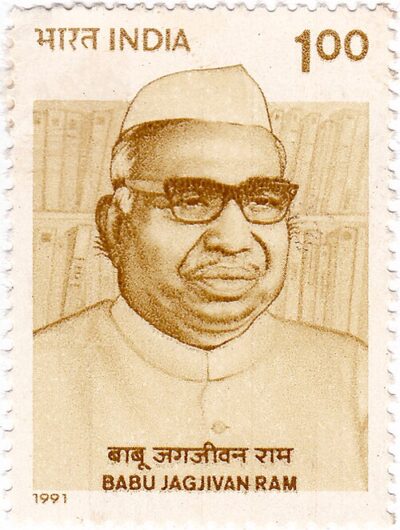
Jagjivan Ram
Jagjivan Ram was an Indian independence activist and politician. Born April 5, 1908, in Bhojpur district. Died July 6, 1986, in New Delhi. Positions held include Deputy Prime Minister of India (1977–1979), Minister of Defence (1977–1978) and Member of the Constituent Assembly of India (1946–1950). Educated at Banaras Hindu University and University of Calcutta.
Facts
19 facts · 2 confirmed by two sources · 1 cited · 16 from one source
Where this comes from
Papalocal keeps its own record. It started from these sources; what each one said is kept here as it was copied, so a change on their side never changes this page by itself. Tap one to read its version.
What Wikidata says · copied November 18, 2026 · revision 2564403285
- Described as
- Indian independence activist and politician (1908-1986)
- Other names
- Babuji
- Born
- April 5, 1908 · 2 references
- Died
- July 6, 1986 · 2 references
- Born in
- Bhojpur district
- Died in
- New Delhi
- Citizen of
- British Raj (–1947); India (1950–); Dominion of India (1947–1950)
- Occupation
- politician
- Positions held
- Deputy Prime Minister of India (1977–1979); Minister of Defence (1977–1978); Member of the Constituent Assembly of India (1946–1950); member of the Committee for Rules of Procedure of the Constituent Assembly of India (1946); Member of the Advisory Committee of the Constituent Assembly of India (1947–) · 1 reference; Member of the 7th Lok Sabha; Member of the 8th Lok Sabha
- Political party
- Indian National Congress
- Education
- Banaras Hindu University; University of Calcutta
- Children
- Meira Kumar
- Wikipedias with a page
- 22
Wikidata item Q1471625 (wikidata.org/wiki/Q1471625), public domain (CC0). Copied November 18, 2026.
What Wikipedia says · copied November 18, 2026 · revision 1385975771
Jagjivan Ram (5 April 1908 – 6 July 1986), popularly known as Babuji, was an Indian independence activist and politician who served as a minister with various portfolios for over 30 years, making him the longest-serving Union Cabinet minister in Indian history. He also served as the Deputy Prime Minister of India from January to July 1979. He played a pivotal role as the Defence Minister of India during the Indo-Pak War of 1971. As Union Agriculture Minister during two separate tenures, he contributed significantly to the Green Revolution and the modernization of Indian agriculture, particularly during the 1974 drought when he was entrusted with addressing a severe food crisis.
He was instrumental in the foundation of the All India Depressed Classes League, an organisation dedicated to attaining equality for Dalits, in 1935 and was elected to Bihar Legislative Assembly in 1937, after which he organised the rural labour movement. In 1946, he became the youngest minister in Jawaharlal Nehru's interim government, the first cabinet of India as a Labour Minister and also a member of the Constituent Assembly of India, where he ensured that social justice was enshrined in the Constitution. He went on to serve as a minister with various portfolios till 1979 as a member of the Indian National Congress (INC).
Though he opposed Prime Minister Indira Gandhi during the Emergency (1975–77), he left Congress in 1977 and joined the Janata Party alliance, along with his Congress for Democracy and later served as the Deputy Prime Minister of India (1977–79); then in 1981, he formed Congress (J). At his death, he was the last surviving minister of the Interim Government and the last surviving original member of the first cabinet of independent India.
- Born, in its opening lines
- April 5, 1908
- Died, in its opening lines
- July 6, 1986
From the Wikipedia article “Jagjivan Ram” (en.wikipedia.org/wiki/Jagjivan_Ram), by its contributors, under CC BY-SA 4.0 (creativecommons.org/licenses/by-sa/4.0/). Copied November 18, 2026; not changed.
Confirmed Two sources agree. Cited One source, and it names where it got it. One source One source, without a reference of its own. Sources disagree The sources disagree. We show the best-supported value and keep theirs below.
